>
Scombriformes (Mackerels) >
Nomeidae (Driftfishes)
Etymology: Nomeus: Greek, nomeys, -eos = shepherd (Ref. 45335).
Eponymy: Laurens Theodorus Gronovius (1730–1777) (sometimes Laurentius Theodorus Gronovius or Laurens Theodore Gronow, or simply ‘Laurenti) was a Dutch naturalist, zoologist, botanist and ichthyologist. [...] (Ref. 128868), visit book page.
More on author: Gmelin.
Environment: milieu / climate zone / intervalo de profundidade / distribution range
Ecologia
marinhas demersal; intervalo de profundidade 200 - 1000 m (Ref. 58302). Subtropical; 52°N - 45°S
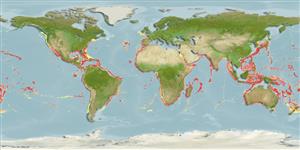
Western Atlantic: Newfoundland, Canada and northern Gulf of Mexico to Brazil (Ref. 7251). Eastern Atlantic: north-west Africa and the Canary Islands (Ref. 4777); also São Tomé Island (Ref. 34088). Not recorded from the Mediterranean and most of the eastern Atlantic (Ref. 9834). Indian and Pacific: widely distributed.
Tamanho / Peso / Idade
Maturidade: Lm ? range ? - ? cm
Max length : 39.0 cm TL macho/indeterminado; (Ref. 4412)
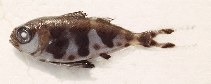
Espinhos dorsais (total) : 9 - 13; Raios dorsais moles (total) : 24 - 28; Espinhos anais: 1 - 2; Raios anais moles: 24 - 29; Vértebras: 41. Juveniles whitish or silvery with dark blue mottlings; pelvic fins black (Ref. 4412). Dark blue above, side silvery with patches of dark blue. Pelvic fin with inner rays joined to abdomen by membrane for its entire length (Ref. 26938).
Body shape (shape guide): fusiform / normal.
Found offshore in warm waters. Juveniles pelagic in coastal and offshore waters down to at least 30 m, but adults possibly demersal in deep water (Ref. 9563). Occur in association with floating Portuguese man-of-war, Physalia, feeding on its tentacles and gonads and may drift with it into shore waters with proper wind conditions (Ref. 4777). Probably also feed on other soft-bodied jellyfish as well as on zooplankton (Ref.4777).
Life cycle and mating behavior
Maturidade | Reprodução | Desova | Ovos | Fecundidade | Larvas
Haedrich, R.L., 1986. Nomeidae. p. 1183-1188. In P.J.P. Whitehead, M.-L. Bauchot, J.-C. Hureau, J. Nielsen and E. Tortonese (eds.) Fishes of the North-eastern Atlantic and the Mediterranean. UNESCO, Paris. Vol. 3. (Ref. 4777)
Categoria na Lista Vermelha da IUCN (Ref. 130435: Version 2025-1)
Ameaça para o homem
Harmless
Utilização humana
Pescarias: pouco comercial
Ferramentas
Relatórios especiais
Descarregue XML
Fontes da internet
Estimates based on models
Preferred temperature (Ref.
123201): 7.7 - 15.4, mean 10.4 °C (based on 658 cells).
Phylogenetic diversity index (Ref.
82804): PD
50 = 1.0000 [Uniqueness, from 0.5 = low to 2.0 = high].
Bayesian length-weight: a=0.00955 (0.00409 - 0.02231), b=3.10 (2.89 - 3.31), in cm total length, based on LWR estimates for this (Sub)family-body shape (Ref.
93245).
Nível Trófico (Ref.
69278): 3.7 ±0.38 se; based on food items.
Resiliência (Ref.
120179): Elevada, tempo mínimo de duplicação da população menor que 15 meses (Preliminary K or Fecundity.).
Fishing Vulnerability (Ref.
59153): Low to moderate vulnerability (29 of 100).
🛈