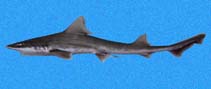
Elasmobranchii (tubarões e raias) (sharks and rays) >
Carcharhiniformes (Ground sharks) >
Triakidae (Houndsharks) > Triakinae
Etymology: Mustelus: Latin for weasel, an ancient name for sharks, possibly referring to the pointed snouts, swift movements and/or rapacious feeding behavior of smaller predatory sharks [strictly not tautonymous with Squalus mustelus Linnaeus 1758 since type was designated by the ICZN] (See ETYFish); henlei: In honor of Friedrich Gustav Jacob Henle (1807-1885), German physician, pathologist and anatomist, who, along with Johann Müller, produced the first authoritative work on sharks (1839-1841) (See ETYFish).
Eponymy: Dr Friedrich Gustav Jakob Henle (1809–1885) was a German physician, anatomist and zoologist whose main subjects were ichthyology and human biology. [...] (Ref. 128868), visit book page.
More on author: Gill.
Environment: milieu / Zona climática / intervalo de profundidade / distribution range
Ecologia
marinhas demersal; intervalo de profundidade 0 - 281 m (Ref. 96339). Subtropical; 48°N - 18°S, 126°W - 72°W (Ref. 55310)
Eastern Pacific: northern California, USA to the Gulf of California; Ecuador and Peru.
Comprimento de primeira maturação / Tamanho / Peso / Idade
Maturidade: Lm 57.0, range 51 - 63 cm
Max length : 100.0 cm TL macho/indeterminado; (Ref. 31395); idade máx. registrada: 13 anos (Ref. 6098)
Adults are found on the continental shelves from the intertidal region to at least 200 m depth. They feed on crabs, ghost shrimps, mantis shrimps, isopods, squids, polychaete worms, tunicates and small bony fishes. Viviparous (with a yolk-sac placenta), with 3 to 5 young in a litter. Size at birth between 19 and 21 cm. Readily kept in captivity. Utilized for human consumption. Marketed fresh, smoked and frozen (Ref. 9987).
Viviparous with a yolk-sac placenta; with 3 to 5 young in a litter. Size at birth ranges from 19-21 cm (Ref. 244). Distinct pairing with embrace (Ref. 205). Polyandry is a common life history strategy among the elasmobranchs and for M. henlei, the occurrence and frequency of polyandric behavior may vary depending on location and density of breeding individuals (Ref. 95902).
Compagno, L.J.V., 1984. FAO Species Catalogue. Vol. 4. Sharks of the world. An annotated and illustrated catalogue of shark species known to date. Part 2 - Carcharhiniformes. FAO Fish. Synop. 125(4/2):251-655. Rome: FAO. (Ref. 244)
Status na Lista Vermelha da UICN (Ref. 130435: Version 2025-1)
Ameaça para os humanos
Harmless
Uso pelos humanos
Pescarias: altamente comercial; peixe esportivo: sim
Ferramentas
Relatórios especiais
Baixar XML
Fontes da internet
Estimates based on models
Preferred temperature (Ref.
123201): 9.7 - 23.5, mean 15.4 °C (based on 100 cells).
Índice de diversidade filogenética (Ref.
82804): PD
50 = 0.5000 [Uniqueness, from 0.5 = low to 2.0 = high].
Bayesian length-weight: a=0.00224 (0.00104 - 0.00482), b=3.14 (2.97 - 3.31), in cm total length, based on LWR estimates for this Genus-body shape (Ref.
93245).
Nível Trófico (Ref.
69278): 3.6 ±0.4 se; based on diet studies.
Resiliência (Ref.
120179): Baixo, tempo mínimo de duplicação da população 4,5 - 14 anos (rm=0.127; K=0.26; tm=2-6; tmax=15; Fec=3).
Fishing Vulnerability (Ref.
59153): High vulnerability (58 of 100).
🛈
Climate Vulnerability (Ref.
125649): High vulnerability (61 of 100).
🛈
Nutrients (Ref.
124155): Calcium = 20.8 [5.7, 103.5] mg/100g; Iron = 0.509 [0.159, 1.911] mg/100g; Protein = 21.7 [19.4, 24.0] %; Omega3 = 0.147 [0.061, 0.347] g/100g; Selenium = 42.3 [12.2, 148.1] μg/100g; VitaminA = 6.83 [2.38, 18.97] μg/100g; Zinc = 0.616 [0.272, 1.231] mg/100g (wet weight);