>
Eupercaria/misc (Various families in series Eupercaria) >
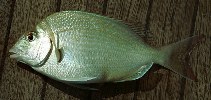
Sparidae (Porgies)
Etymology: Stenotomus: Greek, stenos = narrow + Greek, stoma = mouth (Ref. 45335).
More on author: Linnaeus.
Environment: milieu / climate zone / rango de profundidad / distribution range
Ecología
marino demersal; oceanodromo (Ref. 51243); rango de profundidad 15 - ? m (Ref. 4926). Subtropical; 46°N - 25°N
Western Atlantic: Nova Scotia in Canada to Florida in USA; rare south of North Carolina, USA.
Length at first maturity / Tamaño / Peso / Age
Madurez: Lm 15.5 range ? - ? cm
Max length : 46.0 cm TL macho / no sexado; (Ref. 7251); common length : 25.0 cm TL macho / no sexado; (Ref. 9988); peso máximo publicado: 2.1 kg (Ref. 40637)
Occurs usually in schools inshore in summer and offshore in winter. Feeds on amphipods, worms, sand dollars and young squid (Ref. 4926). Utilized fresh, smoked and frozen; eaten pan-fried, broiled and baked (Ref. 9988). Exported to Japan (Ref. 9988)
Robins, C.R. and G.C. Ray, 1986. A field guide to Atlantic coast fishes of North America. Houghton Mifflin Company, Boston, U.S.A. 354 p. (Ref. 7251)
IUCN Red List Status (Ref. 130435: Version 2025-1)
Threat to humans
Reports of ciguatera poisoning (Ref. 30911)
Human uses
Pesquerías: comercial; pesca deportiva: si; Acuario: Acuarios públicos
Herramientas
Special reports
Download XML
Fuentes de Internet
Estimates based on models
Preferred temperature (Referencia
123201): 9.4 - 24.6, mean 23.5 °C (based on 106 cells).
Phylogenetic diversity index (Referencia
82804): PD
50 = 0.7500 [Uniqueness, from 0.5 = low to 2.0 = high].
Bayesian length-weight: a=0.01738 (0.01058 - 0.02855), b=3.02 (2.88 - 3.16), in cm total length, based on LWR estimates for this species & (Sub)family-body (Ref.
93245).
Nivel trófico (Referencia
69278): 3.8 ±0.1 se; based on diet studies.
Resiliencia (Referencia
120179): Medio, población duplicada en un tiempo mínimo de 1.4-4.4 años (K=0.17-0.23; tmax=19).
Fishing Vulnerability (Ref.
59153): Moderate to high vulnerability (51 of 100).
🛈
Climate Vulnerability (Ref.
125649): Moderate vulnerability (40 of 100).
🛈
Nutrients (Ref.
124155): Calcium = 78.5 [35.6, 139.6] mg/100g; Iron = 1.03 [0.55, 2.10] mg/100g; Protein = 19.3 [18.2, 20.5] %; Omega3 = 0.332 [0.195, 0.556] g/100g; Selenium = 30.7 [14.6, 62.3] μg/100g; VitaminA = 7.68 [2.00, 29.30] μg/100g; Zinc = 0.578 [0.379, 0.855] mg/100g (wet weight);