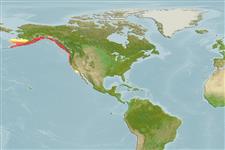
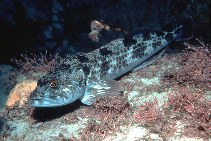
Environment: milieu / climate zone / distribuzione batimetrica / distribution range
Ecologia
marino demersale; oceano-estuarine (Ref. 51243); distribuzione batimetrica 0 - 475 m (Ref. 6793). Temperate; 61°N - 31°N, 172°W - 116°W
Northeast Pacific: Shumagin Islands in the western Gulf of Alaska to Ensenada, Baja California, Mexico. Possibly occurring in the Bering Sea (Ref. 6793).
Length at first maturity / Size / Peso / Age
Maturità: Lm 70.5, range 61 - 76 cm
Max length : 152 cm TL maschio/sesso non determinato; (Ref. 2850); peso massimo pubblicato: 59.1 kg (Ref. 40637); Età massima riportata: 25 anni (Ref. 55701)
Short description
Chiavi di identificazione | Morfologia | Morfometria
Spine dorsali (totale) : 24 - 27; Raggi dorsali molli (totale) : 21 - 24; Spine anali: 3; Raggi anali molli: 21 - 24; Vertebre: 55 - 59. Anal spines of adults buried in flesh, third spine closely applied to first ray (Ref. 6885). Head without scales; fleshy cirrus above each eye; large mouth; maxilla reaching almost to vertical from posterior margin of eye. Jaws with small pointed teeth interspersed with large fanglike teeth (Ref. 48751).
Body shape (shape guide): elongated.
Ranges from the intertidal to 475 m depth (Ref. 6793). Adults are found near rocks, inshore and to 427 m (Ref. 2850). Young occur on sand or mud bottom of bays and inshore areas (Ref. 2850). Both migratory and non-migratory populations exist (Ref. 6885). Adults feed mostly on other fishes but also take crustaceans, octopi and squid (Ref. 4925). Young feed on copepods and other small crustaceans (Ref. 6885). A very important sport and commercial species (Ref. 2850). The liver is rich in vitamin A (Ref. 6885). Marketed fresh and frozen; eaten steamed, fried, broiled, boiled, microwaved and baked (Ref. 9988). Has sharp teeth and gill rakers that can cut fingers if handled.
Eggs are deposited in crevices or under rocks (Ref. 6885). Male guards the eggs until they hatch.
Eschmeyer, W.N., E.S. Herald and H. Hammann, 1983. A field guide to Pacific coast fishes of North America. Boston (MA, USA): Houghton Mifflin Company. xii+336 p. (Ref. 2850)
IUCN Red List Status (Ref. 130435: Version 2025-1)
Threat to humans
Traumatogenic (Ref. 13513)
Human uses
Pesca: commerciale; Pesce da pesca sportiva: si
Strumenti
Special reports
Download XML
Fonti Internet
Estimates based on models
Preferred temperature (Fonte Biblio.
123201): 4.5 - 8.6, mean 5.9 °C (based on 184 cells).
Phylogenetic diversity index (Fonte Biblio.
82804): PD
50 = 1.0020 [Uniqueness, from 0.5 = low to 2.0 = high].
Bayesian length-weight: a=0.00389 (0.00180 - 0.00842), b=3.12 (2.94 - 3.30), in cm total length, based on all LWR estimates for this body shape (Ref.
93245).
Trophic level (Fonte Biblio.
69278): 4.5 ±0.6 se; based on diet studies.
Resilienza (Fonte Biblio.
120179): Medio, tempo minimo di raddoppiamento della popolazione 1.4 - 4.4 anni (tm=4; tmax=25;).
Prior r = 0.36, 95% CL = 0.24 - 0.53, Based on 2 full stock assessments.
Fishing Vulnerability (Ref.
59153): High vulnerability (56 of 100).
🛈
Climate Vulnerability (Ref.
125649): Moderate to high vulnerability (48 of 100).
🛈
Nutrients (Ref.
124155): Calcium = 25.5 [9.8, 54.9] mg/100g; Iron = 0.351 [0.157, 0.792] mg/100g; Protein = 18.3 [16.1, 20.3] %; Omega3 = 0.589 [0.263, 1.706] g/100g; Selenium = 28.4 [14.8, 68.4] μg/100g; VitaminA = 9.37 [2.88, 31.89] μg/100g; Zinc = 0.289 [0.192, 0.446] mg/100g (wet weight); based on
nutrient studies.