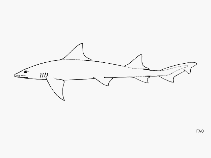
Triakis acutipinna, Sharpfin houndshark

You can sponsor this page

Triakis acutipinna Kato, 1968

Sharpfin houndshark
Envoyez vos Photos et vidéos
Images | Images Google
Image of Triakis acutipinna (Sharpfin houndshark)
Triakis acutipinna
Photo de FAO

Classification / Names Noms communs | Synonymes | Catalog of Fishes(Genre, Espèce) | ITIS | CoL | WoRMS | Cloffa

Élasmobranches (requins et raies) (sharks and rays) > Carcharhiniformes (Ground sharks) > Triakidae (Houndsharks) > Triakinae
Etymology: Triakis: tri-, from tres (L.), three; akis (Gr.), point, referring to each tooth consisting of one large central cusp flanked on by both sides by a small cusplet (See ETYFish)acutipinna: acutus (L.), sharp or pointed; pinna (L.), fin, referring to its sharp-tipped fins (See ETYFish).

Environment: milieu / climate zone / profondeur / distribution range Écologie

marin démersal. Tropical; 0°S - 4°S

Distribution Pays | Zones FAO | Écosystèmes | Occurrences | Carte par point | Introductions | Faunafri

Eastern Pacific: known only from Ecuador.

Taille / Poids / Âge

Maturité: Lm ?  range ? - ? cm
Max length : 90.0 cm TL mâle / non sexé; (Ref. 244); 102.0 cm TL (female)

Biologie     Glossaire (ex. epibenthic)

Known only from two specimens. Ovoviviparous (Ref. 50449).

Life cycle and mating behavior Maturité | Reproduction | Frai | Œufs | Fécondité | Larves

Ovoviviparous, embryos feed solely on yolk (Ref. 50449).

Référence principale Upload your references | Références | Coordinateur : Compagno, Leonard J.V. | Collaborateurs

Compagno, L.J.V., 1984. FAO Species Catalogue. Vol. 4. Sharks of the world. An annotated and illustrated catalogue of shark species known to date. Part 2 - Carcharhiniformes. FAO Fish. Synop. 125(4/2):251-655. Rome: FAO. (Ref. 244)

Statut dans la liste rouge de l'IUCN (Ref. 130435: Version 2025-1)

  Menacé (EN) (B1ab(v); C2a(ii)); Date assessed: 23 September 2020

CITES

Not Evaluated

CMS (Ref. 116361)

Not Evaluated

Menace pour l'homme

  Harmless


Utilisations par l'homme

Pêcheries: sans intérêt
FAO - Publication: search | FishSource |

Plus d'informations

Écologie trophique
Food items (preys)
Composition du régime alimentaire
Consommation alimentaire
Food rations
Prédateurs
Écologie
Écologie
Home ranges
Population dynamics
Paramètres de croissance
Max. ages / sizes
Length-weight rel.
Length-length rel.
Fréquences de longueurs
Mass conversion
Recrutement
Abondance
Life cycle
Reproduction
Maturité
Maturity/Gills rel.
Fécondité
Frai
Spawning aggregations
Œufs
Développement de l'œuf
Larves
Dynamique des populations larvaires
Distribution
Pays
Zones FAO
Écosystèmes
Occurrences
Introductions
BRUVS - Videos
Anatomy
Surface branchiale
Brain
Otolith
Physiology
Body composition
Nutrients
Consommation d'oxygène
Type de nage
Vitesse de nage
Visual pigments
Fish sound
Diseases & Parasites
Toxicity (LC50s)
Génétique
génôme
Génétique
Heterozygosity
Héritabilité
Human related
Aquaculture systems
Profils d'aquaculture
Souches
Ciguatera cases
Stamps, coins, misc.
Outreach
Collaborateurs
Références
Références

Outils

Articles particuliers

Télécharger en XML

Sources Internet

AFORO (otoliths) | Aquatic Commons | BHL | Cloffa | Websites from users | FishWatcher | CISTI | Catalog of Fishes: Genre, Espèce | DiscoverLife | ECOTOX | FAO - Publication: search | Faunafri | Fishipedia | Fishtrace | GloBI | Google Books | Google Scholar | Google | IGFA World Record | OneZoom | Open Tree of Life | Otolith Atlas of Taiwan Fishes | PubMed | Reef Life Survey | Socotra Atlas | TreeBase | Arbre de Vie | Wikipedia: aller à, chercher | World Records Freshwater Fishing | Zoobank | Zoological Record

Estimates based on models

Phylogenetic diversity index (Réf. 82804):  PD50 = 0.5312   [Uniqueness, from 0.5 = low to 2.0 = high].
Bayesian length-weight: a=0.00245 (0.00114 - 0.00526), b=3.13 (2.95 - 3.31), in cm total length, based on LWR estimates for this (Sub)family-body shape (Ref. 93245).
Niveau trophique (Réf. 69278):  3.7   ±0.2 se; based on size and trophs of closest relatives
Résilience (Réf. 120179):  Faible, temps minimum de doublement de population : 4,5 à 14 années (Fec assumed to be <100).
Fishing Vulnerability (Ref. 59153):  High vulnerability (61 of 100). 🛈