>
Ophidiiformes (Cusk eels) >
Dinematichthyidae (Viviparous brotula)
Etymology: Ungusurculus: Name from Latin words 'ungulus' (= claw) and 'surculus' (= grapevine tendril), refers to the functional analogy with the pseudoclaspers and the specific shape of the inner pseudoclasper; riauensis: Named for the Riau Archipelago, where the majority of the specimens were obtained.
More on authors: Schwarzhans & Møller.
Environment: milieu / climate zone / rango de profundidad / distribution range
Ecología
marino asociado a arrecife; rango de profundidad 0 - 5 m (Ref. 90102). Tropical
Western Pacific: restricted to the Indonesian Riau Archipelago and Singapore.
Tamaño / Peso / Age
Madurez: Lm ? range ? - ? cm
Max length : 4.7 cm SL macho / no sexado; (Ref. 76869); 5.6 cm SL (female)
Short description
Claves de identificación | Morfología | Morfometría
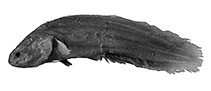
Radios blandos dorsales (total) : 70 - 77; Radios blandos anales: 53 - 61; Vértebra: 40 - 42. This species is diagnosed by the following characters: D 70-77, A 53-61, D/A 20-23, V in D 1.9-2.2; vertebrae 12+28-30=40-42; anterior nostril 1/4 distance from upper lip to aggregate distance to anterior margin of eye; free pseudoclaspers 2 pairs, the outer pseudoclasper wingshaped with broad base and distally widened supporter with massive anterior hook, prominent knob on inner face of outer pseudoclasper fitting into opening of inner pseudoclasper, the inner one long, massive, stalked, distally with claw-like, outwardly directed strong spines; cheeks with 5 scale rows on upper part and 3 rows on lower; no upper preopercular pore; otolith moderately elongate, its length to height is 2.0-2.2, pointed anterior tip, expanded posterior tip, sharp postdorsal angle, bent outwards, short sulcus with small ventral indentation at joining of ostium and cauda but completely fused colliculi, its centre anterior to centre of otolith, inclined about 10°, otolith length to sulcus length is 2.1 (Ref. 76869).
Body shape (shape guide): elongated; Cross section: compressed.
Cryptic ans solitary, inhabitant of reef crevices in about 0-5 m (Ref 90102).
Life cycle and mating behavior
Madurez | Reproducción | Puesta | Huevos | Fecundidad | Larva
Schwarzhans, W. and P.R. Møller, 2007. Review of the Dinematichthyini (Teleostei: Bythitidae) of the Indo-west Pacific. Part III. Beaglichthys, Brosmolus, Monothrix and eight new genera with description of 20 new species. The Beagle, Records of the Museums and Art Galleries of the Northern Territory 23:29-110. (Ref. 76869)
IUCN Red List Status (Ref. 130435: Version 2025-1)
Human uses
Pesquerías: sin interés
Herramientas
Special reports
Download XML
Fuentes de Internet
Estimates based on models
Preferred temperature (Referencia
123201): 28.8 - 29.3, mean 29 °C (based on 283 cells).
Phylogenetic diversity index (Referencia
82804): PD
50 = 0.5156 [Uniqueness, from 0.5 = low to 2.0 = high].
Bayesian length-weight: a=0.00389 (0.00180 - 0.00842), b=3.12 (2.94 - 3.30), in cm total length, based on all LWR estimates for this body shape (Ref.
93245).
Nivel trófico (Referencia
69278): 3.3 ±0.5 se; based on size and trophs of closest relatives
Fishing Vulnerability (Ref.
59153): Low vulnerability (10 of 100).
🛈