Classification / Names
Noms communs | Synonymes | Catalog of Fishes(Genre, Espèce) | ITIS | CoL | WoRMS | Cloffa
>
Gobiiformes (Gobies) >
Gobiidae (Gobies) > Gobionellinae
Etymology: Luciogobius: Latin, lucius = pike + Latin, gobius = gudgeon (Ref. 45335); fluvialis: The specific name, 'fluvialis', is a Latin adjective, meaning flowing or riverine. This is in refence to the habitat of this species.
Environment: milieu / climate zone / profondeur / distribution range
Écologie
; eau douce démersal. Subtropical
Asia: Warashina River, a tributary of the Abe River System in Japan.
Taille / Poids / Âge
Maturité: Lm ? range ? - ? cm
Max length : 3.3 cm SL mâle / non sexé; (Ref. 86963); 3.6 cm SL (female)
Description synthétique
Clés d'identification | Morphologie | Morphométrie
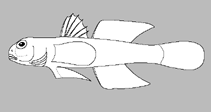
Rayons mous dorsaux (Total) : 8 - 10; Épines anales: 1; Rayons mous anaux: 8 - 10; Vertèbres: 31 - 33. Diagnosed from all other species of Luciogobius by having the following combination of characters: eye small and degenerated, embedded beneath skin, obscured after fixation; body naked, without scales; dermal ridge on cheek lacking barbels; second dorsal-fin origin slightly anterior to anal fin; pelvic fin present; no free soft rays on upper and lower ends of pectoral fin; second dorsal-fin rays modally I,9; anal-fin rays modally I,9; branched caudal-fin rays modally 8+7; vertebrae modally 16+16=32; interorbit region flat; maximum width of head at cheek 11.5% in SL; upper jaw length 8.5% in SL; 37.4% in head length; predorsal length 307.4% in head length; and preanal length 315.8% in head length (Ref. 86963).
Body shape (shape guide): fusiform / normal.
Found in the middle reaches of river on a gravel substrate composed of pebbles of 3-5 cm in diameter and containing less than 5% of sand, where freshwater springs flow from between the pebbles (Ref. 86963).
Life cycle and mating behavior
Maturité | Reproduction | Frai | Œufs | Fécondité | Larves
Kanagawa, N., T. Itai and H. Senou, 2011. Two new species of freshwater gobies of the genus Luciogobius (Perciformes: Gobiidae) from Japan. Bull. Kanagawa Prefect. Mus. (Nat. Sci.) 40:67-74. (Ref. 86963)
Statut dans la liste rouge de l'IUCN (Ref. 130435: Version 2025-1)
Menace pour l'homme
Harmless
Utilisations par l'homme
Pêcheries: sans intérêt
Outils
Articles particuliers
Télécharger en XML
Sources Internet
Estimates based on models
Phylogenetic diversity index (Réf.
82804): PD
50 = 0.5000 [Uniqueness, from 0.5 = low to 2.0 = high].
Bayesian length-weight: a=0.00977 (0.00444 - 0.02153), b=3.04 (2.85 - 3.23), in cm total length, based on LWR estimates for this (Sub)family-body shape (Ref.
93245).
Niveau trophique (Réf.
69278): 3.2 ±0.5 se; based on size and trophs of closest relatives
Résilience (Réf.
120179): Haut, temps minimum de doublement de population inférieur à 15 mois (Preliminary K or Fecundity.).
Fishing Vulnerability (Ref.
59153): Low vulnerability (10 of 100).
🛈