>
Ovalentaria/misc (Various families in series Ovalentaria) >
Pomacentridae (Damselfishes) > Pomacentrinae
Etymology: Pomacentrus: Greek, poma, -atos = cover, operculum + Greek, kentron = sting (Ref. 45335); bellipictus: Name from Latin 'bellipictus' or 'war-painted'; referring to its facial coloration and belligerent behaviour towards divers; masculine compound adjective.
Environment: milieu / climate zone / kisaran kedalaman / distribution range
Ekologi
laut berasosiasi dengan karang; kisaran kedalaman 1 - 2 m (Ref. 118654). Tropical
Western Pacific: Indoneia (West Papua).
Size / Weight / umur
Kematangan: Lm ? range ? - ? cm
Max length : 6.8 cm SL jantan/; (Ref. 118654)
deskripsi pendek
Kunci identifiaksi (pengenalan) | Morfologi | Morfometrik
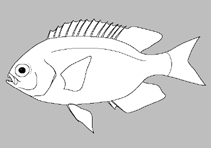
Duri punggung (Keseluruhan (total)) : 13 - 14; duri punggung lunak (Keseluruhan (total)) : 12 - 14; Duri dubur: 2; Sirip dubur lunak: 12 - 15; vertebrata, bertulang belakang: 26. This species is distinguished by the following characters: D XIV (rarely XIII),12-14 (usually XIV,14); A II,12-15 (usually 14-15); pectoral-fin rays 17-19 (rarely 19); tubed lateral-line scales 17-19 (usually 18); total gill rakers on first arch 18-20 (rarely 20); body depth 1.8-2.0 (mean 1.9) in SL; scales absent on preorbital and suborbital; lower margin of suborbital series with 4-12 serrae; color in life mainly dark brown, nearly black, with contrasting blue areas around mouth (including isthmus), below eye, and along margin of preopercle; iris of adult mostly dark gray with a narrow bronze ring around pupil (Ref. 118654).
Cross section: compressed.
Relatively common at the type locality, darting among wave-washed rocks and boulders next to shore in about 1-2 meters and although the shoreline was exposed to significant wave action, the surrounding waters have characteristics more typical of estuarine habitats, i.e. with lowered salinity, high turbidity and sedimentation, and frequently elevated temperatures up to about 31°C. This area of unusual combination of coastal and offshore conditions may account for the development of the microendemic species limited to this area. Adults and subadults exhibited aggressive behavior when approached at close range, charging to within a few centimeters when confronted with either a camera or small collecting spear (Ref. 118654).
Life cycle and mating behavior
Kematangan | Reproduksi, perkembang biakan | Pemijahan | telur-telur | Fecundity | Larva
Allen, G.R., M.V. Erdmann and N.I. Hidayat, 2018. Pomacentrus bellipictus, a new microendemic species of damselfish (Pisces: Pomacentridae) from the Fakfak Peninsula, West Papua, Indonesia. J. Ocean Sci. Found. 30:1-10. (Ref. 118654)
Status IUCN Red List (Ref. 130435: Version 2025-1)
ancaman kepada manusia
Harmless
penggunaan manusia
Alat, peralatan
laporan khas
muat turun XML
Sumber internet
Estimates based on models
Phylogenetic diversity index (Acuan
82804): PD
50 = 0.5000 [Uniqueness, from 0.5 = low to 2.0 = high].
Bayesian length-weight: a=0.02455 (0.01155 - 0.05216), b=2.98 (2.81 - 3.15), in cm total length, based on LWR estimates for this Genus-body shape (Ref.
93245).
Trophic level (Acuan
69278): 2.7 ±0.3 se; based on size and trophs of closest relatives
Daya lenting (Acuan
120179): Tinggi, Waktu penggandaan populasi minimum kurang dari 15 bulan (Preliminary K or Fecundity.).
Fishing Vulnerability (Ref.
59153): Low vulnerability (10 of 100).
🛈