Environment: milieu / climate zone / rango de profundidad / distribution range
Ecología
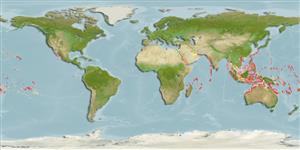
marino asociado a arrecife; rango de profundidad 6 - 30 m (Ref. 86942). Tropical; 30°N - 24°S
Indo-Pacific: Red Sea and East Africa to Fiji (Ref. 10708) and Tonga (Ref. 53797), north to the Yaeyama Islands, south to the Great Barrier Reef. Ulithi in Micronesia.
Tamaño / Peso / Age
Madurez: Lm ? range ? - ? cm
Max length : 1.8 cm SL macho / no sexado; (Ref. 89154)
Short description
Claves de identificación | Morfología | Morfometría
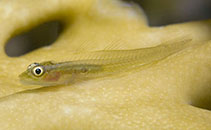
Espinas dorsales (total) : 7 - 8; Radios blandos dorsales (total) : 7 - 8; Espinas anales: 1; Radios blandos anales: 8. Dorsal-fin rays VI + I,8 (rarely I,7); anal-fin rays I,8; pectoral-fin rays usually 13 or 14; body naked anterior to rear base of first dorsal fin, the longitudinal scale count 31–37 (mean scale count 33); body depth at origin of anal fin 13.3–17.5% SL; body progressively compressed posteriorly; head width greater than head depth and broader ventrally; snout length shorter than orbit diameter; gill opening extending forward to or anterior to posterior margin of preopercle; no canine tooth at side of lower jaw; caudal fin truncate to slightly rounded; pelvic fins short, round, and cup-like, the pelvic spines short; body translucent greenish yellow, the skeletal features of body visible; head and abdomen yellowish green with numerous black dots; a yellowish green band with black dots from eye to eye across front of snout and enclosing nostrils; red of gill filaments visible through operculum; fins translucent; iris dusky yellowish green with a broad inner white circle. A small species, the largest specimen 17.8 mm SL (Ref. 89154).
Body shape (shape guide): fusiform / normal.
Inhabits lagoon and seaward reefs and found on large Porites knoll and branching Millepora.
Life cycle and mating behavior
Madurez | Reproducción | Puesta | Huevos | Fecundidad | Larva
Myers, R.F., 1991. Micronesian reef fishes. Second Ed. Coral Graphics, Barrigada, Guam. 298 p. (Ref. 1602)
IUCN Red List Status (Ref. 130435: Version 2025-1)
Threat to humans
Harmless
Human uses
Herramientas
Special reports
Download XML
Fuentes de Internet
Estimates based on models
Preferred temperature (Referencia
123201): 25.2 - 29.3, mean 28.2 °C (based on 2327 cells).
Phylogenetic diversity index (Referencia
82804): PD
50 = 0.5000 [Uniqueness, from 0.5 = low to 2.0 = high].
Bayesian length-weight: a=0.01023 (0.00477 - 0.02194), b=3.01 (2.83 - 3.19), in cm total length, based on LWR estimates for this (Sub)family-body shape (Ref.
93245).
Nivel trófico (Referencia
69278): 3.0 ±0.3 se; based on size and trophs of closest relatives
Resiliencia (Referencia
120179): Alto, población duplicada en un tiempo mínimo inferior a 15 meses (Preliminary K or Fecundity.).
Fishing Vulnerability (Ref.
59153): Low vulnerability (10 of 100).
🛈