>
Gadiformes (Cods) >
Macrouridae (Grenadiers or rattails)
Etymology: Coryphaenoides: Greek, koryphaina = dolphin fish + Suffix oides = similar to (Ref. 45335).
More on author: Günther.
Environment: milieu / climate zone / Tiefenbereich / distribution range
Ökologie
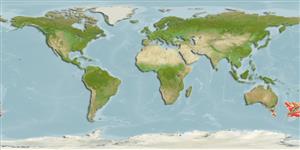
seewasser bathydemersal; standorttreu; tiefenbereich 540 - 2070 m (Ref. 1371). Deep-water; 33°S - 50°S, 137°E - 179°W (Ref. 1371)
Southwest Pacific: New Zealand, Tasman Sea, south of Tasmania, southeast Australia (Victoria), and possibly also across the Indian Ocean (Ref. 1371). A possible subspecies, Coryphaenoides serrulatus oceanus from the Indian Ocean (Walters Shoals south of Madagascar to Broken Ridge in 870-1,255 m) is recognized by Iwamoto and Shcherbachev (Ref. 10993).
Size / Gewicht / Alter
Geschlechtsreife: Lm ? range ? - ? cm
Max length : 48.2 cm TL Männchen/unbestimmt; (Ref. 71794)
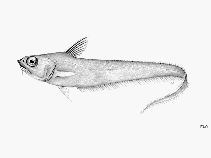
Rückenflossenstacheln (insgesamt) : 2; Afterflossenstacheln: 0. Head of moderate-size, its underside scaled; sensory pores on head prominent; eyes relatively large; snout blunt, its tip and lateral angles with large, stout tubercular scutes. Scales adherent, densely covered with distinctly shield-shaped imbricate spinules. Pyloric caeca short, directed anteriorly, 10 to 12; retia mirabilia 6. Overall color is brownish gray; fins dusky; oral and branchial cavities blackish.
Body shape (shape guide): elongated; Cross section: circular.
A benthic species (Ref. 75154) recorded from the continental slope (Ref. 9563, 75154).
Life cycle and mating behavior
Geschlechtsreife | Fortpflanzung | Ablaichen | Eier | Fecundity | Larven
Cohen, D.M., T. Inada, T. Iwamoto and N. Scialabba, 1990. FAO species catalogue. Vol. 10. Gadiform fishes of the world (Order Gadiformes). An annotated and illustrated catalogue of cods, hakes, grenadiers and other gadiform fishes known to date. FAO Fish. Synop. 125(10). Rome: FAO. 442 p. (Ref. 1371)
IUCN Rote Liste Status (Ref. 130435: Version 2025-1)
Bedrohung für Menschen
Harmless
Nutzung durch Menschen
Fischereien: weniger kommerziell
Tools
Zusatzinformationen
Download XML
Internet Quellen
Estimates based on models
Preferred temperature (Ref.
123201): 3.1 - 7.2, mean 4.8 °C (based on 181 cells).
Phylogenetic diversity index (Ref.
82804): PD
50 = 0.5000 [Uniqueness, from 0.5 = low to 2.0 = high].
Bayesian length-weight: a=0.00214 (0.00109 - 0.00421), b=3.20 (3.03 - 3.37), in cm total length, based on LWR estimates for this (Sub)family-body shape (Ref.
93245).
Trophic level (Ref.
69278): 3.5 ±0.4 se; based on size and trophs of closest relatives
Widerstandsfähigkeit (Ref.
120179): niedrig, Verdopplung der Population dauert 4,5 - 14 Jahre. (Preliminary K or Fecundity.).
Fishing Vulnerability (Ref.
59153): Moderate vulnerability (38 of 100).
🛈