Classification / Names
Common names | Synonyms | Catalog of Fishes(genus, species) | ITIS | CoL | WoRMS | Cloffa
Teleostei (teleosts) >
Gobiiformes (Gobies) >
Gobiidae (Gobies) > Gobiinae
Etymology: Tomiyamichthys: occurring on sand-rubble bottoms in the vicinity of coral reefs; levisquama: Name from Greek 'levis' for smooth and 'squama' for scale, referring to the cycloid scales; noun
in apposition.
Environment: milieu / climate zone / depth range / distribution range
Ecology
Marine; demersal; depth range 0 - 25 m (Ref. 116701). Tropical
Distribution
Countries | FAO areas | Ecosystems | Occurrences | Point map | Introductions | Faunafri
Western Pacific: Australia.
Size / Weight / Age
Maturity: Lm ? range ? - ? cm
Max length : 6.9 cm SL male/unsexed; (Ref. 116701); 6.9 cm SL (female)
Short description
Identification keys | Morphology | Morphometrics
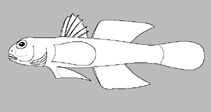
Dorsal spines (total): 7; Dorsal soft rays (total): 10 - 11; Anal spines: 1; Anal soft rays: 10 - 11. This species is distinguished by the following characters: mental fraenum is truncate, with straight posterior margin; large mouth reaching to point below posterior quarter of eye; jaws forming an angle of 35-45° with body axis; upper margin of the upper jaw is in line with point just below eye; with a distinct groove behind eye formed by elevated eyes and triangular projection of skin from nape; slightly bulbous cheeks. very narrow interorbital with less than pupil diameter; gill opening reaching to below a point just behind posterior preopercular margin; head papillae in longitudinal pattern; entirely cycloid scales; predorsal area is partly scaled, midline naked, or rarely with one scale before first dorsal fin, sides of nape scaled forward in an arch from first dorsal origin to above middle to anterior part of operculum; naked cheek, operculum and pectoral fin base; scaled prepelvic area, except for small area anteriorly, scales embedded and not easily seen; belly is covered with cycloid scales, except for a small naked area just behind pelvic fin insertion; first dorsal fin low, with rounded to slightly pointed margin, the 3rd to 5th spines longest and not filamentous, spines 3-5 extending beyond other spines when fin depressed; first dorsal fin sometimes with a small black spot on membranes between distal tips of third and fourth spines; pelvic disc with a median dark stripe; body possess 3 slightly oblique dark bands and rounded spot at end of caudal peduncle extending onto caudal fin; D2 I,10; A I,10; pectoral fin rays often 18-19; longitudinal scale count 50-70; predorsal scale count 0-4; transverse scale count (TRB) 23-25 (Ref. 116701).
Body shape (shape guide): elongated; Cross section: oval.
Occurs over mud bottom (Ref. 116701).
Life cycle and mating behavior
Maturity | Reproduction | Spawning | Eggs | Fecundity | Larvae
Hoese, D. F., Shibukawa, K. and J.W. Johnson, 2016. Description of a new species of Tomiyamichthys from Australia with a discussion of the generic name. Zootaxa 4079(5):582-594. (Ref. 116701)
IUCN Red List Status (Ref. 130435: Version 2025-1)
Threat to humans
Harmless
Human uses
Fisheries: bycatch
Tools
Special reports
Download XML
Internet sources
Estimates based on models
Phylogenetic diversity index (Ref.
82804): PD
50 = 0.5000 [Uniqueness, from 0.5 = low to 2.0 = high].
Bayesian length-weight: a=0.00724 (0.00339 - 0.01546), b=3.10 (2.92 - 3.28), in cm total length, based on LWR estimates for this (Sub)family-body shape (Ref.
93245).
Trophic level (Ref.
69278): 3.3 ±0.3 se; based on size and trophs of closest relatives
Resilience (Ref.
120179): High, minimum population doubling time less than 15 months (Preliminary K or Fecundity.).
Fishing Vulnerability (Ref.
59153): Low vulnerability (10 of 100).
🛈