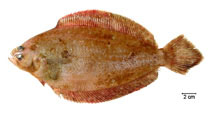
Xystreurys rasilis

You can sponsor this page

Xystreurys rasilis (Jordan, 1891)

Upload your photos and videos
Imágenes | Google image
Image of Xystreurys rasilis
Xystreurys rasilis
Picture by Fischer, L.G.

Classification / Names Nombres comunes | Sinónimos | Catalog of Fishes(Género, Especie) | ITIS | CoL | WoRMS | Cloffa

> Pleuronectiformes (Flatfishes) > Paralichthyidae (Large-tooth flounders)
Etymology: Xystreurys: Greek, xystra, -as = scraper + Greek, eury = wide (Ref. 45335).
More on author: Jordan.

Environment: milieu / climate zone / rango de profundidad / distribution range Ecología

marino demersal; oceanodromo (Ref. 41500), usually 5 - 150 m (Ref. 36453). Subtropical; - 53°S

Distribución Países | Áreas FAO | Ecosistemas | Ocurrencias, apariciones | Mapa de puntos | Introducciones | Faunafri

Southwest Atlantic: Rio de Janeiro, Brazil to Patagonia, Argentina.

Length at first maturity / Tamaño / Peso / Age

Madurez: Lm 21.2  range ? - ? cm
Max length : 40.0 cm NG macho / no sexado; (Ref. 36453)

Short description Claves de identificación | Morfología | Morfometría

Espinas dorsales (total) : 0; Radios blandos dorsales (total) : 75 - 89; Espinas anales: 0; Radios blandos anales: 60 - 71. Dark spots on ocular side irregularly and two dark small spots at end of both dorsal and anal fin bases on blind side symmetrically (Ref. 27363).
Body shape (shape guide): short and / or deep.

Biología     Glosario (por ej. epibenthic)

Feeds on amphipods, small crabs and polychaetes (Ref. 36453). In spring mature individuals migrate to 37°S and southwards to spawn and in autumn migrate offshore for feeding and growing (Ref. 41500).

Life cycle and mating behavior Madurez | Reproducción | Puesta | Huevos | Fecundidad | Larva

Distinct pairing (Ref. 205).

Main reference Upload your references | Referencias | Coordinador : Amaoka, Kunio | Colaboradores

Nakamura, I., T. Inada, M. Takeda and H. Hatanaka, 1986. Important fishes trawled off Patagonia. Japan Marine Fishery Resource Research Center, Tokyo. 369 p. (Ref. 27363)

IUCN Red List Status (Ref. 130435: Version 2025-1)

  Least Concern (LC) ; Date assessed: 06 January 2020

CITES

Not Evaluated

CMS (Ref. 116361)

Not Evaluated

Threat to humans

  Harmless


Human uses

FAO - Publication: search | FishSource |

Más información

Ecología Trófica
Food items (preys)
Composición de la dieta
consumo de alimento
Food rations
Despredadores
Ecología
Ecología
Home ranges
Population dynamics
Coeficiente del crecimiento para
Max. ages / sizes
Length-weight rel.
Length-length rel.
Length-frequencies
Mass conversion
Reclutamiento
Abundancia
Life cycle
Reproducción
Madurez
Maturity/Gills rel.
Fecundidad
Puesta
Spawning aggregations
Huevos
Egg development
Larva
Dinámica larvaria
Distribución
Países
Áreas FAO
Ecosistemas
Ocurrencias, apariciones
Introducciones
BRUVS - Videos
Anatomy
Superficie branquial
Brain
Otolith
Physiology
Body composition
Nutrients
Consumo del oxígeno
Tipo de natación
Velocidad de natación
Visual pigments
Fish sound
Diseases & Parasites
Toxicity (LC50s)
Genética
Genome
Genética
Heterozygosity
heritabilidad
Human related
Aquaculture systems
Perfiles de acuicultura
Razas
Ciguatera cases
Stamps, coins, misc.
Outreach
Colaboradores
Referencias
Referencias

Herramientas

Special reports

Download XML

Fuentes de Internet

AFORO (otoliths) | Aquatic Commons | BHL | Cloffa | Websites from users | Check FishWatcher | CISTI | Catalog of Fishes: Género, Especie | DiscoverLife | ECOTOX | FAO - Publication: search | Faunafri | Fishipedia | Fishtrace | GloBI | Google Books | Google Scholar | Google | IGFA World Record | Bases de datos nacionales | OneZoom | Open Tree of Life | Otolith Atlas of Taiwan Fishes | PubMed | Reef Life Survey | Socotra Atlas | TreeBase | Árbol de la vida | Wikipedia: Go, búsqueda | World Records Freshwater Fishing | Expediente Zoológico

Estimates based on models

Preferred temperature (Referencia 123201): 6.3 - 22.9, mean 12.1 °C (based on 642 cells).
Phylogenetic diversity index (Referencia 82804):  PD50 = 0.7500   [Uniqueness, from 0.5 = low to 2.0 = high].
Bayesian length-weight: a=0.00427 (0.00262 - 0.00695), b=3.22 (3.08 - 3.36), in cm total length, based on LWR estimates for this species & (Sub)family-body (Ref. 93245).
Nivel trófico (Referencia 69278):  3.3   ±0.49 se; based on food items.
Generation time: 2.5 ( na - na) years. Estimated as median ln(3)/K based on 1 growth studies.
Resiliencia (Referencia 120179):  Alto, población duplicada en un tiempo mínimo inferior a 15 meses (K=0.4).
Fishing Vulnerability (Ref. 59153):  Moderate to high vulnerability (45 of 100). 🛈