Platichthys flesus, European flounder : fisheries, aquaculture, gamefish

You can sponsor this page

Platichthys flesus (Linnaeus, 1758)

European flounder
Beobachtung melden im Fish Watcher
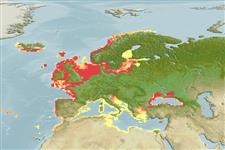
Native range | All suitable habitat | Point map | Year 2050
This map was computer-generated and has not yet been reviewed.
Platichthys flesus   AquaMaps   Data sources: GBIF OBIS
Hochladen Photos und videos
Bilder | videos | Briefmarken, Münzen, Verschiedenes. | Google Bild
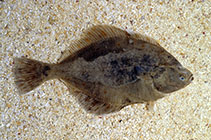
Image of Platichthys flesus (European flounder)
Platichthys flesus
Photo von Muséum-Aquarium de Nancy/D. Terver


Finland territory information

Common names: Kampela
Occurrence: native
Salinity: freshwater
Abundance: common (usually seen) | Ref: Winkler, H.M., K. Skora, R. Repecka, M. Ploks, A. Neelov, L. Urho, A. Gushin and H. Jespersen, 2000
Importance: commercial | Ref:
Aquaculture: | Ref:
Regulations: | Ref:
Uses: no uses
Comments: Occurs along the coast and in the Ahvenanmaa Archipelago.
National Checklist:
Territory Information: https://www.cia.gov/library/publications/resources/the-world-factbook/geos/fi.html
National Fisheries Authority:
Occurrences: Occurrences Point map
Main Ref: Koli, L., 1990
National Database:

Common names from other countries

Klassifizierung / Names Namen | Synonyme | Catalog of Fishes(Gattung, Arten) | ITIS | CoL | WoRMS | Cloffa

> Pleuronectiformes (Flatfishes) > Pleuronectidae (Righteye flounders) > Pleuronectinae
Etymology: Platichthys: Greek, platys = flat + Greek, ichthys = fish (Ref. 45335).
More on author: Linnaeus.

Umwelt: Milieu / Klimazone / Tiefenbereich / Verbreitungsgebiet Ökologie

seewasser; süßwasser; brackwasser demersal; pH range: 7.5 - 8.2; katadrom (Ref. 138126); tiefenbereich 1 - 100 m (Ref. 35388). Temperate; 5°C - 25°C (Ref. 13614); 72°N - 30°N, 32°W - 45°E (Ref. 54704)

Verbreitung Territorien | FAO Gebiete | Ökosysteme | Vorkommen | Punkt Karte | Einführungen | Faunafri

Eastern Atlantic: coastal and brackish waters of western Europe and from the White Sea to the Mediterranean and the Black Sea (Ref. 4705, Ref. 51442). Introduced into the USA and Canada accidentally through transport in ballast water (Ref. 1739). Asia: Iran (Ref. 39702).

Länge bei der ersten Reifung / Größe / Gewicht / Alter

Geschlechtsreife: Lm 22.4, range 14 - 30 cm
Max length : 60.0 cm TL Männchen/unbestimmt; (Ref. 35388); common length : 50.0 cm TL Männchen/unbestimmt; (Ref. 30578); max. veröff. Gewicht: 2.9 kg (Ref. 104349); max. veröff. Alter: 15 Jahre (Ref. 3944)

Kurzbeschreibung Bestimmungsschlüssel | Morphologie | Morphometrie

Rückenflossenstacheln (insgesamt) : 0; Rückenflossenweichstrahlen (insgesamt) : 53 - 62; Afterflossenstacheln: 0; Afterflossenweichstrahlen: 37 - 46. Flatfish, its disc width less than half its length (Ref. 3137). Small mouth (Ref. 3137, Ref. 51442). Eyes mostly (70%) on right side (Ref. 3137, 51442), 79% of dextrally oriented flounder (n = 1076) in Bos, 2000 (Ref. 57574). Rough skin, especially along the lateral line and the basis of the dorsal and anal fin (Ref. 3137). Lateral line straight, slightly rounded over pectorals (Ref. 3137). Green-olive colored (Ref. 51442), the bottom side white (Ref. 3137). Irregular reddish spots on the eye side (Ref. 35388).
Body shape (shape guide): short and / or deep; Cross section: compressed.

Biologie     Fachlexikon (Englisch) (z.B. epibenthic)

Migratory fish, which is most of the year found in estuaries (Ref. 51442). Adults occur on mud and sand bottom in shallow water, at sea and brackish; often entering freshwaters (Ref. 59043). During winter, adults retreat to deeper, warmer waters, where they spawn in spring (Ref. 30193). The growing larvae are moving to the coast (Ref. 51442). Larvae and early juveniles use selective tidal transport to migrate upstream rivers (Ref. 57575) using a range of triggers such as salinity, prey density and water temperature (Ref. 57573, 57574). Juveniles live in shallow coastal waters and estuaries (Ref. 57574), which are also the summer feeding grounds for the adults (Ref. 30193). Juveniles of less than a year old feed on plankton and larvae of insects, juveniles of more than a year and adults feed on benthic fauna (Ref. 51442), including small fishes and invertebrates (Ref. 30193). Nocturnal and burrowing (Ref. 30193). Marketed fresh and frozen; can be steamed, fried, boiled, microwaved and baked (Ref. 9988). Worms and mollusks are excellent baits for line fishing (Ref. 30578).

Lebenszyklus und Paarungsverhalten Geschlechtsreife | Fortpflanzung | Ablaichen | Eier | Fruchtbarkeit | Larven

Spawns in the water column (Ref. 7471). Produces 400,000 to 2,000,000 eggs for each female (Ref. 51442).

Hauptreferenz Laden Sie Ihre Referenzen hoch | Referenzen | Koordinator : Amaoka, Kunio | Partner

Vinnikov, K.A., R.C. Thomson and T.A. Munroe, 2018. Revised classification of the righteye flounders (Teleostei: Pleuronectidae) based on multilocus phylogeny with complete taxon sampling. Molecular phylogenetics and evolution, 125:147-162. (Ref. 122998)

IUCN Rote Liste Status (Ref. 130435: Version 2025-2 (Global))

  nicht bedroht (LC) ; Date assessed: 25 August 2022

CITES

Not Evaluated

CMS (Ref. 116361)

Not Evaluated

Bedrohung für Menschen

  Harmless


Nutzung durch Menschen

Fischereien: kommerziell; Aquakultur: experimental; Sportfisch: ja
FAO - Aquakultur-Systeme: produktion; Fischereien: landungen, Artbeschreibung; Publication: search | FIRMS - Stock assessments | FishSource | Das Meer um uns herum

Mehr Information

Trophische Ökologie
Lebensmittel (Beutetiere)
Nahrungszusammensetzung
Nahrungsaufnahme
Lebensmittelrationen
Räuber
Ökologie
Ökologie
Home ranges
Lebenszyklus
Fortpflanzung
Geschlechtsreife
Reifung/Kiemen rel.
Fruchtbarkeit
Ablaichen
Laichaggregationen
Eier
Eientwicklung
Larven
Larven Pop.Dyn.
Anatomie
Kiemenoberfläche
Gehirn
Otolith
Genetik
Genom
Genetik
Heterozygotie
Vererbbarkeit
Menschenbezogen
Aquakultur-Systeme
Aquakultur Profile
Zuchtlinien
Ciguatera-Fälle
Briefmarken, Münzen, Verschiedenes.
Aufsuchen
Partner
Referenzen
Referenzen

Tools

Zusatzinformationen

Download XML

Internet Quellen

Schätzungen auf der Grundlage von Modellen

Bevorzugte Temperatur (Ref. 123201): 7.2 - 14.2, mean 10.2 °C (based on 862 cells).
Phylogenetischer Diversitätsindex (Ref. 82804):  PD50 = 0.5625   [Uniqueness, from 0.5 = low to 2.0 = high].
Bayesian length-weight: a=0.00759 (0.00671 - 0.00858), b=3.07 (3.03 - 3.11), in cm total length, based on LWR estimates for this species (Ref. 93245).
Trophische Ebene (Ref. 69278):  3.3   ±0.2 se; based on diet studies.
Generation time: 4.4 (3.1 - 5.5) years. Estimated as median ln(3)/K based on 13 growth studies.
Widerstandsfähigkeit (Ref. 120179):  niedrig, Verdopplung der Population dauert 4,5 - 14 Jahre. (K=0.22-0.3; tm=2-5; tmax=15; Fec= 2 million).
Prior r = 0.56, 95% CL = 0.37 - 0.83, Based on 5 full stock assessments.
Anfälligkeit der Fischerei (Ref. 59153):  Moderate to high vulnerability (49 of 100). 🛈
Klimaanfälligkeit (Ref. 125649):  Moderate vulnerability (36 of 100). 🛈
Preiskategorie (Ref. 80766):   Very high.
Nährstoffe (Ref. 124155):  Calcium = 33.1 [14.0, 58.0] mg/100g; Iron = 0.26 [0.13, 0.49] mg/100g; Protein = 17.8 [15.6, 19.8] %; Omega3 = 0.322 [0.161, 0.627] g/100g; Selenium = 14.7 [7.4, 32.3] μg/100g; VitaminA = 6.9 [1.9, 26.1] μg/100g; Zinc = 0.509 [0.347, 0.750] mg/100g (wet weight); based on nutrient studies.