Common names from other countries
Teleostei (teleosts) >
Pleuronectiformes (Flatfishes) >
Pleuronectidae (Righteye flounders) > Microstominae
Etymology: Glyptocephalus: Greek, glyptes = carver + Greek, kephale = head (Ref. 45335).
More on author: Linnaeus.
Environment: milieu / climate zone / depth range / distribution range
Ecology
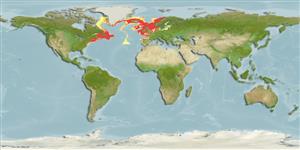
Marine; demersal; oceanodromous (Ref. 51243); depth range 18 - 1570 m (Ref. 5951), usually 45 - 366 m (Ref. 6263). Temperate; 2°C - 6°C (Ref. 6263); 70°N - 36°N, 79°W - 26°E
North Atlantic and adjacent Arctic Ocean.
Length at first maturity / Size / Weight / Age
Maturity: Lm 30.4 range ? - ? cm
Max length : 60.0 cm SL male/unsexed; (Ref. 4705); max. published weight: 2.5 kg (Ref. 35388); max. reported age: 25 years (Ref. 6263)
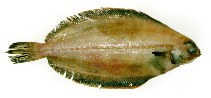
Dorsal spines (total): 0; Dorsal soft rays (total): 95 - 120; Anal soft rays: 85 - 102. Pectoral fin of eyed side shorter than head. Distal part of pectoral fin blackish (Ref. 232). Large mucus pores on the blind side of the head. Uniform coloration, rough scales. Body elongated with complete straight lateral line (Ref. 35388).
Body shape (shape guide): short and / or deep; Cross section: compressed.
Inhabits soft mud bottoms in fairly deep water (Ref. 9988). Benthic (Ref. 58426). Feeds on crustaceans, polychaetes, brittle stars (Ref. 9988) and fishes (Ref. 58426). Marketed fresh or frozen; eaten steamed, fried, microwaved and baked (Ref. 9988).
Eggs and larvae are pelagic.
Vinnikov, K.A., R.C. Thomson and T.A. Munroe, 2018. Revised classification of the righteye flounders (Teleostei: Pleuronectidae) based on multilocus phylogeny with complete taxon sampling. Molecular phylogenetics and evolution, 125:147-162. (Ref. 122998)
IUCN Red List Status (Ref. 130435: Version 2025-2)
Threat to humans
Harmless
Human uses
Fisheries: commercial
Tools
Special reports
Download XML
Internet sources