This website uses cookies to enhance your browsing experience and ensure the functionality of our site. For more detailed information about the types of cookies we use and how we protect your privacy, please visit our Privacy Information page.
×
Cookie Settings
This website uses different types of cookies to enhance your experience. Please select your preferences below:
Africa: basins of the rivers Senegal, Gambia, Volta, Niger and Chad in West Africa (Ref. 3530, 81275). Also in the Nile River basin (Ref. 3530, 28714) and Lake Turkana (Ref. 3530, 52331).
Size / Weight / Age
Maturity: Lm? range ? - ? cm Max length : 167 cm SL male/unsexed; (Ref. 2915); max. published weight: 18.5 kg (Ref. 2915)
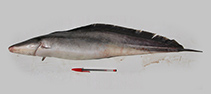
Dorsalspines (total): 0; Dorsalsoft rays (total): 183 - 230. Diagnosis: body very elongate (Ref. 28714, 81275), anguilliform (Ref. 81275), its depth 7.2-10.6 times in SL, and covered with tiny scales (Ref. 2915, 81275). Lateral line complete (Ref. 81275). Dorsal fin soft-rayed, extending almost over the entire length of back (Ref. 81275), stopping short of a naked tail (Ref. 28714). Pelvic, anal and caudal fins absent (Ref. 28714, 81275), body ending in a thin/sharp point (Ref. 2915, 81275). Pectoral fins reduced (Ref. 81275), 1.9-5.0 times in head length (Ref. 2915, 81275). Head naked, its length 5.6-6.9 times in SL; snout prominent (Ref. 2915, 81275). Mouth large and terminal; teeth strong, pointed or notched, aligned in a single row in both jaws, 12-16 in upper, 22-28 in lower jaw; premaxillae, as well as vomer and palatines, coalesced; maxillae, vomer and palatines toothless; eye very small, without a free margin (covered by skin); only the left gonad is developed and functional (Ref. 81275).
Coloration: dark grey to almost black, darker posteriorly; belly whitish (Ref. 81275). Body shape (shape guide): elongated; Cross section: circular.
Obligate air-breathing (Ref. 126274); Obligate air-breathing (Ref. 118411, 126274). Inhabits marginal vegetation and swamps constructing a flask-shaped nest in vegetation during the floods, which it is reputed to defend with vigour (Ref. 28714). Following flooding of the Gambia River banks, large elliptical floating nests are build in densely vegetated swamps at depths of about 1-1.5 m, in which about 1000 ‘amber-like’ eggs are laid; larvae hatch after 5 days (Ref. 10609). Feeds on crustaceans, insects and fish (Ref. 28714). No pelvic, anal or caudal fins (Ref. 28714). Possesses an electric organ that extends along almost the entire trunk to the tip of the tail (Ref. 10840). Also equipped with ampullary receptors and two types of tuberous receptors for electroreception (Ref. 10841). Showed increased electric organ discharge (EOD) rate by 50-60 Hz between 21 and 31°C (Ref. 10837).
Life cycle and mating behavior Maturity | Reproduction | Spawning | Eggs | Fecundity | Larvae
Breeds in well-vegetated, marginal areas of swamps and rivers, where a large, floating nest, about 1 m in diameter, is constructed, in which the eggs are laid and later guarded by one of the parents (Ref. 27583). Distinct pairing (Ref. 205).
Bigorne, R., 1990. Gymnarchidae. p. 185-186. In C. Lévêque, D. Paugy and G.G. Teugels (eds.) Faune des poissons d'eaux et saumâtres d'Afrique de l'Ouest. tome 1. Faune Trop. 28. Musée Royal de l'Afrique Centrale, Tervuren, Belgique and ORSTOM, Paris. (Ref. 2911)
IUCN Red List Status (Ref. 130435: Version 2025-2)