Xiphias gladius, Swordfish : fisheries, gamefish

You can sponsor this page

Xiphias gladius Linnaeus, 1758

Swordfish
Aggiungete la vostra osservazione in Fish Watcher
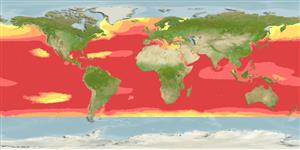
Native range | All suitable habitat | Point map | Year 2050
This map was computer-generated and has not yet been reviewed.
Xiphias gladius   AquaMaps   Data sources: GBIF OBIS
Carica il tuo foto e Video
Immagini | Video | Francobolli, monete, materiale vario. | Google image
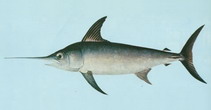
Image of Xiphias gladius (Swordfish)
Xiphias gladius
Immagine di CAFS


Trinidad and Tobago territory information

Common names: [No common name]
Occurrence: native
Salinity: marine
Abundance: | Ref:
Importance: minor commercial | Ref: FAO, 1994
Aquaculture: | Ref:
Regulations: | Ref:
Uses: no uses
Comments: Also Ref. 5217, 33407.
National Checklist:
Territory Information: https://www.cia.gov/library/publications/resources/the-world-factbook/geos/td.html
National Fisheries Authority: http://www.cep.unep.org/trini_tbgo/fisheries/index.htm
Occurrences: Occurrences Point map
Main Ref: Nakamura, I., 1985
National Database:

Common names from other countries

Classificazione / Nomi Nomi Comuni | Sinonimi | Catalog of Fishes(Genere, Specie) | ITIS | CoL | WoRMS | Cloffa

> Carangiformes (Jacks) > Xiphiidae (Swordfish)
Etymology: Xiphias: Greek, xiphos = sword (Ref. 45335).
More on author: Linnaeus.

Ambiente: milieu / zona climatica / distribuzione batimetrica / gamma di distribuzione Ecologia

marino pelagic-oceanic; oceanodromo (Ref. 71039); distribuzione batimetrica 0 - 2878 m (Ref. 116993), usually 0 - 550 m (Ref. 54934). Temperate; 5°C - 27°C (Ref. 43); 69°N - 50°S, 180°W - 180°E (Ref. 54934)

Distribuzione Territories | Aree FAO | Ecosistemi | Presenze | Mappa dei ritrovamenti | Introduzioni | Faunafri

Atlantic, Indian and Pacific: tropical and temperate and sometimes cold waters, including the Mediterranean Sea, the Sea of Marmara, the Black Sea, and the Sea of Azov. Highly migratory species. Mt DNA restriction analysis reveal that genetic differentiation occurs between populations inhabiting the Mediterranean Sea and the tropical Atlantic ocean, indicating little genetic exchange occurring between the two (Ref. 12784).

Lunghezza alla prima maturità / Dimensione / Peso / Età

Maturità: Lm 212.0, range 156 - 250 cm
Max length : 455 cm FL maschio/sesso non determinato; (Ref. 40637); common length : 300 cm TL maschio/sesso non determinato; (Ref. 9354); peso massimo pubblicato: 650.0 kg (Ref. 4689)

Breve descrizione Chiavi di identificazione | Morfologia | Morfometria

Spine dorsali (totale) : 0; Raggi dorsali molli (totale) : 38 - 56; Spine anali: 0; Raggi anali molli: 16 - 18. Blackish-brown fading to light-brown below; 1st dorsal fin with blackish-brown membrane, other fins brown or blackish-brown (Ref. 43). A long, flat, sword-like bill and no pelvic fins (Ref. 26938).
Body shape (shape guide): elongated.

Biologia     Glossario (es. epibenthic)

Oceanic but sometimes found in coastal waters (Ref. 9354). Generally above the thermocline (Ref. 9354), preferring temperatures of 18°C to 22°C (Ref. 9987). Larvae are frequently encountered at temperatures above 24 °C (Ref. 9702). Migrate toward temperate or cold waters in the summer and back to warm waters in the fall. Adults are opportunistic feeders, known to forage for their food from the surface to the bottom over a wide depth range (Ref. 9702). Feed mainly on fishes (Atlantic mackerel, barracudinas, silver hake, redfish, herring and lanternfishes (Ref. 5951); also on crustaceans and squids (Ref. 9354). They use their sword to kill their prey (Ref. 9354). Large individuals may accumulate large percentages of mercury in its flesh (Ref. 9354). Are batch spawners (Ref. 51846). Spawning takes place in Atlantic during spring in southern Sargasso Sea. Migrate to cooler waters to feed (Ref. 4689). Females grow fastest. Determination of age is difficult since the otoliths are very small and scales are missing in adults. Year rings have been successfully counted on cross sections of the fin rays (Ref. 35388). Pelagic eggs measure 1.6-1.8mm and the newly hatched larvae is 4 mm long. Sword is well developed at a length of 10mm and young live pelagically in the upper water layers where they quickly develop into very voracious predators (Ref. 35388). Mt DNA restriction analysis reveal that genetic differentiation occurs between populations inhabiting the Mediterranean Sea and the tropical Atlantic ocean, indicating little genetic exchange occurring between the two (Ref. 12784). Good food fish, marketed fresh or frozen, and can be made into sashimi, teriyaki or fillets (Ref. 9354).

Ciclo vitale e comportamento di accoppiamento Maturità | Riproduzione | Deposizione | Uova | Fecondità | Larve

In the Atlantic Ocean, spawning occurs in the upper water layer at depths between 0 and 75 m, at temperatures around 23°C, and salinity of 33.8 to 37.4 ppt. The distribution of larval broadbill swordfish in the Pacific Ocean indicates that spawning occurs mainly in waters with a temperature of 24°C or more. Spawning appears to occur in all seasons in equatorial waters, but is restricted to spring and summer at higher latitudes (Ref. 30448). Fertilisation in broadbill swordfish is external and pairing of solitary males and females is thought to occur when spawning (Ref. 9742). Broadbill swordfish are reported to spawn in the upper layers of the water column, from the surface to a depth of 75 m (Ref. 43). Estimates of egg numbers vary considerably, from 1 million to 16 million in 168,000 g female (Ref. 9742) and 29 million in a 272,000 g female (Ref. 30372).

Riferimento principale Caricare le referenze | Bibliografia | Coordinatore | Collaboratori

Nakamura, I., 1985. FAO species catalogue. Vol. 5. Billfishes of the world. An annotated and illustrated catalogue of marlins, sailfishes, spearfishes and swordfishes known to date. FAO Fish. Synop. 125(5):65p. Rome: FAO. (Ref. 43)

Stato della Lista Rossa IUCN (Ref. 130435: Version 2025-2)

  Near Threatened (NT) (A2bd); Date assessed: 01 May 2021

CITES

Not Evaluated

CMS (Ref. 116361)

Not Evaluated

Minaccia per l'uomo


Usi umani

Pesca: commerciale; Pesce da pesca sportiva: si
FAO - pesca: sbarchi, profilo della specie; Publication: search | FIRMS - Stock assessments | FishSource | Sea Around Us

Informazioni ulteriori

Ciclo di vita
Riproduzione
Maturità
Maturità/Gli occhielli sono relativi.
Fecondità
Deposizione
Aggregazioni riproduttive
Uova
Sviluppo delle uova
Larve
Dinamica popolazioni larvali
Distribuzione
Territories
Aree FAO
Ecosistemi
Presenze
Introduzioni
BRUVS - Video
Anatomia
Area branchiale
Cervello
Otolite
Fisiologia
Composizione corporea
Nutrienti
Consumo di ossigeno
Tipo di nuoto
Velocità di nuoto
Pigmenti visivi
Suono del pesce
Malattie e parassiti
Tossicità (LC50)
Genetica
Genome
Genetica
Eterozigosi
Ereditarietà
Legato all'uomo
Sistemi di acquacoltura
Profili di acquacoltura
Varietà
Casi di Ciguatera
Francobolli, monete, materiale vario.
Raggiungimento
Collaboratori
Bibliografia
Bibliografia

Strumenti

Rapporti speciali

Scarica XML

Fonti Internet

Stime basate su modelli

Temperatura preferita (Fonte Biblio. 123201): 10.9 - 27.6, mean 22.7 °C (based on 5276 cells).
Indice di diversità filogenetica (Fonte Biblio. 82804):  PD50 = 1.5000   [Uniqueness, from 0.5 = low to 2.0 = high].
Bayesian length-weight: a=0.00380 (0.00160 - 0.00904), b=3.15 (2.93 - 3.37), in cm total length, based on LWR estimates for this (Sub)family-body shape (Ref. 93245).
Livello trofico (Fonte Biblio. 69278):  4.5   ±0.2 se; based on diet studies.
Generation time: 8.9 (6.1 - 13.7) years. Estimated as median ln(3)/K based on 11 growth studies.
Resilienza (Fonte Biblio. 120179):  Medio, tempo minimo di raddoppiamento della popolazione 1.4 - 4.4 anni (rm=0.076; K=0.23; tm=5-6; tmax=9).
Prior r = 0.46, 95% CL = 0.30 - 0.69, Based on 17 full stock assessments.
Vulnerabilità della pesca (Ref. 59153):  High to very high vulnerability (72 of 100). 🛈
Vulnerabilità climatica (Ref. 125649):  Moderate vulnerability (43 of 100). 🛈
Categoria di prezzo (Ref. 80766):   Very high.
Nutrienti (Ref. 124155):  Calcium = 9 [4, 16] mg/100g; Iron = 0.278 [0.142, 0.491] mg/100g; Protein = 19.3 [17.0, 22.1] %; Omega3 = 0.333 [0.155, 0.694] g/100g; Selenium = 44.1 [17.4, 121.6] μg/100g; VitaminA = 5.71 [1.63, 20.67] μg/100g; Zinc = 0.443 [0.157, 0.783] mg/100g (wet weight); based on nutrient studies.