Xiphias gladius, Swordfish : fisheries, gamefish

You can sponsor this page

Xiphias gladius Linnaeus, 1758

Swordfish
Thêm quan sát của bạn vào Fish Watcher
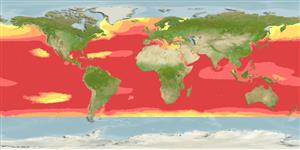
Native range | All suitable habitat | Point map | Year 2050
This map was computer-generated and has not yet been reviewed.
Xiphias gladius   AquaMaps   Data sources: GBIF OBIS
Tải lên của bạn hình ảnh Và Video
Các tranh (Ảnh) | Video | Tem, tiền xu, v.v. | Google image
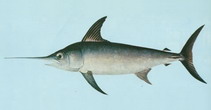
Image of Xiphias gladius (Swordfish)
Xiphias gladius
Hình ảnh của CAFS


Trinidad and Tobago territory information

Common names: [No common name]
Occurrence: native
Salinity: marine
Abundance: | Ref:
Importance: minor commercial | Ref: FAO, 1994
Aquaculture: | Ref:
Regulations: | Ref:
Uses: no uses
Comments: Also Ref. 5217, 33407.
National Checklist:
Territory Information: https://www.cia.gov/library/publications/resources/the-world-factbook/geos/td.html
National Fisheries Authority: http://www.cep.unep.org/trini_tbgo/fisheries/index.htm
Occurrences: Occurrences Point map
Main Ref: Nakamura, I., 1985
National Database:

Common names from other countries

Phân loại / Tên Tên thường gặp | Các synonym ( Các tên trùng) | Catalog of Fishes(Giống, Các loài) | ITIS | CoL | WoRMS | Cloffa

> Carangiformes (Jacks) > Xiphiidae (Swordfish)
Etymology: Xiphias: Greek, xiphos = sword (Ref. 45335).
More on author: Linnaeus.

Môi trường: môi trường / vùng khí hậu / Mức độ sâu / phạm vi phân phối Sinh thái học

biển pelagic-oceanic; Ở đại duơng, biển (Ref. 71039); mức độ sâu 0 - 2878 m (Ref. 116993), usually 0 - 550 m (Ref. 54934). Temperate; 5°C - 27°C (Ref. 43); 69°N - 50°S, 180°W - 180°E (Ref. 54934)

Sự phân bố Lãnh thổ | Các khu vực của FAO | Các hệ sinh thái | Những lần xuất hiện | Bản đồ điểm | Những chỉ dẫn | Faunafri

Atlantic, Indian and Pacific: tropical and temperate and sometimes cold waters, including the Mediterranean Sea, the Sea of Marmara, the Black Sea, and the Sea of Azov. Highly migratory species. Mt DNA restriction analysis reveal that genetic differentiation occurs between populations inhabiting the Mediterranean Sea and the tropical Atlantic ocean, indicating little genetic exchange occurring between the two (Ref. 12784).

Chiều dài lúc trưởng thành đầu tiên / Bộ gần gũi / Khối lượng (Trọng lượng) / Tuổi

Chín muồi sinh dục: Lm 212.0, range 156 - 250 cm
Max length : 455 cm FL con đực/không giới tính; (Ref. 40637); common length : 300 cm TL con đực/không giới tính; (Ref. 9354); Khối lượng cực đại được công bố: 650.0 kg (Ref. 4689)

Mô tả ngắn gọn Khóa để định loại | Hình thái học | Sinh trắc học

Các tia vây lưng cứng (tổng cộng) : 0; Các vây lưng mềm (tổng cộng) : 38 - 56; Tia cứng vây hậu môn: 0; Tia mềm vây hậu môn: 16 - 18. Blackish-brown fading to light-brown below; 1st dorsal fin with blackish-brown membrane, other fins brown or blackish-brown (Ref. 43). A long, flat, sword-like bill and no pelvic fins (Ref. 26938).
Body shape (shape guide): elongated.

Sinh học     Tự điển (thí dụ epibenthic)

Oceanic but sometimes found in coastal waters (Ref. 9354). Generally above the thermocline (Ref. 9354), preferring temperatures of 18°C to 22°C (Ref. 9987). Larvae are frequently encountered at temperatures above 24 °C (Ref. 9702). Migrate toward temperate or cold waters in the summer and back to warm waters in the fall. Adults are opportunistic feeders, known to forage for their food from the surface to the bottom over a wide depth range (Ref. 9702). Feed mainly on fishes (Atlantic mackerel, barracudinas, silver hake, redfish, herring and lanternfishes (Ref. 5951); also on crustaceans and squids (Ref. 9354). They use their sword to kill their prey (Ref. 9354). Large individuals may accumulate large percentages of mercury in its flesh (Ref. 9354). Are batch spawners (Ref. 51846). Spawning takes place in Atlantic during spring in southern Sargasso Sea. Migrate to cooler waters to feed (Ref. 4689). Females grow fastest. Determination of age is difficult since the otoliths are very small and scales are missing in adults. Year rings have been successfully counted on cross sections of the fin rays (Ref. 35388). Pelagic eggs measure 1.6-1.8mm and the newly hatched larvae is 4 mm long. Sword is well developed at a length of 10mm and young live pelagically in the upper water layers where they quickly develop into very voracious predators (Ref. 35388). Mt DNA restriction analysis reveal that genetic differentiation occurs between populations inhabiting the Mediterranean Sea and the tropical Atlantic ocean, indicating little genetic exchange occurring between the two (Ref. 12784). Good food fish, marketed fresh or frozen, and can be made into sashimi, teriyaki or fillets (Ref. 9354).

Vòng đời và hành vi giao phối Chín muồi sinh dục | Sự tái sinh sản | Đẻ trứng | Các trứng | Sự sinh sản | Ấu trùng

In the Atlantic Ocean, spawning occurs in the upper water layer at depths between 0 and 75 m, at temperatures around 23°C, and salinity of 33.8 to 37.4 ppt. The distribution of larval broadbill swordfish in the Pacific Ocean indicates that spawning occurs mainly in waters with a temperature of 24°C or more. Spawning appears to occur in all seasons in equatorial waters, but is restricted to spring and summer at higher latitudes (Ref. 30448). Fertilisation in broadbill swordfish is external and pairing of solitary males and females is thought to occur when spawning (Ref. 9742). Broadbill swordfish are reported to spawn in the upper layers of the water column, from the surface to a depth of 75 m (Ref. 43). Estimates of egg numbers vary considerably, from 1 million to 16 million in 168,000 g female (Ref. 9742) and 29 million in a 272,000 g female (Ref. 30372).

Tài liệu tham khảo chính Tải lên tài liệu tham khảo của bạn | Các tài liệu tham khảo | Người điều phối | Người cộng tác

Nakamura, I., 1985. FAO species catalogue. Vol. 5. Billfishes of the world. An annotated and illustrated catalogue of marlins, sailfishes, spearfishes and swordfishes known to date. FAO Fish. Synop. 125(5):65p. Rome: FAO. (Ref. 43)

Tình trạng Sách đỏ IUCN (Ref. 130435: Version 2025-2 (Global))

  Near Threatened (NT) (A2bd); Date assessed: 01 May 2021

CITES

Not Evaluated

CMS (Ref. 116361)

Not Evaluated

Mối đe dọa đối với con người


Sử dụng của con người

Các nghề cá: tính thương mại; cá để chơi: đúng
FAO - Các nghề cá: hạ cánh, hồ sơ loài; Publication: search | FIRMS - Stock assessments | FishSource | Biển chung quanh ta

Thêm thông tin

Vòng đời
Sự tái sinh sản
Chín muồi sinh dục
Độ trưởng thành/Mang liên quan
Sự sinh sản
Đẻ trứng
Tập hợp sinh sản
Các trứng
Sự phát triển của trứng
Ấu trùng
Sự biến động ấu trùng
Sự phân bố
Lãnh thổ
Các khu vực của FAO
Các hệ sinh thái
Những lần xuất hiện
Những chỉ dẫn
BRUVS - Video
Giải phẫu
Vùng mang
Não
sỏi tai
Sinh lý học
Thành phần cơ thể
Chất dinh dưỡng
Thành phần ô-xy
Kiểu bơi
Tốc độ bơi
Sắc tố thị giác
Tiếng cá
Bệnh tật & Ký sinh trùng
Độc tính (LC50)
Di truyền
Bộ gen
Di truyền
Sự dị hợp tử
Di sản
Liên quan đến con người
Hệ thống nuôi trồng thủy sản
Các tổng quan nuôi trồng thủy sản
Các giống
Các trường hợp ngộ độc Ciguatera
Tem, tiền xu, v.v.
Tiếp cận
Người cộng tác
Các tài liệu tham khảo

Các công cụ

Báo cáo đặc biệt

Tải xuống XML

Các nguồn internet

Ước tính dựa trên mô hình

Nhiệt độ ưa thích (Tài liệu tham khảo 123201): 10.9 - 27.6, mean 22.7 °C (based on 5276 cells).
Chỉ số đa dạng phát sinh loài (Tài liệu tham khảo 82804):  PD50 = 1.5000   [Uniqueness, from 0.5 = low to 2.0 = high].
Bayesian length-weight: a=0.00380 (0.00161 - 0.00900), b=3.15 (2.93 - 3.37), in cm total length, based on LWR estimates for this (Sub)family-body shape (Ref. 93245).
Mức dinh dưỡng (Tài liệu tham khảo 69278):  4.5   ±0.2 se; based on diet studies.
Generation time: 8.9 (6.1 - 13.7) years. Estimated as median ln(3)/K based on 11 growth studies.
Thích nghi nhanh (Tài liệu tham khảo 120179):  Trung bình, thời gian nhân đôi của chủng quần tối thiểu là 1.4 - 4.4 năm (rm=0.076; K=0.23; tm=5-6; tmax=9).
Prior r = 0.46, 95% CL = 0.30 - 0.69, Based on 17 full stock assessments.
Sự dễ bị tổn thương của nghề đánh cá (Ref. 59153):  High to very high vulnerability (72 of 100). 🛈
Sự dễ bị tổn thương của khí hậu (Ref. 125649):  Moderate vulnerability (43 of 100). 🛈
Loại giá (Ref. 80766):   Very high.
Chất dinh dưỡng (Ref. 124155):  Calcium = 9 [4, 16] mg/100g; Iron = 0.278 [0.142, 0.491] mg/100g; Protein = 19.3 [17.0, 22.1] %; Omega3 = 0.333 [0.155, 0.694] g/100g; Selenium = 44.1 [17.4, 121.6] μg/100g; VitaminA = 5.71 [1.63, 20.67] μg/100g; Zinc = 0.443 [0.157, 0.783] mg/100g (wet weight); based on nutrient studies.