Trachinus draco, Greater weever : fisheries, gamefish, aquarium

You can sponsor this page

Trachinus draco Linnaeus, 1758

Greater weever
Adicionar as suas observações no Fish Watcher
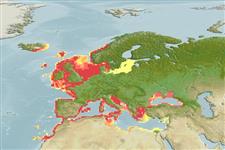
Native range | All suitable habitat | Point map | Year 2050
This map was computer-generated and has not yet been reviewed.
Trachinus draco   AquaMaps   Data sources: GBIF OBIS
Adicionar o seu Fotografias e vídeos
Fotografias | vídeos | Imagem do Google
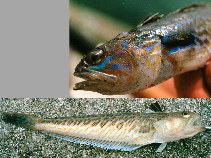
Image of Trachinus draco (Greater weever)
Trachinus draco
Fotografia de Østergaard, T.


United Kingdom country information

Common names: Môr-wiber fawr
Occurrence: native
Salinity: marine
Abundance: | Ref:
Importance: | Ref:
Aquaculture: | Ref:
Regulations: | Ref:
Uses: no uses
Comments:
National Checklist:
Country Information: https://www.cia.gov/library/publications/resources/the-world-factbook/geos/uk.html
National Fisheries Authority:
Occurrences: Occurrences Point map
Main Ref: Tortonese, E., 1986
National Database:

Common names from other countries

Classificação / Names Nomes comuns | Sinónimos | Catalog of Fishes(Género, Espécies) | ITIS | CoL | WoRMS | Cloffa

> Perciformes/Percoidei (Perchs) > Trachinidae (Weeverfishes)
Etymology: Trachinus: Greek, trachys, -eia, -ys = rough (Ref. 45335).
More on author: Linnaeus.

Environment: milieu / climate zone / intervalo de profundidade / distribution range Ecologia

marinhas demersal; intervalo de profundidade 1 - 150 m (Ref. 6790), usually 1 - 30 m (Ref. 35388). Temperate; 66°N - 27°N, 19°W - 42°E

Distribuição Países | Áreas FAO | Ecossistemas | Ocorrências | Mapa dos pontos | Introduções | Faunafri

Eastern Atlantic: Norway to Morocco, Madeira and Canary Islands, including the Mediterranean and the Black Sea (Ref. 6790). Reported from Mauritania (Ref. 55783).

Length at first maturity / Tamanho / Peso / Idade

Maturidade: Lm 12.0  range ? - ? cm
Max length : 53.0 cm TL macho/indeterminado; (Ref. 40637); common length : 25.0 cm SL macho/indeterminado; (Ref. 3397); peso máx. Publicado: 1.9 kg (Ref. 40637)

Descrição breve Chaves de identificação | Morfologia | Morfometria

Body elongate, length more than 6 times height. Greenish in upper parts, yellowish-white oblique stripes. Small 2-3 spines in front of each eye (Ref. 35388).
Body shape (shape guide): elongated.

Biologia     Glossário (ex. epibenthic)

On sandy, muddy or gravelly bottoms, from a few meters to about 150 m. Rest on the bottom, often buried with eyes and tip of first dorsal fin exposed (Ref. 9988). At night they swim around freely, even pelagically (Ref. 35388). Feed on small invertebrates and fishes; chiefly nocturnal. Oviparous, eggs and larval stages pelagic (Ref. 4675). There are dark markings along the scales; the anterior dorsal fin is black and contains venomous spines. Utilized fresh and frozen; can be pan-fried, broiled, boiled and baked (Ref. 9988). Spawning takes place in June and August, pelagic eggs are 1 mm (Ref. 35388). Also Ref. 57406.

Life cycle and mating behavior Maturidade | Reprodução | Desova | Ovos | Fecundidade | Larvas

Oviparous, eggs and larvae are pelagic (Ref. 4675).

Referência principal Upload your references | Referências | Coordenador | Colaboradores

Roux, C., 1990. Trachinidae. p. 893-895. In J.C. Quero, J.C. Hureau, C. Karrer, A. Post and L. Saldanha (eds.) Check-list of the fishes of the eastern tropical Atlantic (CLOFETA). JNICT, Lisbon; SEI, Paris; and UNESCO, Paris. Vol. 2. (Ref. 6790)

Categoria na Lista Vermelha da IUCN (Ref. 130435: Version 2025-1)

  Preocupação menor (LC) ; Date assessed: 14 July 2014

CITES

Not Evaluated

CMS (Ref. 116361)

Not Evaluated

Ameaça para o homem

  Venomous (Ref. 4690)


Utilização humana

Pescarias: pouco comercial; peixe desportivo: sim; Aquário: Aquários públicos
FAO - pescarias: landings; Publication: search | FishSource | Sea Around Us

Mais informação

Ecologia Trófica
Food items (preys)
Composição da dieta
Consumo alimentar
Food rations
Predadores
Ecologia
Ecologia
Home ranges
Life cycle
Reprodução
Maturidade
Maturity/Gills rel.
Fecundidade
Desova
Spawning aggregations
Ovos
Desenvolvimento dos ovos
Larvas
Dinâmica larvar
Distribuição
Países
Áreas FAO
Ecossistemas
Ocorrências
Introduções
BRUVS - Videos
Anatomy
Área branquial
Brain
Otolith
Physiology
Body composition
Nutrients
Consumo de oxigénio
Tipo de natação
Velocidade de natação
Visual pigments
Fish sound
Diseases & Parasites
Toxicity (LC50s)
Genética
genoma
Genética
Heterozygosity
Hereditariedade
Human related
Aquaculture systems
Perfis para aquacultura
Estirpes
Ciguatera cases
Stamps, coins, misc.
Outreach
Colaboradores
Referências
Referências

Ferramentas

Relatórios especiais

Descarregue XML

Fontes da internet

Estimates based on models

Preferred temperature (Ref. 123201): 8.7 - 18.7, mean 10.9 °C (based on 780 cells).
Phylogenetic diversity index (Ref. 82804):  PD50 = 0.5059   [Uniqueness, from 0.5 = low to 2.0 = high].
Bayesian length-weight: a=0.00562 (0.00460 - 0.00688), b=3.04 (2.98 - 3.10), in cm total length, based on LWR estimates for this species (Ref. 93245).
Nível Trófico (Ref. 69278):  3.9   ±0.6 se; based on diet studies.
Resiliência (Ref. 120179):  Médio, tempo mínimo de duplicação da população 1,4 - 4,4 anos (K=0.08-0.5; Assuming tm=2-4).
Fishing Vulnerability (Ref. 59153):  Moderate to high vulnerability (55 of 100). 🛈
Climate Vulnerability (Ref. 125649):  Moderate vulnerability (38 of 100). 🛈
Categoria de preço (Ref. 80766):   Low.
Nutrients (Ref. 124155):  Calcium = 29.9 [20.3, 57.9] mg/100g; Iron = 0.36 [0.23, 0.58] mg/100g; Protein = 18.7 [17.9, 19.4] %; Omega3 = 0.643 [0.399, 1.025] g/100g; Selenium = 13.2 [7.3, 25.9] μg/100g; VitaminA = 23.8 [7.7, 74.1] μg/100g; Zinc = 0.445 [0.328, 0.607] mg/100g (wet weight); based on nutrient studies.