التصنيف / Names
الأسماء الشائعة | مرادفات | Catalog of Fishes(جنس, الانواع) | ITIS | CoL | WoRMS | Cloffa
>
Cichliformes (Cichlids, convict blennies) >
Cichlidae (Cichlids) > Cichlinae
Etymology: Australoheros: From the Latin word 'australis' meaning southern, and the name Heros, after the nominotypic genus of the Heroini tribe.
Tribe; angiru: Name from the Guaraní word 'angirû' meaning friend, partner (amigo or compañero in Spanish); based on the fact that A. angiru and A. kaaygua have been confused as one species, these two are non-sister group species living in the same river drainage (río Iguazú), though not sympatrically.
Environment: milieu / climate zone / نطاق العمق / distribution range
البيئة
; المياه العذبة قاعية التغذية و المعيشة. Tropical
South America: Brazil and Argentina; disjunct distribution in the rio Iguaçu and in the upper rio Uruguai.
الحجم / وزن / العمر
النضج: Lm ? range ? - ? cm
Max length : 7.7 cm SL ذكر/ مختلط الجنس; (Ref. 87600)
وصف مختصر
مفاتيح التعريف | الوصف الخارجي | قياسات المظهر الخارجي
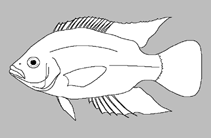
الأشواك الظهرية (المجموع) : 16 - 17; الأشعة الظهرية الناعمة (المجموع) : 8 - 10; شوكة شرجية: 6 - 8; أشعه شرجية لينه: 6 - 8; فقرات: 26 - 27. This species is one of the most deep-bodied species of Australoheros with body depth in SL > 49%, a feature shared with A. guarani and A. facetus. It has been previously associated with A. kaaygua, but it is the sister species of A. minuano based on DNA characters. This species is distinguished from A. kaaygua by having less scale rows between anterior end of dorsal fin and upper lateral line, ch4 states 1-2 (vs. 0), by a very narrow or missing caudal base spot, by a pure yellow ground color (vs. yellowish-green), by yellow eyes (vs. dark green), by more scales between anterior end of dorsal fin and upper lateral line 5 (vs. 4), more anal fin spines 7 (vs. 6), more anal fin rays > 7 (vs. < 7), more dorsal fin rays (9 vs. 8), less E0 scales (24 vs. > 25), more L1 scales > 17-18 (vs. 16), less L2 scales 8 (vs. > 9), by a being more deep-bodied 49.6% SL (vs. 43.8%), and by having a shorter caudal peduncle 7.4% SL (vs. 10.4%). Australoheros angiru is distinguished from A. minuano by a large and dominant midlateral blotch, very narrow or missing caudal base spot, absence of a pinkish body coloration, small mouth terminal or subterminal (vs. large supraterminal), more scales between the anterior end of the dorsal fin and the upper lateral line, 5 (vs. 4), less anal fin rays, 7 (vs. 8), less dorsal fin rays, 9 (vs. 10), by slight differences in body depth 49.6% SL (vs. 46.9%) and in preorbital distance 7.3% SL (vs. 6.0%) (Ref. 87600).
Life cycle and mating behavior
النضج | التكاثر | وضع البيض | بيض | الخصوبة | Larvae
Říčan, O., L. Piálek, A. Almirón and J. Casciotta, 2011. Two new species of Australoheros (Teleostei: Cichlidae), with notes on diversity of the genus and biogeography of the Río de la Plata basin. Zootaxa 2982:1-26. (Ref. 87600)
IUCN Red List Status (Ref. 130435: Version 2025-1)
استخدامات بشرية
أدوات
تقارير خاصة
Download XML
مصادر علي الأنترنت
Estimates based on models
Phylogenetic diversity index (مرجع
82804): PD
50 = 0.5000 [Uniqueness, from 0.5 = low to 2.0 = high].
Bayesian length-weight: a=0.01380 (0.00659 - 0.02894), b=3.07 (2.89 - 3.25), in cm total length, based on LWR estimates for this (Sub)family-body shape (Ref.
93245).
مستوى غذائي (مرجع
69278): 3.2 ±0.5 se; based on size and trophs of closest relatives
Fishing Vulnerability (Ref.
59153): Low vulnerability (10 of 100).
🛈