


Australoheros angiru Říčan, Piálek, Almirón & Casciotta, 2011
Ladda upp din foton och Videor
Google image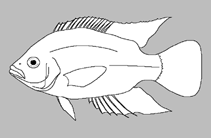 No image available for this species;
drawing shows typical species in Cichlidae.
Google image
drawing shows typical species in Cichlidae.
Klassificering / Namn Populärnamn | synonymer | Catalog of Fishes(Släkte, Arter) | ITIS | CoL | WoRMS | Cloffa
> Cichliformes (Cichlids, convict blennies) > Cichlidae (Cichlids) > Cichlinae
Etymology: Australoheros: From the Latin word 'australis' meaning southern, and the name Heros, after the nominotypic genus of the Heroini tribe. Tribe; angiru: Name from the Guaraní word 'angirû' meaning friend, partner (amigo or compañero in Spanish); based on the fact that A. angiru and A. kaaygua have been confused as one species, these two are non-sister group species living in the same river drainage (río Iguazú), though not sympatrically.
Etymology: Australoheros: From the Latin word 'australis' meaning southern, and the name Heros, after the nominotypic genus of the Heroini tribe. Tribe; angiru: Name from the Guaraní word 'angirû' meaning friend, partner (amigo or compañero in Spanish); based on the fact that A. angiru and A. kaaygua have been confused as one species, these two are non-sister group species living in the same river drainage (río Iguazú), though not sympatrically.
Miljö: miljö / Klimatzon / djupintervall / distributionsområde Ekologi
; sötvatten bentopelagisk. Tropical
Utbredning Territorier | FAO områden | Ekosystem | Förekomster | Prickkarta | Utplanteringar | Faunafri
South America: Brazil and Argentina; disjunct distribution in the rio Iguaçu and in the upper rio Uruguai.
Storlek / Vikt / Ålder
Kort beskrivning Bestämningsnycklar | Morfologi | Morfometri
Taggstrålar i ryggfenan (totalt) : 16 - 17; Mjukstrålar i ryggfenan (totalt) : 8 - 10; Taggstrålar i analfenan: 6 - 8; Mjukstrålar i analfenan: 6 - 8; Ryggkotor: 26 - 27. This species is one of the most deep-bodied species of Australoheros with body depth in SL > 49%, a feature shared with A. guarani and A. facetus. It has been previously associated with A. kaaygua, but it is the sister species of A. minuano based on DNA characters. This species is distinguished from A. kaaygua by having less scale rows between anterior end of dorsal fin and upper lateral line, ch4 states 1-2 (vs. 0), by a very narrow or missing caudal base spot, by a pure yellow ground color (vs. yellowish-green), by yellow eyes (vs. dark green), by more scales between anterior end of dorsal fin and upper lateral line 5 (vs. 4), more anal fin spines 7 (vs. 6), more anal fin rays > 7 (vs. < 7), more dorsal fin rays (9 vs. 8), less E0 scales (24 vs. > 25), more L1 scales > 17-18 (vs. 16), less L2 scales 8 (vs. > 9), by a being more deep-bodied 49.6% SL (vs. 43.8%), and by having a shorter caudal peduncle 7.4% SL (vs. 10.4%). Australoheros angiru is distinguished from A. minuano by a large and dominant midlateral blotch, very narrow or missing caudal base spot, absence of a pinkish body coloration, small mouth terminal or subterminal (vs. large supraterminal), more scales between the anterior end of the dorsal fin and the upper lateral line, 5 (vs. 4), less anal fin rays, 7 (vs. 8), less dorsal fin rays, 9 (vs. 10), by slight differences in body depth 49.6% SL (vs. 46.9%) and in preorbital distance 7.3% SL (vs. 6.0%) (Ref. 87600).
Livscykel och parningsbeteende Könsmognad | Reproduktion | Lek | Ägg | Fekunditet | Larver
Huvudreferens
Ladda upp dina referenser | referenser | Koordinator : Kullander, Sven O. | Medarbetare
Říčan, O., L. Piálek, A. Almirón and J. Casciotta, 2011. Two new species of Australoheros (Teleostei: Cichlidae), with notes on diversity of the genus and biogeography of the Río de la Plata basin. Zootaxa 2982:1-26. (Ref. 87600)
Status på IUCN:s rödlista (Ref. 130435: Version 2025-2 (Global))
Least Concern (LC) ; Date assessed: 04 November 2020
CITES
Not Evaluated
Hot mot människor
Harmless
Mänskliga användningsområden
FAO - Publication: search | FishSource |
Ytterligare information
Trofisk ekologi
Livsmedelsartiklar (preys)
Födosammansättning
Födointag
Matransoner
Predatorer
Livsmedelsartiklar (preys)
Födosammansättning
Födointag
Matransoner
Predatorer
Ekologi
Ekologi
Ekologi
Populationsdynamik
Tillväxtparametrar
Max. åldrar / storlekar
Längd-vikt rel.
Längd-längd rel.
Längd-frekvenser
Massakonvertering
Rekrytering
Abundans
Tillväxtparametrar
Max. åldrar / storlekar
Längd-vikt rel.
Längd-längd rel.
Längd-frekvenser
Massakonvertering
Rekrytering
Abundans
Livscykel
Reproduktion
Könsmognad
Mognad/Gills rel.
Fekunditet
Lek
Lekande aggregat
Ägg
Utveckling av ägg
Larver
Larvdynamik
Reproduktion
Könsmognad
Mognad/Gills rel.
Fekunditet
Lek
Lekande aggregat
Ägg
Utveckling av ägg
Larver
Larvdynamik
Anatomi
Gälyta
Hjärna
Otolit
Gälyta
Hjärna
Otolit
Fysiologi
Kroppssammansättning
Näringsämnen
Syreförbrukning
Typ av simning
Simhastighet
Visuella pigment
Ljud från fisk
Sjukdomar & Parasiter
Toxicitet (LC50)
Kroppssammansättning
Näringsämnen
Syreförbrukning
Typ av simning
Simhastighet
Visuella pigment
Ljud från fisk
Sjukdomar & Parasiter
Toxicitet (LC50)
Genetik
Genom
Genetik
Heterozygositet
Ärftlighet
Genetisk mångfald
Genom
Genetik
Heterozygositet
Ärftlighet
Genetisk mångfald
Människorelaterad
Vattenbrukssystem
Vattenbruksprofiler
Avelslinjer
Ciguatera-fall
Frimärken, mynt, diverse.
Vattenbrukssystem
Vattenbruksprofiler
Avelslinjer
Ciguatera-fall
Frimärken, mynt, diverse.
Verktyg
Särskilda rapporter
Kontrollera för underhåll av akvarium | Kontrollera om det finns faktablad om arter | Kontrollera om det finns faktablad om vattenbruk
Ladda ner XML
Internet-källor
AFORO (otoliths) | Aquatic Commons | BHL | Cloffa | Websites from users | Check FishWatcher | CISTI | Catalog of Fishes: Släkte, Arter | DiscoverLife | ECOTOX | FAO - Publication: search | Faunafri | Fishipedia | Fishtrace | GloBI | Google Books | Google Scholar | Google | IGFA World Record | OneZoom | Open Tree of Life | Otolith Atlas of Taiwan Fishes | PubMed | Reef Life Survey | Socotra Atlas | TreeBase | Tree of Life | Wikipedia: Go, sök | World Records Freshwater Fishing | Zoobank | Zoologiskt register
Uppskattningar baserade på modeller
Index för fylogenetisk mångfald (Ref. 82804): PD50 = 0.5000 [Uniqueness, from 0.5 = low to 2.0 = high].
Bayesian length-weight: a=0.01445 (0.00665 - 0.03141), b=3.08 (2.90 - 3.26), in cm total length, based on LWR estimates for this (Sub)family-body shape (Ref. 93245).
Trofisk nivå (Ref. 69278): 3.2 ±0.5 se; based on size and trophs of closest relatives