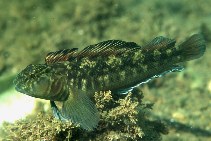
Environment: milieu / climate zone / rango de profundidad / distribution range
Ecología
; salobre demersal; rango de profundidad 0 - 3 m (Ref. 123650). Temperate
Southwest Pacific: throughout New Zealand.
Tamaño / Peso / Age
Madurez: Lm ? range ? - ? cm
Max length : 9.0 cm TL macho / no sexado; (Ref. 13730)
Short description
Claves de identificación | Morfología | Morfometría
Espinas dorsales (total) : 24 - 27; Radios blandos dorsales (total) : 11 - 13; Espinas anales: 2; Radios blandos anales: 24 - 26; Vértebra: 42 - 44. Spines of first dorsal fin high, often as high as second dorsal, with posterior spines longer than anterior. Supraorbital tentacles simple. No sensory papillae on frontal, temporal and upper
part of otic areas. Dorsal fin formula V-0N-0-1-0-1. Ten procurrent rays in upper caudal lobe, 9 in lower lobe; in upper lobe, 1 procurrent ray between upper lobe and posterior epural, 5 opposite epurals, 1 between anterior epural and neural spine of second preural, 2 anterior to neural spine of third preural vertebra; in lower lobe, 8 procurrent rays opposite haemal spine of second preural vertebra, 1 opposite haemal spine of third vertebra.
Body shape (shape guide): elongated.
Facultative air-breathing in the genus (Ref. 126274); Adults occur in estuaries and lower reaches of rivers and streams (Ref. 13227) where
there is cover from rocks and submerged trees (Ref. 84085). Eggs are hemispherical and covered with numerous sticky threads that anchor them in the algae on the nesting sites (Ref. 240). Larvae are planktonic which occur primarily in shallow, nearshore waters (Ref. 94114).
Life cycle and mating behavior
Madurez | Reproducción | Puesta | Huevos | Fecundidad | Larva
Fricke, R., 1994. Tripterygiid fishes of Australia, New Zealand and the southwest Pacific Ocean (Teleostei). Theses Zool. 24:1-585. (Ref. 13227)
IUCN Red List Status (Ref. 130435: Version 2025-1)
Threat to humans
Harmless
Human uses
Herramientas
Special reports
Download XML
Fuentes de Internet
Estimates based on models
Phylogenetic diversity index (Referencia
82804): PD
50 = 0.5039 [Uniqueness, from 0.5 = low to 2.0 = high].
Bayesian length-weight: a=0.00617 (0.00288 - 0.01322), b=3.04 (2.86 - 3.22), in cm total length, based on LWR estimates for this (Sub)family-body shape (Ref.
93245).
Nivel trófico (Referencia
69278): 3.3 ±0.4 se; based on size and trophs of closest relatives
Resiliencia (Referencia
120179): Alto, población duplicada en un tiempo mínimo inferior a 15 meses (Preliminary K or Fecundity.).
Fishing Vulnerability (Ref.
59153): Low vulnerability (10 of 100).
🛈