


Ladda upp din foton och Videor
Google image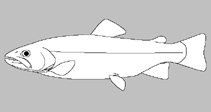 No image available for this species;
drawing shows typical species in Salmonidae.
Google image
drawing shows typical species in Salmonidae.
Klassificering / Namn Populärnamn | synonymer | Catalog of Fishes(Släkte, Arter) | ITIS | CoL | WoRMS | Cloffa
> Salmoniformes (Salmons) > Salmonidae (Salmonids) > Coregoninae
Etymology: Coregonus: Greek, kore = pupils of the eye + Greek, gonia = angle (Ref. 45335).
Eponymy: Edward William Nelson (1855–1934) was an outstanding American naturalist. [...] (Ref. 128868), visit book page.
More on author: Bean.
Etymology: Coregonus: Greek, kore = pupils of the eye + Greek, gonia = angle (Ref. 45335).
Eponymy: Edward William Nelson (1855–1934) was an outstanding American naturalist. [...] (Ref. 128868), visit book page.
More on author: Bean.
Miljö: miljö / Klimatzon / djupintervall / distributionsområde Ekologi
; sötvatten bentopelagisk; flodvandrande (Ref. 27547). Boreal; 68°N - 59°N
Utbredning Territorier | FAO områden | Ekosystem | Förekomster | Prickkarta | Utplanteringar | Faunafri
North America: Probably restricted to northern Northwest Territories, Yukon Territory in Canada and Alaska in Yukon River, Paxson Lake, Copper River system, Anderson River and Mackenzie River delta. Hybridizes with Stenodus leucichthys, probably a result of simultaneous broadcasting of reproductive products in the same area; occasionally hybridizes with Coregonus sardinella (Ref. 27547). Belongs to the Coregonus clupeaformis complex (Ref. 27547).
Storlek / Vikt / Ålder
Kort beskrivning Bestämningsnycklar | Morfologi | Morfometri
Taggstrålar i ryggfenan (totalt) : 0; Mjukstrålar i ryggfenan (totalt) : 11 - 13; Taggstrålar i analfenan: 0; Mjukstrålar i analfenan: 10 - 14; Ryggkotor: 60 - 63. Distinguished by the gill rakers that are longer than 20% of the interorbital width, a total of 22 to 27 gill rakers on the first arch (with modal counts of 24 or 25), and a pronounced hump behind the head in adults (Ref. 27547). Adipose fin well developed, often larger in males; axillary process present in pelvic fins (Ref. 27547). Dark brown to midnight blue above fading to silver on sides and wide beneath; no parr marks in young (Ref. 27547).
Body shape (shape guide): fusiform / normal.
Body shape (shape guide): fusiform / normal.
Occurs in small to large rivers (Ref. 5723). Rarely enters lakes (Ref. 5723). Makes fairly extensive upstream and downstream movements related to spawning runs (Ref. 27547). Feeds mainly on immature insects (Ref. 27547). Usually does not feed during the latter part of the spawning run (Ref. 27547). Excellent food fish but usually not eaten (Ref. 27547).
Livscykel och parningsbeteende Könsmognad | Reproduktion | Lek | Ägg | Fekunditet | Larver
The spawning run involves an upward migration beginnning as early as late June. The spawning act occurs at night or during the day. A female begins to swim vertically toward the surface, belly upstream. A male (sometimes 2 or 3) joins her and eggs and milt are released as fish approach the surface. The fish break the surface, fall away from each other and return to the bottom. After spawning most move downstream. The young of the year move downstream during their first year and do not return until they are sexually mature. Generally, the same spawning grounds are utilized yearly (Ref. 27547).
Huvudreferens
Ladda upp dina referenser | referenser | Koordinator | Medarbetare
Page, L.M. and B.M. Burr, 1991. A field guide to freshwater fishes of North America north of Mexico. Houghton Mifflin Company, Boston. 432 p. (Ref. 5723)
CITES
Not Evaluated
Hot mot människor
Harmless
Mänskliga användningsområden
Fiskeri: husbehovsfiske; sportfisk: ja
FAO - Publication: search | FishSource |
Ytterligare information
Populationsdynamik
Tillväxtparametrar
Max. åldrar / storlekar
Längd-vikt rel.
Längd-längd rel.
Längd-frekvenser
Massakonvertering
Rekrytering
Abundans
Tillväxtparametrar
Max. åldrar / storlekar
Längd-vikt rel.
Längd-längd rel.
Längd-frekvenser
Massakonvertering
Rekrytering
Abundans
Livscykel
Reproduktion
Könsmognad
Mognad/Gills rel.
Fekunditet
Lek
Lekande aggregat
Ägg
Utveckling av ägg
Larver
Larvdynamik
Reproduktion
Könsmognad
Mognad/Gills rel.
Fekunditet
Lek
Lekande aggregat
Ägg
Utveckling av ägg
Larver
Larvdynamik
Anatomi
Gälyta
Hjärna
Otolit
Gälyta
Hjärna
Otolit
Fysiologi
Kroppssammansättning
Näringsämnen
Syreförbrukning
Typ av simning
Simhastighet
Visuella pigment
Ljud från fisk
Sjukdomar & Parasiter
Toxicitet (LC50)
Kroppssammansättning
Näringsämnen
Syreförbrukning
Typ av simning
Simhastighet
Visuella pigment
Ljud från fisk
Sjukdomar & Parasiter
Toxicitet (LC50)
Genetik
Genom
Genetik
Heterozygositet
Ärftlighet
Genetisk mångfald
Genom
Genetik
Heterozygositet
Ärftlighet
Genetisk mångfald
Människorelaterad
Vattenbrukssystem
Vattenbruksprofiler
Avelslinjer
Ciguatera-fall
Frimärken, mynt, diverse.
Vattenbrukssystem
Vattenbruksprofiler
Avelslinjer
Ciguatera-fall
Frimärken, mynt, diverse.
Verktyg
Särskilda rapporter
Kontrollera för underhåll av akvarium | Kontrollera om det finns faktablad om arter | Kontrollera om det finns faktablad om vattenbruk
Ladda ner XML
Internet-källor
AFORO (otoliths) | Aquatic Commons | BHL | Cloffa | Websites from users | Check FishWatcher | CISTI | Catalog of Fishes: Släkte, Arter | DiscoverLife | ECOTOX | FAO - Publication: search | Faunafri | Fishipedia | Fishtrace | GloBI | Google Books | Google Scholar | Google | IGFA World Record | OneZoom | Open Tree of Life | Otolith Atlas of Taiwan Fishes | PubMed | Reef Life Survey | Socotra Atlas | TreeBase | Tree of Life | Wikipedia: Go, sök | World Records Freshwater Fishing | Zoobank | Zoologiskt register
Uppskattningar baserade på modeller
Index för fylogenetisk mångfald (Ref. 82804): PD50 = 0.5000 [Uniqueness, from 0.5 = low to 2.0 = high].
Bayesian length-weight: a=0.00537 (0.00266 - 0.01086), b=3.22 (3.06 - 3.38), in cm total length, based on LWR estimates for this Genus-body shape (Ref. 93245).
Trofisk nivå (Ref. 69278): 3.5 ±0.43 se; based on food items.
Resiliens (Ref. 120179): Mellan, lägsta populationsfördubblingstid 1,4-4,4 år (tm=3-5).