>
Carangaria/misc (Various families in series Carangaria) >
Centropomidae (Snooks)
Etymology: Centropomus: Greek, kentron = sting + Greek, poma, -atos = cover, operculum (Ref. 45335).
More on author: Poey.
Environment: milieu / climate zone / profondeur / distribution range
Écologie
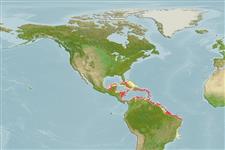
marin; eau douce; saumâtre benthopélagique; amphidrome (Ref. 51243); profondeur ? - 22 m (Ref. 26912). Subtropical; 25°N - 23°S, 98°W - 34°W
Western Atlantic: southern Florida (USA), Greater and Lesser Antilles, and continental Caribbean coasts of Central and South America southward extending to Rio de Janeiro, Brazil.
Taille / Poids / Âge
Maturité: Lm ? range ? - ? cm
Max length : 36.2 cm TL mâle / non sexé; (Ref. 40637); common length : 25.0 cm TL mâle / non sexé; (Ref. 5217); poids max. publié: 1.0 kg (Ref. 5217)
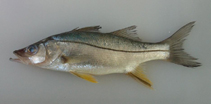
Épines dorsales (Total) : 8 - 9; Rayons mous dorsaux (Total) : 10; Épines anales: 1 - 3; Rayons mous anaux: 6. 2nd spine of anal fin greatly enlarged; body yellowish brown dorsally, silver laterally and ventrally; lateral line dusky; pectoral and pelvic fins yellow, other fins dusky (Ref. 13608).
Body shape (shape guide): fusiform / normal.
Inhabits coastal waters, estuaries and lagoons, penetrating into freshwater; usually prefers very low brackish water or freshwater. Found over soft bottoms (Ref. 5217). Feeds on small fishes (Engraulidae, Clupeidae, etc.) and crustaceans (mainly shrimps) (Ref. 35237).
Juveniles in mangrove areas and irrigation canals.
Fraser, T.H., 1978. Centropomidae. In W. Fischer (ed.) FAO species identification sheets for fishery purposes. West Atlantic (Fishing Area 31). FAO, Rome. Vol. 1-2. pag.var. (Ref. 3713)
Statut dans la liste rouge de l'IUCN (Ref. 130435: Version 2025-1)
Menace pour l'homme
Harmless
Utilisations par l'homme
Pêcheries: intérêt commercial mineur; pêche sportive: oui
Outils
Articles particuliers
Télécharger en XML
Sources Internet
Estimates based on models
Preferred temperature (Réf.
123201): 26.8 - 28.3, mean 27.5 °C (based on 517 cells).
Phylogenetic diversity index (Réf.
82804): PD
50 = 0.5002 [Uniqueness, from 0.5 = low to 2.0 = high].
Bayesian length-weight: a=0.00724 (0.00431 - 0.01217), b=3.09 (2.94 - 3.24), in cm total length, based on LWR estimates for this species & Genus-body shape (Ref.
93245).
Niveau trophique (Réf.
69278): 4.2 ±0.62 se; based on food items.
Résilience (Réf.
120179): Milieu, temps minimum de doublement de population : 1,4 à 4,4 années (tm=3-4; Fec=80,000).
Fishing Vulnerability (Ref.
59153): Low to moderate vulnerability (26 of 100).
🛈
Nutrients (Ref.
124155): Calcium = 58.7 [33.6, 120.4] mg/100g; Iron = 0.742 [0.452, 1.292] mg/100g; Protein = 19.3 [17.0, 21.5] %; Omega3 = 0.39 [0.18, 0.89] g/100g; Selenium = 17.8 [9.1, 32.5] μg/100g; VitaminA = 26.9 [9.7, 79.2] μg/100g; Zinc = 0.949 [0.660, 1.368] mg/100g (wet weight);