


Lythrichthys longimanus (Alcock, 1894)
Red deepwater scorpionfish
Hochladen Photos und videos
Bilder | Google Bild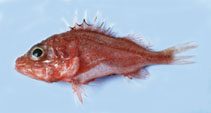 Lythrichthys longimanus
Photo von Gloerfelt-Tarp, T.
Bilder | Google Bild
Photo von Gloerfelt-Tarp, T.
Klassifizierung / Names Namen | Synonyme | Catalog of Fishes(Gattung, Arten) | ITIS | CoL | WoRMS | Cloffa
> Perciformes/Scorpaenoidei (Scorpionfishes) > Setarchidae (Deep-sea bristly scorpionfishes)
More on author: Alcock.
More on author: Alcock.
Umwelt: Milieu / Klimazone / Tiefenbereich / Verbreitungsgebiet Ökologie
seewasser bathydemersal; tiefenbereich 180 - 704 m (Ref. 11015). Deep-water
Verbreitung Territorien | FAO Gebiete | Ökosysteme | Vorkommen | Punkt Karte | Einführungen | Faunafri
Indo-West Pacific: Andaman Sea to Fiji; north to Japan; south to New Caledonia.
Größe / Gewicht / Alter
Geschlechtsreife: Lm ? range ? - ? cm
Max length : 18.0 cm SL Männchen/unbestimmt; (Ref. 559); max. veröff. Gewicht: 58.00 g (Ref. 132231)
Max length : 18.0 cm SL Männchen/unbestimmt; (Ref. 559); max. veröff. Gewicht: 58.00 g (Ref. 132231)
Kurzbeschreibung Bestimmungsschlüssel | Morphologie | Morphometrie
Rückenflossenstacheln (insgesamt) : 11 - 13; Rückenflossenweichstrahlen (insgesamt) : 9 - 11; Afterflossenstacheln: 3; Afterflossenweichstrahlen: 4 - 6. This species is distinguished by the following set of characters: scale rows between 6th dorsal-fn spine and lateral line 8-10 (usually 9); scale rows between last dorsal-fn spine and lateral line 10-13 (11); middle postorbital scale rows 3-4 (3); caudal-peduncle depth 8.2-9.6% (moderately 9.9%) of SL; interorbital width at vertical midline of eye 19.8-24.2% (22.3%) of HL, maxillary depth 14.3-16.9% (15.6%), and lower opercular spine length 28.0-33.6% (31.3%); dorsal margin of interorbital space is somewhat fattened; with nasal and parietal spines; supraocular spine is rudimentary; second lacrimal spine directed posteroventrally; tip of the lower opercular spine just short of or reaching to posterior margin of opercle (sometimes beyond margin in specimens from ca. 15.0 cm SL); jaws with short, dense conical teeth; premaxillary teeth in 3-6 irregular rows, totaling ca. 200 teeth. Colouration: head and body base color scarlet to dull red, with numerous small smudge-like or blurred black blotches above the lateral line when fresh; black distal margin on caudal fin in specimens from ca. > 10.0 cm SL; oral surface uniformly dull- to coal black in preserved specimens (uniformly pale, sometimes a few smudges on specimens up to ca. 10.0 cm SL) (Ref. 123746).
Body shape (shape guide): fusiform / normal; Cross section: compressed.
Body shape (shape guide): fusiform / normal; Cross section: compressed.
Found on the continental shelf and continental slope. Benthic (Ref. 75154). The dorsal spine contains poison glands which can inflict painful wounds (Ref. 11015).
Lebenszyklus und Paarungsverhalten Geschlechtsreife | Fortpflanzung | Ablaichen | Eier | Fruchtbarkeit | Larven
Hauptreferenz
Laden Sie Ihre Referenzen hoch | Referenzen | Koordinator | Partner
Wada, H., Y. Kai and H. Motomura, 2021. Revision of the resurrected deep-water scorpionfish genus Lythrichthys Jordan and Starks 1904 (Setarchidae), with description of two new species. Ichthyol. Res. 68(3):373-403. (Ref. 123746)
CITES
Not Evaluated
Bedrohung für Menschen
Venomous
Nutzung durch Menschen
Fischereien: bycatch
FAO - Publication: search | FishSource |
Mehr Information
Trophische Ökologie
Lebensmittel (Beutetiere)
Nahrungszusammensetzung
Nahrungsaufnahme
Lebensmittelrationen
Räuber
Lebensmittel (Beutetiere)
Nahrungszusammensetzung
Nahrungsaufnahme
Lebensmittelrationen
Räuber
Ökologie
Ökologie
Ökologie
Populationsdynamik
Wachstumsparameter
Max. Alter/Größen
Länge-Gewicht-Rel.
Länge-Länge-Verhältnis.
Längenhäufigkeiten
Massenkonvertierung
Rekrutierung
Dichte
Wachstumsparameter
Max. Alter/Größen
Länge-Gewicht-Rel.
Länge-Länge-Verhältnis.
Längenhäufigkeiten
Massenkonvertierung
Rekrutierung
Dichte
Lebenszyklus
Fortpflanzung
Geschlechtsreife
Reifung/Kiemen rel.
Fruchtbarkeit
Ablaichen
Laichaggregationen
Eier
Eientwicklung
Larven
Larven Pop.Dyn.
Fortpflanzung
Geschlechtsreife
Reifung/Kiemen rel.
Fruchtbarkeit
Ablaichen
Laichaggregationen
Eier
Eientwicklung
Larven
Larven Pop.Dyn.
Physiologie
Körperliche Zusammensetzung
Nährstoffe
Sauerstoffverbrauch
Schwimmart
Schwimmgeschwindigkeit
Visuelle Pigmente
Fischgeräusche
Krankheiten und Parasiten
Toxizität (LC50s)
Körperliche Zusammensetzung
Nährstoffe
Sauerstoffverbrauch
Schwimmart
Schwimmgeschwindigkeit
Visuelle Pigmente
Fischgeräusche
Krankheiten und Parasiten
Toxizität (LC50s)
Genetik
Genom
Genetik
Heterozygotie
Vererbbarkeit
Genetische Vielfalt
Genom
Genetik
Heterozygotie
Vererbbarkeit
Genetische Vielfalt
Menschenbezogen
Aquakultur-Systeme
Aquakultur Profile
Zuchtlinien
Ciguatera-Fälle
Briefmarken, Münzen, Verschiedenes.
Aquakultur-Systeme
Aquakultur Profile
Zuchtlinien
Ciguatera-Fälle
Briefmarken, Münzen, Verschiedenes.
Tools
E-Book | Feldführer | Bestimmungsschlüssel | Längenhäufigkeits Tool | Lebensdaten Tool | Punkt Karte |
Catch-MSY |
Zusatzinformationen
Download XML
Zusammenfassung | Punktdaten | Namen | Photos
Internet Quellen
AFORO (otoliths) | Aquatic Commons | BHL | Cloffa | Websites from users | FishWatcher Einträge suchen | CISTI | Catalog of Fishes: Gattung, Arten | DiscoverLife | ECOTOX | FAO - Publication: search | Faunafri | Fishipedia | Fishtrace | GloBI | Google Books | Google Scholar | Google | IGFA World Record | Nationale Datenbanken | OneZoom | Open Tree of Life | Otolith Atlas of Taiwan Fishes | PubMed | Reef Life Survey | Socotra Atlas | TreeBase | Tree of Life | Wikipedia: Gehe zu, Suchen | World Records Freshwater Fishing | Zoologischer Rekord
Schätzungen auf der Grundlage von Modellen
Bevorzugte Temperatur (Ref. 123201): 8.8 - 17.2, mean 11.8 °C (based on 290 cells).
Phylogenetischer Diversitätsindex (Ref. 82804): PD50 = 0.5317 [Uniqueness, from 0.5 = low to 2.0 = high].
Bayesian length-weight: a=0.00912 (0.00439 - 0.01895), b=3.15 (2.96 - 3.34), in cm total length, based on LWR estimates for this species & (Sub)family-body (Ref. 93245).
Trophische Ebene (Ref. 69278): 3.3 ±0.4 se; based on size and trophs of closest relatives