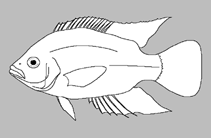
Environnement : milieu / zone climatique / profondeur / gamme de distribution
Écologie
; eau douce benthopélagique. Tropical
Africa: endemic to Lake Bermin, Cameroon (Ref. 52307, 81260).
Taille / Poids / Âge
Maturité: Lm ? range ? - ? cm
Max length : 13.2 cm SL mâle / non sexé; (Ref. 12251)
Épines dorsales (Total) : 15; Rayons mous dorsaux (Total) : 10 - 12; Épines anales: 3; Rayons mous anaux: 7 - 8. Diagnosis: lower pharyngeal jaw slender and gracile, with a reduced dentigerous plate; gill filaments of first arch long (ca. 20% HL); 10-12 gill rakers on first arch; anterior rakers markedly reduced in size (Ref. 81260).
Prefers a herbivorous diet, especially phytoplankton which might be taken from the water column and not from the substrate; primarily found near the lake shore, forming stable pairs and preferring to spawn on sunken wood or on stones (Ref. 52307). Substrate brooder (Ref. 81260). Both parents guard their brood (Ref. 52307).
Cycle de vie et comportement reproducteur
Maturité | Reproduction | Frai | Œufs | Fécondité | Larves
Dunz, A.R. and U.K. Schliewen, 2013. Molecular phylogeny and revised classification of the haplotilapiine cichlid fishes formerly referred to as "Tilapia". Mol. Phylogenet. Evol. 68(1):64-80. (Ref. 93285)
Statut dans la liste rouge de l'IUCN (Ref. 130435: Version 2025-2)
Menace pour l'homme
Harmless
Utilisations par l'homme
Outils
Articles particuliers
Télécharger en XML
Sources Internet
Estimations basées sur des modèles
Indice de diversité phylogénétique (Réf.
82804): PD
50 = 0.5000 [Uniqueness, from 0.5 = low to 2.0 = high].
Bayesian length-weight: a=0.01862 (0.00830 - 0.04177), b=3.01 (2.82 - 3.20), in cm total length, based on LWR estimates for this (Sub)family-body shape (Ref.
93245).
Niveau trophique (Réf.
69278): 2.6 ±0.1 se; based on size and trophs of closest relatives
Résilience (Réf.
120179): Haut, temps minimum de doublement de population inférieur à 15 mois (Preliminary K or Fecundity.).
Vulnérabilité de la pêche (Ref.
59153): Low vulnerability (10 of 100).
🛈