>
Osteoglossiformes (Bony tongues) >
Mormyridae (Elephantfishes)
Etymology: Paramormyrops: Greek, para = near + Greek, mormyros = a fish (Sparus sp) (Ref. 45335).
More on authors: Taverne, Thys, van & denAudenaerdeHeymerGéry.
Environment: milieu / climate zone / rango de profundidad / distribution range
Ecología
; agua dulce bentopelágico. Tropical
Africa: Ogowe River and Ivindo River in Gabon (Ref. 81635).
Tamaño / Peso / Age
Madurez: Lm ? range ? - ? cm
Max length : 23.8 cm SL macho / no sexado; (Ref. 81635)
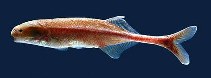
Espinas dorsales (total) : 0; Radios blandos dorsales (total) : 19 - 21; Espinas anales: 0; Radios blandos anales: 24 - 27. A slender and elongate body (Ref. 81635). Head gently rounded, sloping downward; snout is V-shaped from above (Ref. 81635). Fleshy submental swelling present (Ref. 81635). Origin of anal fin slightly in advance of dorsal fin (Ref. 81635). Body colour is light brown to yellow above, yellowish gold below; small dark brown spots irregular over the body surface (Ref. 81635).
Body shape (shape guide): fusiform / normal.
Its preferred environment is large rivers, where it inhabits shallow regions with rapids (Ref. 81635).
Life cycle and mating behavior
Madurez | Reproducción | Puesta | Huevos | Fecundidad | Larva
Hopkins, C.D., S. Lavoué and J.P. Sullivan, 2007. Mormyridae. p. 219-334. In M.L.J. Stiassny, G.G. Teugels and C.D. Hopkins (eds.) The fresh and brackish water fishes of Lower Guinea, West-Central Africa. Volume I. Collection Faune et Flore tropicales 42. Institut de Recherche pour le Développement, Paris, France, Muséum National d’Histoire Naturelle, Paris, France, and Musée Royal de l’Afrique Centrale, Tervuren, Belgium. 800 pp. (Ref. 81635)
IUCN Red List Status (Ref. 130435: Version 2025-1)
Threat to humans
Harmless
Human uses
Herramientas
Special reports
Download XML
Fuentes de Internet
Estimates based on models
Phylogenetic diversity index (Referencia
82804): PD
50 = 0.5010 [Uniqueness, from 0.5 = low to 2.0 = high].
Bayesian length-weight: a=0.01288 (0.00598 - 0.02775), b=2.86 (2.68 - 3.04), in cm total length, based on LWR estimates for this (Sub)family-body shape (Ref.
93245).
Nivel trófico (Referencia
69278): 3.2 ±0.3 se; based on size and trophs of closest relatives
Resiliencia (Referencia
120179): Medio, población duplicada en un tiempo mínimo de 1.4-4.4 años (Assuming Fec < 5,000).
Fishing Vulnerability (Ref.
59153): Low vulnerability (19 of 100).
🛈