>
Osteoglossiformes (Bony tongues) >
Mormyridae (Elephantfishes)
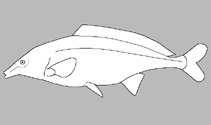
Etymology: Paramormyrops: Greek, para = near + Greek, mormyros = a fish (Sparus sp) (Ref. 45335); sphekodes: The name sphekodes comes from the Greek, σφήκα, for wasp, which may refer to the fish's elongate and slender body (Ref. 116799).
More on author: Sauvage.
Environment: milieu / Klimaatzone / Diepte / distribution range
Ecologie
; zoet water benthopelagisch. Tropical
Africa: Ogowe River and other coastal river basins in Cameroon, Gabon and Republic of Congo (Ref. 81635). Possibly a narrowly distributed species, endemic to a relatively small part of the upper Ogowe River basin (Ref. 116799). Reports from the Congo River basin (Ref. 1878, 3203, 51193, 88779, 120641) unconfirmed in other sources (Ref. 81635, 116799).
Grootte / Gewicht / Leeftijd
Maturiteit: Lm ? range ? - ? cm
Max length : 11.4 cm SL mannelijk / geslacht onbekend; (Ref. 81635)
Dorsale stekels (totaal) : 0; Dorsale zachte stralen (totaal) : 20 - 23; Anale stekels: 0; Anale zachte stralen: 24 - 28; Wervels: 43 - 45. Diagnosis: Paramormyrops sphekodes is distinguished from all other Paramormyrops by this combination of characters: 5 teeth in upper jaw, 6 in lower; 12 circumpeduncular scales; sharp head profile, V-shaped when viewed from above; snout angle 48-56° corresponding to an interorbital width 1-1.36 times the snout length; body depth 15.4-17.31% of standard length, body depth at pectoral fin 84-94% of body depth at urogenital pore; eye diameter 13-16% of head length measured from snout tip to posterior edge of bony operculum; snout length 24-27% of head length; ration of head length to depth 1.1-1.24; head length 21-23% of standard length; EOD waveform with two phases, head-positive then negative, EOD duration 1.635 ± 0.226 ms with a corresponding power spectrum peak at 1573 ± 531 Hz; electric organ composed of type NPp electrocytes, that is having Non-Penetrating stalks innervated on the posterior face of the cell (Ref. 116799). With five teeth in the upper jaw and six in the lower, P. sphekodes differs from P. hopkinsi, P. jacksoni and P. tavernei, which have seven or more teeth in the upper jaw and eight or more in the lower jaw; with 12 circumpeduncular scales, it differs from P. longicaudatus, P. batesii and P. tavernei, which all have 16 or more; with its relatively sharp V-shaped head profile, it differs from P. batesii, P. gabonensis, P. retrodorsalis, P. tavernei and P. kingsleyae which have distinctly blunt or U-shaped snouts; Paramormyrops sphekodes has type NPp electrocytes in its electric organ, as do seven other Paramormyrops from Lower Guinea, while P. batesii and P. kingsleyae have electric organs composed of electrocytes with penetrating stalks innervated on the anterior face (Ref. 116799). Paramormyrops sphekodes differs from P. curvifrons in head and snout shape; head and snout are shorter, deeper and more rounded when viewed laterally in P. sphekodes compared to P. curvifrons; Paramormyrops curvifrons also has a downward sloping forehead, protruding snout and enlarged chin; the ratio head length to standard length is 23.5-26.9 in P. curvifrons, higher than 21.5-23.4 in P. sphekodes, while the ratio of head depth to head length is reduced in P. curvifrons compared to P. sphekodes; the ratio of pre-pectoral distance to pre-dorsal distance is greater in P. curvifrons compared to P. sphekodes, and P. curvifrons has a significantly narrower snout than P. sphekodes measured by either snout angle or ratio interorbital width to snout length (Ref. 116799).
Body shape (shape guide): fusiform / normal.
Found in large river habitats with rocky bottoms, sandy substrate, with rushing water and rapids (Ref. 116799).
Levenscyclus en paargedrag
Maturiteit | Voortplanting | Paaien | Eieren | Fecunditeit | Larven
Hopkins, C.D., S. Lavoué and J.P. Sullivan, 2007. Mormyridae. p. 219-334. In M.L.J. Stiassny, G.G. Teugels and C.D. Hopkins (eds.) The fresh and brackish water fishes of Lower Guinea, West-Central Africa. Volume I. Collection Faune et Flore tropicales 42. Institut de Recherche pour le Développement, Paris, France, Muséum National d’Histoire Naturelle, Paris, France, and Musée Royal de l’Afrique Centrale, Tervuren, Belgium. 800 pp. (Ref. 81635)
Status op de Rode Lijst van het IUCN (Ref. 130435: Version 2025-1)
Gevaar voor de mens
Harmless
Gebruik door de mens
Tools
Speciale rapporten
Download XML
Internetbronnen
Estimates based on models
Fylogenetische diversiteitsindex (Ref.
82804): PD
50 = 0.5010 [Uniqueness, from 0.5 = low to 2.0 = high].
Bayesian length-weight: a=0.01288 (0.00598 - 0.02775), b=2.86 (2.68 - 3.04), in cm total length, based on LWR estimates for this (Sub)family-body shape (Ref.
93245).
Trofisch niveau (Ref.
69278): 3.1 ±0.3 se; based on size and trophs of closest relatives
Weerstandsvermogen (Ref.
120179): Gemiddeld, minimale populatieverdubbelingstijd 1,4-4,4 jaar (Assuming Fec < 5,000).
Fishing Vulnerability (Ref.
59153): Low vulnerability (10 of 100).
🛈