>
Gobiiformes (Gobies) >
Gobiidae (Gobies) > Gobiinae
Etymology: Gladiogobius: Latin, gladius = sword + Latin, gobius = gudgeon (Ref. 45335).
More on author: Herre.
Environment: milieu / Klimaatzone / Diepte / distribution range
Ecologie
marien; brak water rifbewoner; diepte 0 - 3 m (Ref. 90102). Tropical; 30°N - 9°S
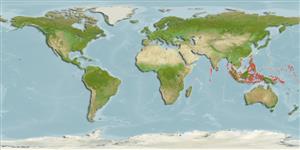
Indo-Pacific: Red Sea to western New Guinea, north to the Yaeyamas in the southern Ryukyus; Palau in Micronesia.
Grootte / Gewicht / Leeftijd
Maturiteit: Lm ? range ? - ? cm
Max length : 7.5 cm SL mannelijk / geslacht onbekend; (Ref. 48637)
Korte beschrijving
Determinatiesleutels | Morfologie | Morfometrie
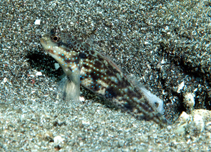
Dorsale stekels (totaal) : 7; Dorsale zachte stralen (totaal) : 10; Anale stekels: 1; Anale zachte stralen: 10. Large spine at lower posterior edge of preoperculum; characterized further by pale grey body color with narrow brown stripes and longitudinal rows of small white dots on side of body; lower side of body with row of five large rectangular brown blotches; irregular brown saddles along back; large grey spot above base of pectoral fin; elongate and filamentous fourth dorsal spine; rounded caudal fin; longitudinal scale series 23-25; head and nape without scales; ctenoid body scales except cycloid on abdomen, base of pectoral fin and prepelvic region; median predorsal scales absent; opening of gill not reaching to above edge of preopercle; moderately long cheek spine, 21-27% head length, not reaching posterior margin of opercular membrane; depth of body 4.8-5.4 in SL (Ref. 90102).
Body shape (shape guide): fusiform / normal.
Inhabits tide pools of sandy intertidal areas of lagoons, bays, and river mouths. Also lives in sheltered sandy bays and estuaries among rubble and in lagoons along edges of coral patches. Usually found in small loose groups (Ref. 48637).
Levenscyclus en paargedrag
Maturiteit | Voortplanting | Paaien | Eieren | Fecunditeit | Larven
Myers, R.F., 1991. Micronesian reef fishes. Second Ed. Coral Graphics, Barrigada, Guam. 298 p. (Ref. 1602)
Status op de Rode Lijst van het IUCN (Ref. 130435: Version 2025-1)
Gevaar voor de mens
Harmless
Gebruik door de mens
Visserij: van geen belang
Tools
Speciale rapporten
Download XML
Internetbronnen
Estimates based on models
Preferred temperature (Ref.
123201): 28 - 29.4, mean 28.8 °C (based on 1165 cells).
Fylogenetische diversiteitsindex (Ref.
82804): PD
50 = 0.6250 [Uniqueness, from 0.5 = low to 2.0 = high].
Bayesian length-weight: a=0.01023 (0.00477 - 0.02194), b=3.01 (2.83 - 3.19), in cm total length, based on LWR estimates for this (Sub)family-body shape (Ref.
93245).
Trofisch niveau (Ref.
69278): 3.3 ±0.4 se; based on size and trophs of closest relatives
Weerstandsvermogen (Ref.
120179): Hoog, minimale populatieverdubbelingstijd minder dan 15 maanden (Preliminary K or Fecundity.).
Fishing Vulnerability (Ref.
59153): Low vulnerability (10 of 100).
🛈