>
Characiformes (Characins) >
Distichodontidae (Distichodus)
Etymology: Distichodus: Greek, di = two + Greek, stix, stichos = line, row (Ref. 45335); langi: Named in honour of the collector, Herbert Lang (Ref. 41594), who collected fish in the Congo basin from 1909 to 1915 for the AMNH, in collaboration with James Chapin (Ref. 96324).
Eponymy: Herbert Otto Henry Lang (1879–1957) was born in Germany and trained as a taxidermist. [...] (Ref. 128868), visit book page.
More on authors: Nichols & Griscom.
Environment: milieu / climate zone / intervalo de profundidade / distribution range
Ecologia
; Água doce pelágico(a,os,as). Tropical
Africa: Uele River in Democratic Republic of the Congo (Ref. 41594, 96324). Also reported from Aruwimi River (Ref. 96324), but this is unconfirmed (Ref. 106290).
Tamanho / Peso / Idade
Maturidade: Lm ? range ? - ? cm
Max length : 36.4 cm SL macho/indeterminado; (Ref. 96324)
Descrição breve
Chaves de identificação | Morfologia | Morfometria
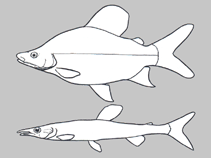
Espinhos dorsais (total) : 0; Raios dorsais moles (total) : 26 - 28; Espinhos anais: 0; Raios anais moles: 14. Diagnosis: Within the Congo basin, Distichodus langi can be distinguished from D. affinis, D. altus, D. decemmaculatus, D. noboli, D. notospilus and D. teugelsi by its higher total number of lateral line scales, 68-70 vs. less than 46; from D. maculatus by the absence of large, dark spots all over the body and a higher number of dorsal fin rays, 26-28 vs. 19-21; from D. antonii by its inferior, vs. terminal, mouth, its higher number of scales between the lateral line and the dorsal fin, 15-16 vs. 10-12, and its higher number of lateral line scales in front of the hypural joint, 68-70 vs. 52-64; from D. fasciolatus by its higher number of dorsal fin rays, 26-28 vs. 24-26, its higher number of pelvic fin rays, 11 vs. generally 10, and its deeper head, 67.4-69.4% of head length vs. 35.9-62.9% of head length; from D. lusosso by its inferior, vs. terminal, mouth and feebly compressed snout, vs. distinctive prolonged; from D. sexfasciatus by its feebly compressed snout, vs. strongly compressed, its higher number of dark vertical bars along the body, 13 vs. 6-7, and its higher number of teeth on the outer row on both jaws, more than 20 vs. 12-14; and from the D. atroventralis complex by a higher number of scales between the lateral line and pelvic fin, 12 vs. 9-11, its higher number of pectoral fin rays, 21 vs. 17-20, its higher number of circumpeduncular scales, 24-25 vs. 20-24, and its deeper head, 67.4-69.4% of head length vs. 35.1-55.7% of head length (Ref. 96324).
Body shape (shape guide): short and / or deep.
Life cycle and mating behavior
Maturidade | Reprodução | Desova | Ovos | Fecundidade | Larvas
Moelants, T., V. Mbadu Zebe, J. Snoeks and E. Vreven, 2014. A review of the Distichodus antonii assemblage (Characiformes: Distichodontidae) from the Congo basin. J. Nat. Hist. 48(27-28):1707-1735. (Ref. 96324)
Categoria na Lista Vermelha da IUCN (Ref. 130435: Version 2025-1)
Ameaça para o homem
Harmless
Utilização humana
Ferramentas
Relatórios especiais
Descarregue XML
Fontes da internet
Estimates based on models
Phylogenetic diversity index (Ref.
82804): PD
50 = 0.5000 [Uniqueness, from 0.5 = low to 2.0 = high].
Bayesian length-weight: a=0.01000 (0.00244 - 0.04107), b=3.04 (2.81 - 3.27), in cm total length, based on all LWR estimates for this body shape (Ref.
93245).
Fishing Vulnerability (Ref.
59153): Low to moderate vulnerability (34 of 100).
🛈