


Uploaden van uw Foto's en video's
Afbeeldingen | Postzegels, munten, diversen. | Google afbeelding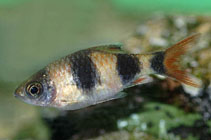 Dawkinsia arulius
Afbeelding van JJPhoto
Afbeeldingen | Postzegels, munten, diversen. | Google afbeelding
Afbeelding van JJPhoto
Classificatie / Namen Lokale namen | Synoniemen | Catalog of Fishes(Genus, Soort(en)) | ITIS | CoL | WoRMS | Cloffa
> Cypriniformes (Carps) > Cyprinidae (Minnows or carps) > Smiliogastrinae
Etymology: Dawkinsia: Named for Richard Dawkins, for his contribution to the public understanding of science and, in particular, of evolutionary science.
Eponymy: Dr Clinton Richard Dawkins (d: 1941) is an ethologist and evolutionary biologist who was Professor for Public Understanding of Science (1995–2008) at Oxford, which had awarded both his bachelor’s degree (1962) and his doctorate (1966) and where he [...] (Ref. 128868), visit book page.
More on author: Jerdon.
Etymology: Dawkinsia: Named for Richard Dawkins, for his contribution to the public understanding of science and, in particular, of evolutionary science.
Eponymy: Dr Clinton Richard Dawkins (d: 1941) is an ethologist and evolutionary biologist who was Professor for Public Understanding of Science (1995–2008) at Oxford, which had awarded both his bachelor’s degree (1962) and his doctorate (1966) and where he [...] (Ref. 128868), visit book page.
More on author: Jerdon.
Milieu: milieu / Klimaatzone / Diepte / verspreidingsgebied Ecologie
; zoet water benthopelagisch; pH range: 6.0 - 6.5; dH range: ? - 10. Tropical; 19°C - 25°C (Ref. 13371)
Verspreiding Gebieden | FAO regio's | Ecosystemen | Voorkomen | Verspreidingskaart | Introducties | Faunafri
Asia: Cauvery basin in India (Ref. 55036). Formerly classified as critically endangered in the 2000 IUCN red list of threatened species (Ref. 36508).
Grootte / Gewicht / Leeftijd
Korte beschrijving Determinatiesleutels | Morfologie | Morfometrie
Adults differ from Puntius filamentosus, P. singhala and P. assimilis by possessing prominent black markings on body anterior to anal-fin origin. Distinguished from P. exclamatio by lacking an elongate, tear-shaped black blotch above anal fin. Differs from P. srilankensis by having mouth subterminal and lower lip entire (vs. mouth inferior and lower lip medially absent). Distinguished from P. tambraparniei by lacking branched dorsal-fin rays elongated into filaments in adult males (vs. present) and by having a pair of maxillary barbels <0.5% SL (vs. 2.4-4.7%) (Ref. 55036).
Body shape (shape guide): fusiform / normal.
Body shape (shape guide): fusiform / normal.
Inhabits large streams, rivers and lakes (Ref. 41236). Omnivorous, peaceful and schooling (Ref. 57467).
Levenscyclus en paargedrag Maturiteit | Voortplanting | Paaien | Eieren | Fecunditeit | Larven
Spawns preferably near the surface.
Hoofdreferentie
Upload uw referenties | Referenties | Coördinator | Medewerkers
Pethiyagoda, R. and M. Kottelat, 2005. A review of the barb of the Puntius filamentosus group (Teleostei: Cyprinidae) of southern India and Sri Lanka. Raffles Bull. Zool. Suppl. 12:127-144. (Ref. 55036)
Status op de Rode Lijst van het IUCN (Ref. 130435: Version 2025-2 (Global))
Bedreigd (EN) (B2ab(iii)); Date assessed: 25 June 2010
CITES
Not Evaluated
Gevaar voor de mens
Harmless
Gebruik door de mens
Visserij: commercieel; Aquarium: Commercieel
FAO - Publication: search | FishSource |
Meer informatie
Trofische ecologie
Voedsel (prooien)
Dieetsamenstelling
Voedselconsumptie
Voedselrantsoenen
Predatoren
Voedsel (prooien)
Dieetsamenstelling
Voedselconsumptie
Voedselrantsoenen
Predatoren
Populatiedynamica
Groeiparameters
Max. leeftijden / maten
Lengte-gewicht rel.
Lengte-lengte rel.
Lengtefrequenties
Massaconversie
Rekrutering
Abundantie
Groeiparameters
Max. leeftijden / maten
Lengte-gewicht rel.
Lengte-lengte rel.
Lengtefrequenties
Massaconversie
Rekrutering
Abundantie
Levenscyclus
Voortplanting
Maturiteit
Rijpheid/kieuwen rel.
Fecunditeit
Paaien
Paaibestanden
Eieren
Ontwikkeling van de eieren
Larven
Larvale populatiedynamiek
Voortplanting
Maturiteit
Rijpheid/kieuwen rel.
Fecunditeit
Paaien
Paaibestanden
Eieren
Ontwikkeling van de eieren
Larven
Larvale populatiedynamiek
Anatomie
Kieuwoppervlak
Hersenen
Otoliet
Kieuwoppervlak
Hersenen
Otoliet
Fysiologie
Lichaamssamenstelling
Voedingsstoffen
Zuurstofverbruik
Type zwemmen
Zwemsnelheid
Visuele pigmenten
Vis geluid
Ziekten en parasieten
Toxiciteit (LC50)
Lichaamssamenstelling
Voedingsstoffen
Zuurstofverbruik
Type zwemmen
Zwemsnelheid
Visuele pigmenten
Vis geluid
Ziekten en parasieten
Toxiciteit (LC50)
Menselijk gerelateerd
Aquacultuursystemen
Aquacultuurprofielen
Kweeklijnen
Ciguatera gevallen
Postzegels, munten, diversen.
Aquacultuursystemen
Aquacultuurprofielen
Kweeklijnen
Ciguatera gevallen
Postzegels, munten, diversen.
Tools
Speciale rapporten
Bekijk gegevens voor het houden in een aquarium | Bekijk Fact Sheets voor de soort | Bekijk Aquacultuur Fact Sheets
Download XML
Internetbronnen
AFORO (otoliths) | Aquatic Commons | BHL | Cloffa | Websites from users | Bekijk FishWatcher | CISTI | Catalog of Fishes: Genus, Soort(en) | DiscoverLife | ECOTOX | FAO - Publication: search | Faunafri | Fishipedia | Fishtrace | GloBI | Google Books | Google Scholar | Google | IGFA World Record | OneZoom | Open Tree of Life | Otolith Atlas of Taiwan Fishes | Publieke aquaria | PubMed | Reef Life Survey | Socotra Atlas | TreeBase | Tree of Life | Wikipedia: ga naar, zoek | World Records Freshwater Fishing | Zoological Record
Schattingen op basis van modellen
Fylogenetische diversiteitsindex (Ref. 82804): PD50 = 0.5001 [Uniqueness, from 0.5 = low to 2.0 = high].
Bayesian length-weight: a=0.01072 (0.00504 - 0.02277), b=3.02 (2.84 - 3.20), in cm total length, based on LWR estimates for this (Sub)family-body shape (Ref. 93245).
Trofisch niveau (Ref. 69278): 2.7 ±0.1 se; based on size and trophs of closest relatives
Weerstandsvermogen (Ref. 120179): Hoog, minimale populatieverdubbelingstijd minder dan 15 maanden (Preliminary K or Fecundity.).