>
Eupercaria/misc (Various families in series Eupercaria) >
Haemulidae (Grunts) > Haemulinae
Etymology: Haemulon: Greek, haimaleos = bloody (Ref. 45335).
More on author: Poey.
Environment: milieu / Klimaatzone / Diepte / distribution range
Ecologie
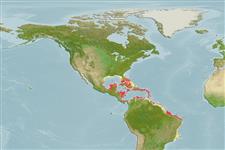
marien rifbewoner; diepte 3 - 25 m (Ref. 9626). Subtropical; 33°N - 34°S, 98°W - 34°W
Western Atlantic: southern Florida (USA), Bahamas, and Yucatan, Mexico to Brazil; including the Gulf of Mexico and the entire Caribbean Sea (Ref. 9626).
Grootte / Gewicht / Leeftijd
Maturiteit: Lm ? range ? - ? cm
Max length : 36.0 cm TL mannelijk / geslacht onbekend; (Ref. 7251); common length : 20.0 cm TL mannelijk / geslacht onbekend; (Ref. 3798)
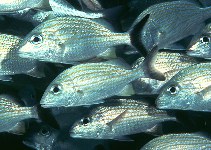
Dorsale stekels (totaal) : 12; Dorsale zachte stralen (totaal) : 15 - 16; Anale stekels: 3; Anale zachte stralen: 8. Pale gray above; belly darker gray. Yellow stripes along side; bronze-yellow stripes and spots on head (Ref. 26938). Snout and fins primarily brownish (Ref. 13442).
Body shape (shape guide): fusiform / normal.
Occurs in clear rocky or coral reefs (Ref. 5217) and mangroves (Ref. 26340). Often forming schools (Ref. 3798). Nocturnal feeder on crabs, gastropods, starfish and annelid worms (Ref. 5521). Marketed fresh (Ref. 3798).
Levenscyclus en paargedrag
Maturiteit | Voortplanting | Paaien | Eieren | Fecunditeit | Larven
Oviparous, distinct pairing during breeding (Ref. 205).
Cervigón, F., 1993. Los peces marinos de Venezuela. Volume 2. Fundación Científica Los Roques, Caracas,Venezuela. 497 p. (Ref. 9626)
Status op de Rode Lijst van het IUCN (Ref. 130435: Version 2025-1)
Gevaar voor de mens
Harmless
Gebruik door de mens
Visserij: van minder commercieel belang; Aquarium: Publieke aquaria
Tools
Speciale rapporten
Download XML
Internetbronnen
Estimates based on models
Preferred temperature (Ref.
123201): 26.3 - 28.2, mean 27.5 °C (based on 658 cells).
Fylogenetische diversiteitsindex (Ref.
82804): PD
50 = 0.5000 [Uniqueness, from 0.5 = low to 2.0 = high].
Bayesian length-weight: a=0.01622 (0.00910 - 0.02890), b=2.99 (2.84 - 3.14), in cm total length, based on LWR estimates for this species & Genus-body shape (Ref.
93245).
Trofisch niveau (Ref.
69278): 3.7 ±0.2 se; based on diet studies.
Weerstandsvermogen (Ref.
120179): Gemiddeld, minimale populatieverdubbelingstijd 1,4-4,4 jaar (Preliminary K or Fecundity.).
Fishing Vulnerability (Ref.
59153): Low to moderate vulnerability (26 of 100).
🛈
Nutrients (Ref.
124155): Calcium = 27.7 [9.4, 68.4] mg/100g; Iron = 0.569 [0.282, 1.083] mg/100g; Protein = 20.1 [18.2, 21.9] %; Omega3 = 0.2 [0.1, 0.4] g/100g; Selenium = 12.1 [5.9, 24.5] μg/100g; VitaminA = 55.8 [20.2, 164.9] μg/100g; Zinc = 0.784 [0.496, 1.273] mg/100g (wet weight);