>
Scombriformes (Mackerels) >
Scombridae (Mackerels, tunas, bonitos) > Scombrinae
Etymology: Sarda: Latin and Greek, sarda = sardine; name related to the island of Sardinia (Ref. 45335).
More on authors: Temminck & Schlegel.
Environment: milieu / climate zone / Mức độ sâu / distribution range
Sinh thái học
Biển pelagic-neritic; Ở đại duơng, biển (Ref. 51243); Mức độ sâu 1 - 167 m (Ref. 58302). Subtropical; 14°C - 23°C (Ref. 168); 43°N - 41°S, 24°E - 77°W (Ref. 168)
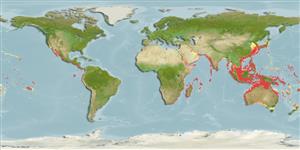
Indo-Pacific: widespread but with many gaps in its known distribution. Eastern Pacific: Hawaiian Islands and Pacific coast of USA to southern tip of Baja California and Tres Marias Islands extending to Cabo Blanco, Peru (especially during El Niño events), the Galapagos Islands and Gulf of Guayaquil.
Length at first maturity / Bộ gần gũi / Khối lượng (Trọng lượng) / Age
Chín muồi sinh dục: Lm 47.8, range 45 - ? cm
Max length : 102 cm FL con đực/không giới tính; (Ref. 9684); common length : 55.0 cm TL con đực/không giới tính; (Ref. 55763); Khối lượng cực đại được công bố: 10.7 kg (Ref. 168)
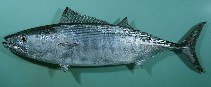
Các tia vây lưng cứng (tổng cộng) : 17 - 19; Tia cứng vây hậu môn: 0; Tia mềm vây hậu môn: 14 - 16; Động vật có xương sống: 44 - 45. Mouth moderately large. Laminae of olfactory rosette 21 to 39. Interpelvic process small and bifid. Body completely covered with very small scales posterior to the corselet. Swim bladder absent. Spleen large and prominent in ventral view. Liver with elongate left and right lobes and a short middle lobe. Back with narrow oblique stripes.
Body shape (shape guide): fusiform / normal; Cross section: oval.
A coastal species (Ref. 9340) found schooling with small tunas. Also found around some islands (Ref. 9684). Feeds on clupeoids, other fishes, squids and decapod crustaceans. Spawning varies with the monsoon season (Ref. 9684). Also caught with troll lines, encircling nets (Ref. 9340) and drift nets (Ref. 9684). Marketed mainly fresh; also dried-salted (Ref. 9684), canned and frozen (Ref. 9987).
Collette, B.B. and C.E. Nauen, 1983. FAO Species Catalogue. Vol. 2. Scombrids of the world. An annotated and illustrated catalogue of tunas, mackerels, bonitos and related species known to date. Rome: FAO. FAO Fish. Synop. 125(2):137 p. (Ref. 168)
IUCN Red List Status (Ref. 130435: Version 2025-1)
Threat to humans
Harmless
Human uses
Các nghề cá: buôn bán nhỏ; cá để chơi: đúng
Các công cụ
Special reports
Download XML
Các nguồn internet
Estimates based on models
Preferred temperature (Tài liệu tham khảo
123201): 20.5 - 29, mean 27.6 °C (based on 2552 cells).
Phylogenetic diversity index (Tài liệu tham khảo
82804): PD
50 = 0.5312 [Uniqueness, from 0.5 = low to 2.0 = high].
Bayesian length-weight: a=0.01000 (0.00527 - 0.01898), b=3.05 (2.89 - 3.21), in cm total length, based on LWR estimates for this species & (Sub)family-body (Ref.
93245).
Mức dinh dưỡng (Tài liệu tham khảo
69278): 4.2 ±0.66 se; based on food items.
Generation time: 1.6 ( na - na) years. Estimated as median ln(3)/K based on 2
growth studies.
Thích nghi nhanh (Tài liệu tham khảo
120179): Trung bình, thời gian nhân đôi của chủng quần tối thiểu là 1.4 - 4.4 năm (Assuming tm=3-4).
Fishing Vulnerability (Ref.
59153): Moderate vulnerability (35 of 100).
🛈
Climate Vulnerability (Ref.
125649): High vulnerability (59 of 100).
🛈
Nutrients (Ref.
124155): Calcium = 37.8 [21.1, 63.0] mg/100g; Iron = 2.61 [1.51, 4.59] mg/100g; Protein = 20.7 [19.5, 21.8] %; Omega3 = 0.356 [0.167, 0.745] g/100g; Selenium = 32.3 [18.0, 56.1] μg/100g; VitaminA = 13.9 [5.5, 37.6] μg/100g; Zinc = 0.462 [0.350, 0.686] mg/100g (wet weight);