Corvula sanctaeluciae, Striped croaker : fisheries, bait

You can sponsor this page

Corvula sanctaeluciae Jordan, 1890

Striped croaker
Adicionar as suas observações no Fish Watcher
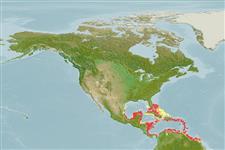
Native range | All suitable habitat | Point map | Year 2050
This map was computer-generated and has not yet been reviewed.
Corvula sanctaeluciae   AquaMaps   Data sources: GBIF OBIS
Adicionar o seu Fotografias e vídeos
Fotografias | Imagem do Google
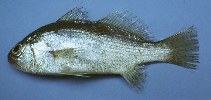
Image of Corvula sanctaeluciae (Striped croaker)
Corvula sanctaeluciae
Fotografia de Ramjohn, D.D.

Classificação / Names Nomes comuns | Sinónimos | Catalog of Fishes(Género, Espécies) | ITIS | CoL | WoRMS | Cloffa

> Eupercaria/misc (Various families in series Eupercaria) > Sciaenidae (Drums or croakers)
More on author: Jordan.

Environment: milieu / climate zone / intervalo de profundidade / distribution range Ecologia

marinhas demersal; intervalo de profundidade ? - 35 m (Ref. 26912). Subtropical; 28°N - 4°N, 98°W - 51°W

Distribuição Países | Áreas FAO | Ecossistemas | Ocorrências | Mapa dos pontos | Introduções | Faunafri

Western Atlantic: eastern Florida (USA), throughout the Antilles and along the Caribbean coast from the Bay of Campeche (Mexico) to Guianas.

Tamanho / Peso / Idade

Maturidade: Lm ?  range ? - ? cm
Max length : 26.0 cm TL macho/indeterminado; (Ref. 3702); common length : 22.0 cm TL macho/indeterminado; (Ref. 3702)

Descrição breve Chaves de identificação | Morfologia | Morfometria

Espinhos dorsais (total) : 11; Raios dorsais moles (total) : 21 - 24; Espinhos anais: 2; Raios anais moles: 7 - 8. Colour grey or greyish blue on back, silvery below. Sides with faint streaks, oblique above and longitudinal below lateral line. Fins pale, yellowish, dusted with dark spots. A faint dark spot at pectoral-fin origin. Mouth moderate in size, slightly oblique, terminal. Preopercular margin thin, nearly smooth. Anal fin second spine moderately strong, less than 2/3 the length of first soft ray. Gas bladder with 2 chambers; anterior one yoke-shaped, without appendages on posterior margin, posterior one carrot-shaped. Lapillus (small earstone) enlarged, more than half the size of sagitta (Ref 51721).
Body shape (shape guide): fusiform / normal.

Biologia     Glossário (ex. epibenthic)

Common over muddy and sandy bottoms in inshore waters. Juveniles are also found in rocky areas. Feeds mainly on shrimps. Seldom marketed as a food fish; mostly used as bait (Ref. 3702).

Life cycle and mating behavior Maturidade | Reprodução | Desova | Ovos | Fecundidade | Larvas

Referência principal Upload your references | Referências | Coordenador | Colaboradores

Robins, C.R. and G.C. Ray, 1986. A field guide to Atlantic coast fishes of North America. Houghton Mifflin Company, Boston, U.S.A. 354 p. (Ref. 7251)

Categoria na Lista Vermelha da IUCN (Ref. 130435: Version 2025-1)

  Preocupação menor (LC) ; Date assessed: 03 October 2019

CITES

Not Evaluated

CMS (Ref. 116361)

Not Evaluated

Ameaça para o homem

  Harmless


Utilização humana

Pescarias: pouco comercial; isco: usually
FAO - Publication: search | FishSource |

Mais informação

Ecologia Trófica
Food items (preys)
Composição da dieta
Consumo alimentar
Food rations
Predadores
Ecologia
Ecologia
Home ranges
Population dynamics
Parâmetros de crescimento
Max. ages / sizes
Length-weight rel.
Length-length rel.
Frequência de comprimento
Mass conversion
Recrutamento
Abundância
Life cycle
Reprodução
Maturidade
Maturity/Gills rel.
Fecundidade
Desova
Spawning aggregations
Ovos
Desenvolvimento dos ovos
Larvas
Dinâmica larvar
Distribuição
Países
Áreas FAO
Ecossistemas
Ocorrências
Introduções
BRUVS - Videos
Anatomy
Área branquial
Brain
Otolith
Physiology
Body composition
Nutrients
Consumo de oxigénio
Tipo de natação
Velocidade de natação
Visual pigments
Fish sound
Diseases & Parasites
Toxicity (LC50s)
Genética
genoma
Genética
Heterozygosity
Hereditariedade
Human related
Aquaculture systems
Perfis para aquacultura
Estirpes
Ciguatera cases
Stamps, coins, misc.
Outreach
Colaboradores
Referências
Referências

Ferramentas

Relatórios especiais

Descarregue XML

Fontes da internet

AFORO (otoliths) | Aquatic Commons | BHL | Cloffa | Websites from users | Consultar FishWatcher | CISTI | Catalog of Fishes: Género, Espécies | DiscoverLife | ECOTOX | FAO - Publication: search | Faunafri | Fishipedia | Fishtrace | GloBI | Google Books | Google Scholar | Google | IGFA World Record | OneZoom | Open Tree of Life | Otolith Atlas of Taiwan Fishes | PubMed | Reef Life Survey | Socotra Atlas | TreeBase | Árvore da vida | Wikipedia: ir para, procurar | World Records Freshwater Fishing | Zoobank | Registo zoológico

Estimates based on models

Preferred temperature (Ref. 123201): 27 - 28.3, mean 27.6 °C (based on 377 cells).
Phylogenetic diversity index (Ref. 82804):  PD50 = 0.6250   [Uniqueness, from 0.5 = low to 2.0 = high].
Bayesian length-weight: a=0.00851 (0.00415 - 0.01744), b=3.08 (2.91 - 3.25), in cm total length, based on LWR estimates for this (Sub)family-body shape (Ref. 93245).
Nível Trófico (Ref. 69278):  3.6   ±0.59 se; based on food items.
Resiliência (Ref. 120179):  Elevada, tempo mínimo de duplicação da população menor que 15 meses (Preliminary K or Fecundity.).
Fishing Vulnerability (Ref. 59153):  Low vulnerability (16 of 100). 🛈
Categoria de preço (Ref. 80766):   Medium.