>
Eupercaria/misc (Various families in series Eupercaria) >
Sciaenidae (Drums or croakers)
Etymology: Cynoscion: Greek, kyon = dog + Greek, odous = teeth + Greek, skion, skiaina = barbel, red mullet (Ref. 45335).
More on author: Cuvier.
Environment: milieu / climate zone / djupintervall / distribution range
Ekologi
marina; brackvatten bottenlevande; djupintervall 6 - 70 m (Ref. 3702). Tropical; 14°N - 24°S, 84°W - 34°W
Western Atlantic: Nicaragua to Santos, Brazil.
Size / Vikt / Age
Könsmognad: Lm ? range ? - ? cm
Max length : 115 cm TL hane/ej könsbestämd; (Ref. 40637); common length : 65.0 cm TL hane/ej könsbestämd; (Ref. 3702); publicerad maxvikt: 4.4 kg (Ref. 125970)
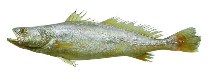
Taggstrålar i ryggfenan (totalt) : 11; Mjukstrålar i ryggfenan (totalt) : 27 - 31; Taggstrålar i analfenan: 2; Mjukstrålar i analfenan: 8. Greyish to brownish above, silvery below. Upper sides sometimes with inconspicuous minute dark dots. Dorsal fin dusky, its spinous portion black-edged. Soft dorsal fin with dark spots on each ray. Pectoral and pelvic fins as well as anal fin yellowish to orange. Caudal fin dusky. Inside mouth orange. Mouth large, distinctly oblique, lower jaw projecting. Upper jaw with a pair of large canine-like teeth at tip. Chin without barbels or pores. Snout with 2 marginal pores. Gas bladder with a pair of long, curved, horn-like appendages. Sagitta (large earstone) elongate, with a notch on dorsal margin. Soft portion of dorsal fin membranes unscaled except 2 or 3 rows of scales at base (Ref 51721).
Body shape (shape guide): fusiform / normal.
Usually found over sandy mud bottoms in coastal waters near river mouths (Ref. 3702). Adults stay in deep waters during the day and swim to the surface at night (Ref. 35237). Juveniles inhabit estuaries. Marketed fresh; its flesh is of excellent quality (Ref. 3702). Its swim bladder is being used to make glue (Ref. 35237).
Life cycle and mating behavior
Könsmognad | Reproduktion | Lek | Ägg | Fecundity | Larver
Cervigón, F., 1993. Los peces marinos de Venezuela. Volume 2. Fundación Científica Los Roques, Caracas,Venezuela. 497 p. (Ref. 9626)
IUCN Red List Status (Ref. 130435: Version 2025-1)
Threat to humans
Harmless
Human uses
Fiskeri: kommersiell; sportfisk: ja
Verktyg
Special reports
Download XML
Internet-källor
Estimates based on models
Preferred temperature (Ref.
123201): 26.7 - 28, mean 27.4 °C (based on 112 cells).
Phylogenetic diversity index (Ref.
82804): PD
50 = 0.5000 [Uniqueness, from 0.5 = low to 2.0 = high].
Bayesian length-weight: a=0.00661 (0.00533 - 0.00819), b=3.06 (3.04 - 3.08), in cm total length, based on LWR estimates for this species (Ref.
93245).
Trofisk nivå (Ref.
69278): 4.0 ±0.70 se; based on food items.
Resiliens (Ref.
120179): Låg, lägsta populationsfördubblingstid 4,5-14 år (Preliminary K or Fecundity.).
Prior r = 0.26, 95% CL = 0.17 - 0.38, Based on 1 data-limited stock assessment.
Fishing Vulnerability (Ref.
59153): High to very high vulnerability (69 of 100).
🛈
Nutrients (Ref.
124155): Calcium = 67.7 [40.4, 126.2] mg/100g; Iron = 0.787 [0.413, 1.359] mg/100g; Protein = 18.5 [17.0, 20.3] %; Omega3 = 0.208 [0.114, 0.339] g/100g; Selenium = 65.4 [34.7, 122.1] μg/100g; VitaminA = 13.3 [5.1, 37.4] μg/100g; Zinc = 0.939 [0.680, 1.330] mg/100g (wet weight);