>
Eupercaria/misc (Various families in series Eupercaria) >
Sciaenidae (Drums or croakers)
Etymology: Paralonchurus: Greek, para = the side of + Greek, logchos = lance + Greek, oura = tail (Ref. 45335).
More on author: Steindachner.
Environment: milieu / Klimaatzone / Diepte / distribution range
Ecologie
marien; brak water demersaal; diepte ? - 50 m (Ref. 9626). Tropical
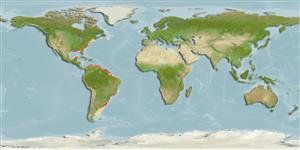
Western Atlantic: Panama to southern Brazil. Reported in Yucatan, Mexico (Ref. 74908).
Lengte bij maturiteit / Grootte / Gewicht / Leeftijd
Maturiteit: Lm 15.7 range ? - ? cm
Max length : 33.7 cm TL mannelijk / geslacht onbekend; (Ref. 125970); common length : 25.0 cm TL mannelijk / geslacht onbekend; (Ref. 3702); max. gepubliceerd gewicht: 520.00 g (Ref. 125970)
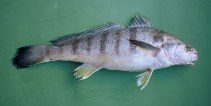
Dorsale stekels (totaal) : 11 - 12; Dorsale zachte stralen (totaal) : 29 - 30; Anale stekels: 2; Anale zachte stralen: 8. Body silvery to yellowish, brown above, whitish below. Sides with 7 to 9 dark vertical bars extending to below lateral line. A large dark brown spot, larger than eye, behind upper end of gill slit. Mouth small, inferior, nearly horizontal. Chin with 5 pores and many barbels, 3 or 4 pairs in a tuft around median pore and 10 to 12 pairs along inner edges of lower jaw. Caudal fin asymmetrically rhomboidal with lower half pointed. Gas bladder well developed, much longer than head length, bearing anteriorly 2 pairs of appendages, anterior pair slit and horn-like, lateral pair long, tube-like, and extending posteriorly to tip of main chamber (Ref 51721).
Body shape (shape guide): fusiform / normal.
Found over muddy bottoms, often near estuarine areas (Ref. 9626). Feeds mainly on worms (Ref. 3702). Marketed mostly fresh and salted (Ref. 3702).
Levenscyclus en paargedrag
Maturiteit | Voortplanting | Paaien | Eieren | Fecunditeit | Larven
Cervigón, F., 1993. Los peces marinos de Venezuela. Volume 2. Fundación Científica Los Roques, Caracas,Venezuela. 497 p. (Ref. 9626)
Status op de Rode Lijst van het IUCN (Ref. 130435: Version 2025-1)
Gevaar voor de mens
Harmless
Gebruik door de mens
Visserij: van minder commercieel belang
Tools
Speciale rapporten
Download XML
Internetbronnen
Estimates based on models
Preferred temperature (Ref.
123201): 14 - 27.8, mean 24 °C (based on 564 cells).
Fylogenetische diversiteitsindex (Ref.
82804): PD
50 = 0.5156 [Uniqueness, from 0.5 = low to 2.0 = high].
Bayesian length-weight: a=0.00759 (0.00705 - 0.00816), b=3.08 (3.06 - 3.10), in cm total length, based on LWR estimates for this species (Ref.
93245).
Trofisch niveau (Ref.
69278): 3.4 ±0.3 se; based on diet studies.
Weerstandsvermogen (Ref.
120179): Hoog, minimale populatieverdubbelingstijd minder dan 15 maanden (Preliminary K or Fecundity.).
Fishing Vulnerability (Ref.
59153): Low vulnerability (24 of 100).
🛈
Nutrients (Ref.
124155): Calcium = 184 [108, 359] mg/100g; Iron = 1.18 [0.63, 2.04] mg/100g; Protein = 19 [18, 20] %; Omega3 = 0.243 [0.129, 0.403] g/100g; Selenium = 48.1 [26.7, 89.8] μg/100g; VitaminA = 20 [8, 53] μg/100g; Zinc = 1.49 [1.09, 2.12] mg/100g (wet weight);