


Crossocheilus oblongus Kuhl & Van Hasselt, 1823
Siamese flying foxBilder | Google Bild
- Crossocheilus oblongus
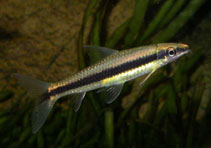
Photo von Noren, M.
- Crossocheilus oblongus
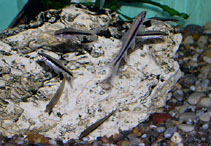
Juvenile Photo von Hasselgreen Jr., P.C.
Klassifizierung / Names Namen | Synonyme | Catalog of Fishes(Gattung, Arten) | ITIS | CoL | WoRMS | Cloffa
Etymology: Crossocheilus: Greek krossoi = tassel + Greek, cheilos = lip (Ref. 45335).
More on authors: Kuhl & VanHasselt.
Taxonomic Remarks
Crossocheilus siamensis: The species name has been applied to several species described or undescribed, and will be synonymized in the next update. It is either Garra cambodgiensis (Tirant, 1883), Crossocheilus atrilimes Kottelat, 2000, Crossocheilus langei Bleeker, 1860, or an undescribed lemon-finned Crossocheilus (Josef Niederle, pers. comm., 18/09/08).
> From: Josef Niederle[SMTP:NIEDERLE@MATH.MUNI.CZ]
> Sent: Thursday, September 18, 2008 10:24:13 PM
> To: Capuli, Emily (WorldFish)
> Subject: crossocheilus
A binom misapplied to several species, and the information contained in fishbase belongs to several species too. The main reference in fishbase is Kottelat, 1998. Nevertheless, Kottelat later changed his opinion and described the fishes from Mekong basin he originaly
called Crossocheilus siamensis as Crossocheilus atrilimes. Cf. Kottelat, M., 2000 Ref. 36949. Hence the reference is to Crossocheilus atrilimes in reality. Ref. 12693 refers to Crossocheilus atrilimes too and probably to the following species in reality. There is no reference to the genuine Epalzeorhynchos siamensis alias Crossocheilus siamensis except Smith, 1931
and Smith, 1945. Another formally undescribed species similar to Crossocheilus
atrilimes occurs in the Mekong basin in southern Laos. It is twice larger and has lemon-yellow fin colour instead of the sandy yellow in Crossocheilus atrilimes. It possesses small maxillary barbels. The image Crsia_u1.jpg belongs probably to it. It is difficult to distinguish images of Crossocheilus atrilimes and the lemon-finned Crossocheilus because the colours are not faithful. Smith, 1931 correctly described the lateral stripe as beginning at the opercle in Crossocheilus siamensis. It may be checked on the image of the holotype at
http://math.muni.cz/~niederle/crossocheilus_siamensis_page.html
Further, it has a nearly V-shaped furrowed upper lip. The information should be contained in morphology. The Crossocheilus siamensis of the aquarium trade is either Garra cambodgiensis, or Crossocheilus atrilimes, or the lemon-finned Crossocheilus mentioned above, or Crossocheilus langei, to which the images Crsia_u0.jpg, Crsia_u2.jpg and
Crsia_u3.jpg belong. The first species is completely different, in the remaining three the lateral stripe begins at the snout. The genuine red-algae eater is Crossocheilus langei.
Umwelt: Milieu / Klimazone / Tiefenbereich / Verbreitungsgebiet Ökologie
Verbreitung Territorien | FAO Gebiete | Ökosysteme | Vorkommen | Punkt Karte | Einführungen | Faunafri
Größe / Gewicht / Alter
Kurzbeschreibung Bestimmungsschlüssel | Morphologie | Morphometrie
Body shape (shape guide): elongated.
Lebenszyklus und Paarungsverhalten Geschlechtsreife | Fortpflanzung | Ablaichen | Eier | Fruchtbarkeit | Larven
Hauptreferenz
Laden Sie Ihre Referenzen hoch | Referenzen | Koordinator | Partner
IUCN Rote Liste Status (Ref. 130435: Version 2025-2 (Global))
CITES
Bedrohung für Menschen
Nutzung durch Menschen
Mehr Information
Lebensmittel (Beutetiere)
Nahrungszusammensetzung
Nahrungsaufnahme
Lebensmittelrationen
Räuber
Wachstumsparameter
Max. Alter/Größen
Länge-Gewicht-Rel.
Länge-Länge-Verhältnis.
Längenhäufigkeiten
Massenkonvertierung
Rekrutierung
Dichte
Fortpflanzung
Geschlechtsreife
Reifung/Kiemen rel.
Fruchtbarkeit
Ablaichen
Laichaggregationen
Eier
Eientwicklung
Larven
Larven Pop.Dyn.
Kiemenoberfläche
Gehirn
Otolith
Körperliche Zusammensetzung
Nährstoffe
Sauerstoffverbrauch
Schwimmart
Schwimmgeschwindigkeit
Visuelle Pigmente
Fischgeräusche
Krankheiten und Parasiten
Toxizität (LC50s)
Genom
Genetik
Heterozygotie
Vererbbarkeit
Genetische Vielfalt
Aquakultur-Systeme
Aquakultur Profile
Zuchtlinien
Ciguatera-Fälle
Briefmarken, Münzen, Verschiedenes.
Tools
Zusatzinformationen
Download XML
Internet Quellen