


Brachysomophis cirrocheilos (Bleeker, 1857)
Stargazer snake eel
Waarneming toevoegen in Fish Watcher
| Native range | All suitable habitat | Point map | Year 2050 |

|
| This map was computer-generated and has not yet been reviewed. |
| Brachysomophis cirrocheilos AquaMaps Data sources: GBIF OBIS |
Uploaden van uw Foto's en video's
Afbeeldingen | video's | Google afbeelding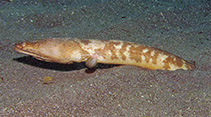 Brachysomophis cirrocheilos
Afbeelding van Erdmann, M.V.
Afbeeldingen | video's | Google afbeelding
Afbeelding van Erdmann, M.V.
Classificatie / Namen Lokale namen | Synoniemen | Catalog of Fishes(Genus, Soort(en)) | ITIS | CoL | WoRMS | Cloffa
> Anguilliformes (Eels and morays) > Ophichthidae (Snake eels) > Ophichthinae
Etymology: Brachysomophis: Greek, brachys, eia = short + Greek, soma = body + Greek, ophis = serpent (Ref. 45335); cirrocheilos: From apparently a combination of Latin ('cirrus' = tendril) and Greek ('cheilos' = lip).
More on author: Bleeker.
Etymology: Brachysomophis: Greek, brachys, eia = short + Greek, soma = body + Greek, ophis = serpent (Ref. 45335); cirrocheilos: From apparently a combination of Latin ('cirrus' = tendril) and Greek ('cheilos' = lip).
More on author: Bleeker.
Milieu: milieu / Klimaatzone / Diepte / verspreidingsgebied Ecologie
marien; brak water rifbewoner; diepte 1 - 38 m (Ref. 42180). Tropical; 39°N - 20°S, 35°E - 148°E (Ref. 42180)
Verspreiding Gebieden | FAO regio's | Ecosystemen | Voorkomen | Verspreidingskaart | Introducties | Faunafri
Indo-West Pacific: Red Sea and East Africa to Japan, Taiwan south to Indonesia and Australia.
Grootte / Gewicht / Leeftijd
Korte beschrijving Determinatiesleutels | Morfologie | Morfometrie
Wervels: 135 - 140. Coloration pale, overlain dorsally and along flanks with irregular brown smudges. A moderately elongate species with tail 51-58% and head 11-14% of TL; dorsal fin arising well behind pectoral-fin tips; pectoral fins not elongate; snout moderate, about 3.2 in jaw; jaws elongate; lower jaw extending beyond snout; nostrils in very short tubes in upper lip and closely associated; labial fringe well-developed but cirri not elongate on jaws, with cauliflower-like projections at tips; center of eye behind anterior 40% of jaw; interorbital space and top of head flat, dorsal head profile nearly flat from mid-head to snout tip; head pores inconspicuous; free sensory neuromasts not visible on nape; teeth conical. Numerous prominent barbels on both lips; outer row of maxillary teeth not visible when are closed (Ref 42180).
Body shape (shape guide): eel-like; Cross section: circular.
Body shape (shape guide): eel-like; Cross section: circular.
Most commonly found in sand and mud, near coastal reefs at depths of 1 up to at least 10 m. Burrows into the sand tail-first until only its eyes and the top of its snout are visible. Sometimes seen with only its head or snout protruding from the sand. More commonly encountered at night but also seen with its head protruding out of the substrate during the day. Observed with cleaner shrimp Periclimenes magnificus on its head. The shrimp would swim off for short periods and then return to this species (Ref. 42180). Feeds on small fishes and crustaceans (Ref. 2334).
Levenscyclus en paargedrag Maturiteit | Voortplanting | Paaien | Eieren | Fecunditeit | Larven
Hoofdreferentie
Upload uw referenties | Referenties | Coördinator : McCosker, John E. | Medewerkers
McCosker, J.E. and J.E. Randall, 2001. Revision of the snake-eel genus Brachysomophis (Anguilliformes: Ophichthidae), with description of two new species and comments on the species of Mystriophis. Indo-Pac. Fish. (33):1-32. (Ref. 42180)
Status op de Rode Lijst van het IUCN (Ref. 130435: Version 2025-2 (Global))
Niet bedreigd (LC) ; Date assessed: 12 November 2019
CITES
Not Evaluated
Gevaar voor de mens
Harmless
Gebruik door de mens
Visserij: visserij voor eigen gebruik
FAO - Publication: search | FishSource |
Meer informatie
Trofische ecologie
Voedsel (prooien)
Dieetsamenstelling
Voedselconsumptie
Voedselrantsoenen
Predatoren
Voedsel (prooien)
Dieetsamenstelling
Voedselconsumptie
Voedselrantsoenen
Predatoren
Populatiedynamica
Groeiparameters
Max. leeftijden / maten
Lengte-gewicht rel.
Lengte-lengte rel.
Lengtefrequenties
Massaconversie
Rekrutering
Abundantie
Groeiparameters
Max. leeftijden / maten
Lengte-gewicht rel.
Lengte-lengte rel.
Lengtefrequenties
Massaconversie
Rekrutering
Abundantie
Levenscyclus
Voortplanting
Maturiteit
Rijpheid/kieuwen rel.
Fecunditeit
Paaien
Paaibestanden
Eieren
Ontwikkeling van de eieren
Larven
Larvale populatiedynamiek
Voortplanting
Maturiteit
Rijpheid/kieuwen rel.
Fecunditeit
Paaien
Paaibestanden
Eieren
Ontwikkeling van de eieren
Larven
Larvale populatiedynamiek
Anatomie
Kieuwoppervlak
Hersenen
Otoliet
Kieuwoppervlak
Hersenen
Otoliet
Fysiologie
Lichaamssamenstelling
Voedingsstoffen
Zuurstofverbruik
Type zwemmen
Zwemsnelheid
Visuele pigmenten
Vis geluid
Ziekten en parasieten
Toxiciteit (LC50)
Lichaamssamenstelling
Voedingsstoffen
Zuurstofverbruik
Type zwemmen
Zwemsnelheid
Visuele pigmenten
Vis geluid
Ziekten en parasieten
Toxiciteit (LC50)
Genetica
genoom
Genetica
Heterozygositeit
Erfelijkheid
Genetische diversiteit
genoom
Genetica
Heterozygositeit
Erfelijkheid
Genetische diversiteit
Menselijk gerelateerd
Aquacultuursystemen
Aquacultuurprofielen
Kweeklijnen
Ciguatera gevallen
Postzegels, munten, diversen.
Aquacultuursystemen
Aquacultuurprofielen
Kweeklijnen
Ciguatera gevallen
Postzegels, munten, diversen.
Tools
E-boek | Veldgids | Determinatiesleutels | Lengtefrequentie Tool | Levenscyclus tool | Verspreidingskaart |
Vangst-MSY |
Speciale rapporten
Bekijk gegevens voor het houden in een aquarium | Bekijk Fact Sheets voor de soort | Bekijk Aquacultuur Fact Sheets
Download XML
Internetbronnen
AFORO (otoliths) | Aquatic Commons | BHL | Cloffa | Websites from users | Bekijk FishWatcher | CISTI | Catalog of Fishes: Genus, Soort(en) | DiscoverLife | ECOTOX | FAO - Publication: search | Faunafri | Fishipedia | Fishtrace | GloBI | Google Books | Google Scholar | Google | IGFA World Record | Nationale databanken | OneZoom | Open Tree of Life | Otolith Atlas of Taiwan Fishes | PubMed | Reef Life Survey | Socotra Atlas | TreeBase | Tree of Life | Wikipedia: ga naar, zoek | World Records Freshwater Fishing | Zoological Record
Schattingen op basis van modellen
Gewenste temperatuur (Ref. 123201): 25 - 29, mean 27.9 °C (based on 520 cells).
Fylogenetische diversiteitsindex (Ref. 82804): PD50 = 0.5078 [Uniqueness, from 0.5 = low to 2.0 = high].
Bayesian length-weight: a=0.00093 (0.00041 - 0.00214), b=2.99 (2.79 - 3.19), in cm total length, based on LWR estimates for this (Sub)family-body shape (Ref. 93245).
Trofisch niveau (Ref. 69278): 4.0 ±0.66 se; based on food items.
Weerstandsvermogen (Ref. 120179): laag, minimale populatieverdubbelingstijd 4,5-14 jaar (Preliminary K or Fecundity.).