>
Syngnathiformes (Pipefishes and seahorses) >
Syngnathidae (Pipefishes and seahorses) > Nerophinae
Etymology: Nerophis: Greek, neros, nearos = youhtfull appearance + Greek,ophis = serpent (Ref. 45335).
More on author: Linnaeus.
Environment: milieu / climate zone / profondeur / distribution range
Écologie
marin; eau douce; saumâtre démersal; profondeur 2 - 15 m (Ref. 6733). Temperate; 63°N - 30°N, 11°W - 42°E
Eastern Atlantic: Norway to Morocco (excluding region from Denmark to Netherlands), also throughout the Mediterranean and the Black Sea.
Taille / Poids / Âge
Maturité: Lm ? range ? - ? cm
Max length : 29.0 cm TL mâle / non sexé; (Ref. 2058); 30.0 cm TL (female)
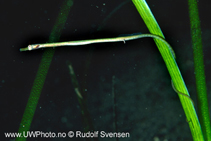
Anal, caudal and pectoral fins absent (Ref. 59043). Anal opening below front end of the dorsal fin, 28-33 body rings. Has a strait snout (Ref. 35388).
Body shape (shape guide): eel-like.
Inhabit algal zone or eel-grass (Zostera) (Ref. 6733). Adults spawn in May - August . Feed on small crustaceans and fish fry (Ref. 35388). Ovoviviparous (Ref. 205). The male carries the eggs in a brood pouch which is found under the tail (Ref. 205). Consistent paternity is ensured despite brooding of embryos on the outside the male's body. Events of cuckoldry by sneaker males is ruled out through genetic paternity analyses based on molecular markers (Ref. 81011). Each male carries eggs from a single female but females may deposit eggs on several brooding pouches (Ref. 81011).
Life cycle and mating behavior
Maturité | Reproduction | Frai | Œufs | Fécondité | Larves
Consistent paternity is ensured despite brooding of embryos on the outside of the male's body instead of a brood pouch characteristic of the family (Ref. 81011, 53335). Events of cuckoldry by sneaker males is ruled out through genetic paternity analyses based on molecular markers (Ref. 81011). Each male carries eggs from a single female but females may deposit eggs on several brooding pouches (Ref. 81011).
Dawson, C.E., 1986. Syngnathidae. p. 628-639. In P.J.P. Whitehead, M.-L. Bauchot, J.-C. Hureau, J. Nielsen and E. Tortonese (eds.) Fishes of the North-eastern Atlantic and the Mediterranean. Volume 2. Unesco, Paris. (Ref. 6733)
Statut dans la liste rouge de l'IUCN (Ref. 130435: Version 2025-1)
Menace pour l'homme
Harmless
Utilisations par l'homme
Pêcheries: sans intérêt
Outils
Articles particuliers
Télécharger en XML
Sources Internet
Estimates based on models
Preferred temperature (Réf.
123201): 8.6 - 19.3, mean 13.5 °C (based on 981 cells).
Phylogenetic diversity index (Réf.
82804): PD
50 = 0.6250 [Uniqueness, from 0.5 = low to 2.0 = high].
Bayesian length-weight: a=0.00093 (0.00036 - 0.00242), b=3.05 (2.83 - 3.27), in cm total length, based on LWR estimates for this (Sub)family-body shape (Ref.
93245).
Niveau trophique (Réf.
69278): 3.5 ±0.47 se; based on food items.
Generation time: 1.0 ( na - na) years. Estimated as median ln(3)/K based on 1
growth studies.
Résilience (Réf.
120179): Haut, temps minimum de doublement de population inférieur à 15 mois (K=1.05).
Fishing Vulnerability (Ref.
59153): Low vulnerability (17 of 100).
🛈
Nutrients (Ref.
124155): Calcium = 52.9 [11.4, 164.9] mg/100g; Iron = 0.518 [0.203, 1.620] mg/100g; Protein = 3.53 [0.00, 7.33] %; Omega3 = 0.457 [0.196, 1.168] g/100g; Selenium = 7.88 [1.15, 24.21] μg/100g; VitaminA = 8.87 [2.82, 27.81] μg/100g; Zinc = 0.772 [0.368, 1.485] mg/100g (wet weight);