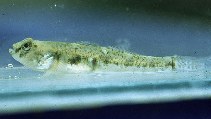
Pomatoschistus microps, Common goby : aquarium

You can sponsor this page

Pomatoschistus microps (Krøyer, 1838)

Common goby
Add your observation in Fish Watcher
Native range | All suitable habitat | Point map | Year 2050
This map was computer-generated and has not yet been reviewed.
Pomatoschistus microps   AquaMaps   Data sources: GBIF OBIS
Upload your photos and videos
Immagini | Videos | Google image
Image of Pomatoschistus microps (Common goby)
Pomatoschistus microps
Picture by Busse, K.

Classification / Names Nomi Comuni | Sinonimi | Catalog of Fishes(Genere, Specie) | ITIS | CoL | WoRMS | Cloffa

> Gobiiformes (Gobies) > Gobiidae (Gobies) > Gobionellinae
Etymology: Pomatoschistus: Greek, poma, -atos = cover, operculum + Greek, schistos = divided (Ref. 45335).

Environment: milieu / climate zone / distribuzione batimetrica / distribution range Ecologia

marino; acqua dolce; salmastro demersale; amfidromo (Ref. 51243); distribuzione batimetrica 0 - 12 m (Ref. 35388). Temperate; 8°C - 24°C (Ref. 4944); 64°N - 20°N, 19°W - 31°E

Distribuzione Stati | Aree FAO | Ecosystems | Presenze | Mappa dei ritrovamenti | Introduzioni | Faunafri

Eastern Atlantic: Norway to Morocco, including Baltic Sea (to southern Portugal) (Ref. 4696) and western Mediterranean. Also in Mauritania and the Canary Islands.

Length at first maturity / Size / Peso / Age

Maturità: Lm ?, range 3 - ? cm
Max length : 9.0 cm TL maschio/sesso non determinato; (Ref. 6303); Età massima riportata: 2.60 anni (Ref. 40230)

Short description Chiavi di identificazione | Morfologia | Morfometria

Spine dorsali (totale) : 6 - 8; Raggi dorsali molli (totale) : 8 - 11; Spine anali: 1; Raggi anali molli: 7 - 10; Vertebre: 30 - 32. This species is distinguished from other gobies in European freshwaters by the following characters: males with conspicuous dark proximal posterior spot on first dorsal; with cephalic lateral line canals; anterior oculoscapular canal extending to snout; branched rays in second dorsal 8-10.5; anal origin below simple of first branched ray of D2; total scales in midlateral series 39-52; completely scaled postdorsal body; caudal rounded (Ref. 59043). No scales in front of the first dorsal fin (Ref. 35388); body shape is terete, slightly depressed; eyes situated dorso-laterally; reduced swim bladders (Ref. 92840).
Body shape (shape guide): elongated.

Biologia     Glossario (es. epibenthic)

Enters estuaries, salt marshes and pools (Ref. 4343); usually on sand or mud (Ref. 59043). Lives in sea as well as brackish waters and migrates into limnetic sections of rivers (Ref. 92840). Also rock pools where it feeds mainly on epibenthic meiofauna like harpacticoids and small amphipods (Ref. 92840); small crustaceans, worms, chironomid larvae and mites (Ref. 4696). Its burrowing habit allows it to survive low water levels and to avoid predators (Ref. 30508). Spawns after first winter, at sea, in February - September, depending on latitude; individual females spawn several times during a season. Adhesive eggs (0.9 x 0.7 mm) are deposited under or between stones, shells and aquatic plants and males guard the eggs until hatching. Juveniles enter freshwater habitats in late summer to forage (Ref. 59043). The male defends and aerates the eggs for about 9 days.

Life cycle and mating behavior Maturità | Riproduzione | Deposizione | Uova | Fecundity | Larve

Benthic spawner (Ref. 32023).

Main reference Upload your references | Bibliografia | Coordinatore | Collaboratori

Maugé, L.A., 1986. Gobiidae. p. 358-388. In J. Daget, J.-P. Gosse and D.F.E. Thys van den Audenaerde (eds.) Check-list of the freshwater fishes of Africa (CLOFFA). ISNB, Brussels; MRAC, Tervuren; and ORSTOM, Paris. Vol. 2. (Ref. 4343)

IUCN Red List Status (Ref. 130435: Version 2025-1)

  Least Concern (LC) ; Date assessed: 18 January 2023

CITES

Not Evaluated

CMS (Ref. 116361)

Not Evaluated

Threat to humans

  Harmless


Human uses

Pesca: di nessun interesse; Acquario: Commerciale
FAO - Publication: search | FishSource |

Informazioni ulteriori

Ecologia
Ecologia
Home ranges
Population dynamics
Growth parameters
Max. ages / sizes
Length-weight rel.
Length-length rel.
Length-frequencies
Mass conversion
Reclutamento
Abbondanza
Life cycle
Riproduzione
Maturità
Maturity/Gills rel.
Fecundity
Deposizione
Spawning aggregations
Uova
Egg development
Larve
Dinamica popolazioni larvali
Distribuzione
Stati
Aree FAO
Ecosystems
Presenze
Introduzioni
BRUVS - Videos
Anatomy
Area branchiale
Brain
Otolith
Physiology
Body composition
Nutrients
Oxygen consumption
Swimming type
Swimming speed
Visual pigments
Fish sound
Diseases & Parasites
Toxicity (LC50s)
Genetica
Genome
Genetica
Heterozygosity
Ereditarietà
Human related
Aquaculture systems
Profili di acquacoltura
Varietà
Ciguatera cases
Stamps, coins, misc.
Outreach
Collaboratori
Bibliografia
Bibliografia

Strumenti

Special reports

Download XML

Fonti Internet

AFORO (otoliths) | Aquatic Commons | BHL | Cloffa | Websites from users | Check FishWatcher | CISTI | Catalog of Fishes: Genere, Specie | DiscoverLife | DORIS | ECOTOX | FAO - Publication: search | Faunafri | Fishipedia | Fishtrace | GloBI | Google Books | Google Scholar | Google | IGFA World Record | Database Nazionali | OneZoom | Open Tree of Life | Otolith Atlas of Taiwan Fishes | Acquari pubblici | PubMed | Reef Life Survey | Socotra Atlas | TreeBase | Tree of Life | Wikipedia: Go, ricerca | World Records Freshwater Fishing | Zoological Record

Estimates based on models

Preferred temperature (Fonte Biblio. 123201): 9 - 16.1, mean 10.8 °C (based on 450 cells).
Phylogenetic diversity index (Fonte Biblio. 82804):  PD50 = 0.5001   [Uniqueness, from 0.5 = low to 2.0 = high].
Bayesian length-weight: a=0.00776 (0.00407 - 0.01480), b=3.08 (2.92 - 3.24), in cm total length, based on LWR estimates for this species & Genus-body shape (Ref. 93245).
Trophic level (Fonte Biblio. 69278):  3.3   ±0.3 se; based on diet studies.
Generation time: 3.7 ( na - na) years. Estimated as median ln(3)/K based on 1 growth studies.
Resilienza (Fonte Biblio. 120179):  Medio, tempo minimo di raddoppiamento della popolazione 1.4 - 4.4 anni (K=0.29; tm=0.8; tmax=2.6; Assuming fec < 10,000).
Fishing Vulnerability (Ref. 59153):  Low to moderate vulnerability (33 of 100). 🛈
Nutrients (Ref. 124155):  Calcium = 97.2 [44.2, 272.7] mg/100g; Iron = 0.439 [0.228, 0.911] mg/100g; Protein = 18.1 [16.1, 19.7] %; Omega3 = 0.61 [0.23, 1.37] g/100g; Selenium = 4.9 [2.0, 12.3] μg/100g; VitaminA = 38.6 [9.8, 137.2] μg/100g; Zinc = 1.18 [0.76, 1.86] mg/100g (wet weight);