>
Scombriformes (Mackerels) >
Scombridae (Mackerels, tunas, bonitos) > Scombrinae
Etymology: Scomberomorus: Latin, scomber = mackerel + Greek, moros = silly, stupid (Ref. 45335).
More on author: Lacepède.
Environment: milieu / climate zone / profondeur / distribution range
Écologie
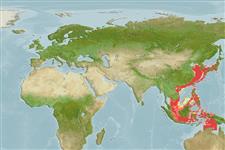
marin; eau douce; saumâtre pelagic-neritic; amphidrome; profondeur 10 - ? m. Subtropical; 41°N - 14°S, 102°E - 140°E (Ref. 168)
Western Pacific: Akita, Honshu, Sea of Japan, Yellow Sea and China south to Vietnam and Cambodia where it enters the Mekong River.
Taille / Poids / Âge
Maturité: Lm ? range ? - ? cm
Max length : 247 cm TL mâle / non sexé; (Ref. 83530); common length : 100.0 cm TL mâle / non sexé; (Ref. 27773); poids max. publié: 131.00 g (Ref. 83530)
Épines dorsales (Total) : 15 - 17; Rayons mous dorsaux (Total) : 15 - 17; Épines anales: 0; Rayons mous anaux: 16 - 19; Vertèbres: 41 - 42. Interpelvic process small and bifid. Body covered with small scales. Lateral line abruptly curving down below first dorsal fin. Intestine with 2 folds and 3 limbs. Swim bladder present. Sides silvery with large round, indistinct spots in two poorly defined rows in adults. Juveniles with saddle-like blotches extending down to about middle of body.
Body shape (shape guide): fusiform / normal; Cross section: oval.
Travels 300 km up the Mekong River, above Phnom Penh but believed to reproduce only in marine waters. Feeds on fishes and swims well upstream river because of easy food availability (Ref. 12693). No information on biology available (Ref. 9684). It is a prized food fish in Japan and probably in China as well. Utilized fresh, dried or salted and smoked; consumed pan-fried, broiled and baked (Ref. 9987).
Life cycle and mating behavior
Maturité | Reproduction | Frai | Œufs | Fécondité | Larves
Collette, B.B. and C.E. Nauen, 1983. FAO Species Catalogue. Vol. 2. Scombrids of the world. An annotated and illustrated catalogue of tunas, mackerels, bonitos and related species known to date. Rome: FAO. FAO Fish. Synop. 125(2):137 p. (Ref. 168)
Statut dans la liste rouge de l'IUCN (Ref. 130435: Version 2025-1)
Menace pour l'homme
Harmless
Utilisations par l'homme
Pêcheries: commercial; pêche sportive: oui
Outils
Articles particuliers
Télécharger en XML
Sources Internet
Estimates based on models
Preferred temperature (Réf.
123201): 11.9 - 28.3, mean 26.6 °C (based on 719 cells).
Phylogenetic diversity index (Réf.
82804): PD
50 = 0.5000 [Uniqueness, from 0.5 = low to 2.0 = high].
Bayesian length-weight: a=0.00851 (0.00392 - 0.01850), b=3.03 (2.86 - 3.20), in cm total length, based on LWR estimates for this Genus-body shape (Ref.
93245).
Niveau trophique (Réf.
69278): 4.5 ±0.80 se; based on food items.
Résilience (Réf.
120179): Faible, temps minimum de doublement de population : 4,5 à 14 années (Preliminary K or Fecundity.).
Fishing Vulnerability (Ref.
59153): Very high vulnerability (90 of 100).
🛈