


Oreochromis aureus (Steindachner, 1864)
Blue tilapia
Uploaden van uw Foto's en video's
Afbeeldingen | Google afbeelding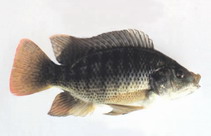 Oreochromis aureus
Afbeelding van CAFS
Afbeeldingen | Google afbeelding
Afbeelding van CAFS
Classificatie / Namen Lokale namen | Synoniemen | Catalog of Fishes(Genus, Soort(en)) | ITIS | CoL | WoRMS | Cloffa
> Cichliformes (Cichlids, convict blennies) > Cichlidae (Cichlids) > Pseudocrenilabrinae
Etymology: Oreochromis: Latin, aurum = gold + Greek, chromis = a fish, perhaps a perch (Ref. 45335).
More on author: Steindachner.
Etymology: Oreochromis: Latin, aurum = gold + Greek, chromis = a fish, perhaps a perch (Ref. 45335).
More on author: Steindachner.
Milieu: milieu / Klimaatzone / Diepte / verspreidingsgebied Ecologie
; zoet water; brak water benthopelagisch; potamodroom (Ref. 126106); diepte 5 - ? m. Tropical; 8°C - 30°C (Ref. 2); 35°N - 10°N
Verspreiding Gebieden | FAO regio's | Ecosystemen | Voorkomen | Verspreidingskaart | Introducties | Faunafri
Africa and Eurasia: Jordan Valley, Lower Nile, Chad Basin, Benue, middle and upper Niger, Senegal River (Ref. 21). Introduced in the oasis of Azraq (Jordan) as well as in warm water ponds of USA, South and Central America and South East Asia. At least one country reports adverse ecological impact after introduction.
Lengte bij maturiteit / Grootte / Gewicht / Leeftijd
Maturiteit: Lm 19.0, range 13 - 20 cm
Max length : 45.7 cm TL mannelijk / geslacht onbekend; (Ref. 40637); common length : 16.0 cm TL mannelijk / geslacht onbekend; (Ref. 12193); max. gepubliceerd gewicht: 2.0 kg (Ref. 40637)
Max length : 45.7 cm TL mannelijk / geslacht onbekend; (Ref. 40637); common length : 16.0 cm TL mannelijk / geslacht onbekend; (Ref. 12193); max. gepubliceerd gewicht: 2.0 kg (Ref. 40637)
Korte beschrijving Determinatiesleutels | Morfologie | Morfometrie
Dorsale stekels (totaal) : 14 - 17; Dorsale zachte stralen (totaal) : 11 - 15; Anale stekels: 3; Anale zachte stralen: 8 - 11; Wervels: 28 - 31. Diagnosis: Adults: narrow preorbital bone (depth max. 21.5% of head length in fishes up to 21.3cm SL); lower pharyngeal jaw with short blade; no enlargement of the jaws in mature fish (lower jaw not exceeding and usually less than 36.8% head length) (Ref. 2). Caudal without regular dark vertical stripes (Ref. 2, 53405, 54467), but with a broad pink to bright red distal margin (Ref. 2). Breeding males assume an intense bright metallic blue on the head, a vermilion edge to the dorsal fin and a more intense pink on the caudal margin (Ref. 2, 54467). Breeding females with the edges of dorsal and caudal fins in a paler more orange color (Ref. 2). Juveniles: upper line of head profile running upward from snout at sharp angle; lower pharyngeal bone nearly triangular, teeth numerous but not densely crowded; dorsal and anal fin striped, with stripes running obliquely on the soft dorsal and longitudinally on the caudal fin; black Tilapia-mark on soft dorsal present; body dark; lower lip developed from beneath (Ref. 54566).
Body shape (shape guide): fusiform / normal.
Body shape (shape guide): fusiform / normal.
Cold tolerant (Ref. 23, 61, 55352), occuring at temperatures ranging from 8°-30°C (Ref. 2), tolerating up to 41 °C (Ref. 23). Adults can tolerate fairly brackish conditions (Ref. 3, 23, 61, 2001, 6465, 54362). They form schools; is sometimes territorial; inhabits warm ponds and impoundments as well as lakes and streams (Ref. 5723, 11028), in open water as well as among stones and vegetation (Ref. 11028). They feed on phytoplankton and small quantities of zooplankton (Ref. 3, 61, 6465, 52307). Young fish have a more varied diet which includes large quantities of copepods and cladocerans (Ref. 2, 61, 6465), but they also take pieces of small invertebrates (Ref. 52307). Ovophilic, agamous (Ref. 52307), maternal mouthbrooder (Ref. 364, 52307). Sexual maturity in ponds reached at age of 5-6 months (Ref. 55352). Reproduction takes place in both fresh and brackish water (Ref. 61, 5723). Good taste (Ref. 61).
Levenscyclus en paargedrag Maturiteit | Voortplanting | Paaien | Eieren | Fecunditeit | Larven
Nesting usually in shallow water weedy areas (Ref. 96). Males establish territory and dig a spawning pit (Ref. 2, 6465, 54601), using mouth and fins (Ref. 2), up to 60cm deep and 4-6m in diameter; a number of territories can often be found clustered together (Ref. 52307). Territories are defended by means of agressive behaviour (Ref. 6465), including lateral display, lateral biting and mouth-to-mouth combat (Ref. 2). Reproduction is stimulated by long photoperiods and inhibited by short daylengths (Ref. 54365). Reproduction requires a minimum temperature of about 20°C (Ref. 2). Males visit schools of females and attempt to attract a female spawning partner (Ref. 2, 52307). Courting behaviour in the nest consists of lateral display by both sexes with nipping and tail-flapping (Ref. 2). Eggs are deposited in single clutches, from several dozen to 100 eggs (Ref. 52307), and are taken into the females mouth as soon as they are fertilized (Ref. 2, 6465, 52307), with a peak spawning frequency around the 9-11th hour of light (Ref. 31140, 54365). One female may hold up to 2000 eggs in her mouth (Ref. 2). The female swims away to deeper water with the brood after spawning is complete (Ref. 2, 52307), while the male renews spawning activities with another female. Hatching occurs about 3 days after oviposition (Ref. 2). Incubation time varies with temperature, 13-14 days at 25-27°C (Ref. 2, 52307) or 8-10 days at 29°C (Ref. 144), and juveniles leave the mother's mouth when they are about 1.1cm in length (Ref. 54601). The young school near parent's head for a few days, reentering the mouth at any sign of danger or at a gesture of the female; parent-offspring relationship ceases after 5 days (Ref. 2).
Hoofdreferentie
Upload uw referenties | Referenties | Coördinator : Kullander, Sven O. | Medewerkers
Trewavas, E., 1983. Tilapiine fishes of the genera Sarotherodon, Oreochromis and Danakilia. British Mus. Nat. Hist., London, UK. 583 p. (Ref. 2)
CITES
Not Evaluated
Gevaar voor de mens
Potential pest (Ref. 6465)
Gebruik door de mens
Visserij: van groot commercieel belang; Aquacultuur: commercieel; sportvis: ja; Aquarium: Commercieel; aas: usually
FAO - Aquacultuursystemen: productie; visserij: aanvoer; Publication: search | FishSource |
Meer informatie
Trofische ecologie
Voedsel (prooien)
Dieetsamenstelling
Voedselconsumptie
Voedselrantsoenen
Predatoren
Voedsel (prooien)
Dieetsamenstelling
Voedselconsumptie
Voedselrantsoenen
Predatoren
Populatiedynamica
Groeiparameters
Max. leeftijden / maten
Lengte-gewicht rel.
Lengte-lengte rel.
Lengtefrequenties
Massaconversie
Rekrutering
Abundantie
Groeiparameters
Max. leeftijden / maten
Lengte-gewicht rel.
Lengte-lengte rel.
Lengtefrequenties
Massaconversie
Rekrutering
Abundantie
Levenscyclus
Voortplanting
Maturiteit
Rijpheid/kieuwen rel.
Fecunditeit
Paaien
Paaibestanden
Eieren
Ontwikkeling van de eieren
Larven
Larvale populatiedynamiek
Voortplanting
Maturiteit
Rijpheid/kieuwen rel.
Fecunditeit
Paaien
Paaibestanden
Eieren
Ontwikkeling van de eieren
Larven
Larvale populatiedynamiek
Anatomie
Kieuwoppervlak
Hersenen
Otoliet
Kieuwoppervlak
Hersenen
Otoliet
Fysiologie
Lichaamssamenstelling
Voedingsstoffen
Zuurstofverbruik
Type zwemmen
Zwemsnelheid
Visuele pigmenten
Vis geluid
Ziekten en parasieten
Toxiciteit (LC50)
Lichaamssamenstelling
Voedingsstoffen
Zuurstofverbruik
Type zwemmen
Zwemsnelheid
Visuele pigmenten
Vis geluid
Ziekten en parasieten
Toxiciteit (LC50)
Menselijk gerelateerd
Aquacultuursystemen
Aquacultuurprofielen
Kweeklijnen
Ciguatera gevallen
Postzegels, munten, diversen.
Aquacultuursystemen
Aquacultuurprofielen
Kweeklijnen
Ciguatera gevallen
Postzegels, munten, diversen.
Tools
E-boek | Veldgids | Determinatiesleutels | Lengtefrequentie Tool | Levenscyclus tool | Verspreidingskaart |
Vangst-MSY |
Speciale rapporten
Bekijk gegevens voor het houden in een aquarium | Bekijk Fact Sheets voor de soort | Bekijk Aquacultuur Fact Sheets
Download XML
Internetbronnen
AFORO (otoliths) | Exoten/Invasieve soorten database | Aquatic Commons | BHL | Cloffa | Websites from users | Bekijk FishWatcher | CISTI | Catalog of Fishes: Genus, Soort(en) | DiscoverLife | ECOTOX | FAO - Aquacultuursystemen: productie; visserij: aanvoer; Publication: search | Faunafri | Fishipedia | Fishtrace | GloBI | Google Books | Google Scholar | Google | IGFA World Record | Nationale databanken | OneZoom | Open Tree of Life | Otolith Atlas of Taiwan Fishes | PubMed | Reef Life Survey | Socotra Atlas | TreeBase | Tree of Life | Wikipedia: ga naar, zoek | World Records Freshwater Fishing | Zoological Record
Schattingen op basis van modellen
Fylogenetische diversiteitsindex (Ref. 82804): PD50 = 0.5000 [Uniqueness, from 0.5 = low to 2.0 = high].
Bayesian length-weight: a=0.01778 (0.01389 - 0.02277), b=2.99 (2.95 - 3.03), in cm total length, based on LWR estimates for this species (Ref. 93245).
Trofisch niveau (Ref. 69278): 2.1 ±0.0 se; based on diet studies.
Generation time: 2.2 (0.3 - 4.4) years. Estimated as median ln(3)/K based on 10 growth studies.
Weerstandsvermogen (Ref. 120179): Hoog, minimale populatieverdubbelingstijd minder dan 15 maanden (K=0.48-0.58; tm<1).
Voedingsstoffen (Ref. 124155): Calcium = 20.5 [7.9, 95.6] mg/100g; Iron = 1.09 [0.53, 2.43] mg/100g; Protein = 17.9 [16.4, 19.7] %; Omega3 = 0.216 [0.110, 0.456] g/100g; Selenium = 59.4 [31.1, 114.4] μg/100g; VitaminA = 8.08 [1.98, 29.17] μg/100g; Zinc = 1.68 [0.99, 3.97] mg/100g (wet weight);