Environment: milieu / climate zone / djupintervall / distribution range
Ekologi
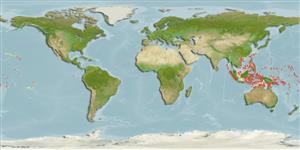
marina revassocierade; ej vandrande; djupintervall 0 - 30 m (Ref. 13227). Tropical; 30°N - 15°S
Western Pacific: Japan (Ref. 76833), Ryukyu Islands to eastern Australia, including Mariana, Marshall, Samoan, and Phoenix islands (Kiribati), the Ouvéa Atoll in the Loyalty Islands, to American Samoa.
Size / Vikt / Age
Könsmognad: Lm ? range ? - ? cm
Max length : 4.8 cm SL hane/ej könsbestämd; (Ref. 54980)
Short description
Bestämningsnycklar | Morfologi | Morfometri
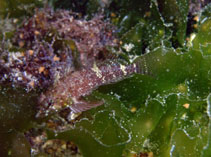
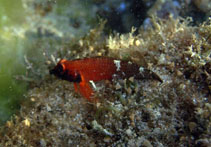
Taggstrålar i ryggfenan (totalt) : 15 - 16; Mjukstrålar i ryggfenan (totalt) : 9 - 10; Taggstrålar i analfenan: 1; Mjukstrålar i analfenan: 17 - 19. Males have dark lower head and are abruptly dark posterior, occasionally with alternating broad dark and light bands (Ref. 37816 ). Adults are identified by the greenish tail and the color usually extends well onto the body (Ref. 48636). Mature males with two broad, black bands below third dorsal fin base and caudal peduncle, two bands joined ventrally; posterior half of anal fin black in mature males; caudal fin base white; pectoral and pelvic fins and body orange in mature males (Ref. 76833).
Body shape (shape guide): elongated.
Adults are found in various reef habitats (Ref. 48636) especially in reef flats and tidepools (Ref. 90102) and in surf-swept reef margins. Also found in intertidal areas and is usually associated with coralline rock and coral reef lagoons (Ref. 13227). Eggs are hemispherical and covered with numerous sticky threads that anchor them in the algae on the nesting sites (Ref. 240). Larvae are planktonic which occur primarily in shallow, nearshore waters (Ref. 94114).
Life cycle and mating behavior
Könsmognad | Reproduktion | Lek | Ägg | Fecundity | Larver
Fricke, R., 1994. Tripterygiid fishes of Australia, New Zealand and the southwest Pacific Ocean (Teleostei). Theses Zool. 24:1-585. (Ref. 13227)
IUCN Red List Status (Ref. 130435: Version 2025-1)
Threat to humans
Harmless
Human uses
Fiskeri: saknar intresse
Verktyg
Special reports
Download XML
Internet-källor
Estimates based on models
Preferred temperature (Ref.
123201): 27.1 - 29.3, mean 28.7 °C (based on 1529 cells).
Phylogenetic diversity index (Ref.
82804): PD
50 = 0.5000 [Uniqueness, from 0.5 = low to 2.0 = high].
Bayesian length-weight: a=0.00617 (0.00288 - 0.01322), b=3.04 (2.86 - 3.22), in cm total length, based on LWR estimates for this (Sub)family-body shape (Ref.
93245).
Trofisk nivå (Ref.
69278): 3.2 ±0.3 se; based on size and trophs of closest relatives
Resiliens (Ref.
120179): Hög, lägsta populationsfördubblingstid mindre än 15 månader (Preliminary K or Fecundity.).
Fishing Vulnerability (Ref.
59153): Low vulnerability (10 of 100).
🛈
Nutrients (Ref.
124155): Calcium = 325 [145, 881] mg/100g; Iron = 1.68 [0.74, 3.29] mg/100g; Protein = 18.2 [16.8, 19.6] %; Omega3 = 0.106 [0.039, 0.307] g/100g; Selenium = 50.5 [14.1, 154.8] μg/100g; VitaminA = 61.8 [13.2, 287.7] μg/100g; Zinc = 3.85 [2.04, 6.37] mg/100g (wet weight);