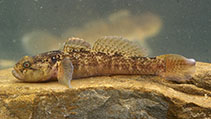
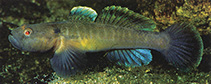
>
Gobiiformes (Gobies) >
Gobiidae (Gobies) > Gobiinae
Etymology: Padogobius: From Greek, Pados, ou = the name of river Po in Italy + Latin, gobius = gudgeon (Ref. 45335).
Eponymy: Franco Andrea Bonelli (1784–1930) was an Italian zoologist, ornithologist and collector. [...] (Ref. 128868), visit book page.
More on author: Bonaparte.
Environment: milieu / climate zone / εύρος βάθους / distribution range
Οικολογία
; Γλυκού νερού βενθικό(ς); pH range: 7.0 - 7.5; dH range: 10 - ?. Temperate; 10°C - 18°C (Ref. 2060); 46°N - 42°N, 7°E - 17°E
Europe: Italian rivers of the northern Adriatic, northwards from the Marches, and including the Po basin (with Swiss tributaries) and Venezia, as well as the Dalmatian rivers Zrmanje and Krka.
Μέγεθος / Βάρος / Age
Γεννητική Ωρίμανση: Lm ? range ? - ? cm
Max length : 8.6 cm TL αρσενικό/απροσδιόριστο; (Ref. 12215); 7.5 cm TL (female)
Short description
Κλείδες προσδιορισμού | Μορφολογία | Μορφομετρία
Σπόνδυλοι: 28 - 29. No head lateral-line canals; paired rows of interorbital papillae, with short single transverse row often present at midpoint of interorbit. Typically D2 I/10 (9-11) (Ref. 12215). This species is distinguished from other gobies in freshwaters of Adriatic basin and Italy by the following characters: no cephalic lateral line canals; branched rays in second dorsal 11-12.5; scales in midlateral series 29-43; completely scaled caudal peduncle (Ref. 59043).
Body shape (shape guide): fusiform / normal; Cross section: circular.
Found in streams with moderate flow over pebble beds, from altitudes of 400 m to sea level, and also at lake edges (with dense vegetation or coarse gravel, Ref. 59043). Spawns for the first time at 1 year; spawning season in April to July, when temperature reaches 20°C; females may repeat spawning during a season. Adhesive eggs deposited between stones, shells and aquatic plants and males guard the eggs until hatching. When spawning and defending the nest, males produce sounds. Feeds on a variety of benthic invertebrates (Ref.59043).
Territorial, usually burrows under flat stones. A short-lived species which is threatened by pollution and habitat destruction (Ref. 26100). Known to be invasive in Italy and has massively expanded its range south since the last decades (Ref. 92840).
Male only guards the clutch as long as the young have not hatched (Ref.26100). Males produce sounds when spawning and defending the nest (Ref.59043).
Kottelat, M., 1997. European freshwater fishes. An heuristic checklist of the freshwater fishes of Europe (exclusive of former USSR), with an introduction for non-systematists and comments on nomenclature and conservation. Biologia, Bratislava, 52/Suppl. 5:1-271. (Ref. 13696)
IUCN Red List Status (Ref. 130435: Version 2025-1)
Threat to humans
Harmless
Human uses
Εργαλεία
Special reports
Download XML
Διαδικτυακές πηγές
Estimates based on models
Phylogenetic diversity index (Αναφ.
82804): PD
50 = 0.7500 [Uniqueness, from 0.5 = low to 2.0 = high].
Bayesian length-weight: a=0.01023 (0.00477 - 0.02194), b=3.01 (2.83 - 3.19), in cm total length, based on LWR estimates for this (Sub)family-body shape (Ref.
93245).
Τροφικό Επίπεδο (Αναφ.
69278): 3.5 ±0.37 se; based on food items.
Ελαστικότητα (Αναφ.
120179): Υψηλό, ελάχιστος χρόνος για διπλασιασμό πληθυσμού < 15 μήνες (Preliminary K or Fecundity.).
Fishing Vulnerability (Ref.
59153): Low vulnerability (10 of 100).
🛈