>
Ovalentaria/misc (Various families in series Ovalentaria) >
Pomacentridae (Damselfishes) > Microspathodontinae
Etymology: Stegastes: Greek, stegastos, -e, -on = covered (Ref. 45335).
Eponymy: Dr Charles William Beebe (1877–1962) was an American naturalist, ornithologist, marine biologist, entomologist, explorer and author. [...] (Ref. 128868), visit book page.
More on author: Nichols.
Environment: milieu / Zona climática / intervalo de profundidade / distribution range
Ecologia
marinhas associadas(os) a recifes; não migratória; intervalo de profundidade 1 - 5 m (Ref. 9334). Tropical; 9°N - 1°S
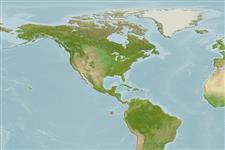
Eastern Pacific: off Panama, Malpelo Island (Colombia), Cocos Island (Costa Rica), and the Galapagos Islands.
Tamanho / Peso / Idade
Maturidade: Lm ? range ? - ? cm
Max length : 15.0 cm SL macho/indeterminado; (Ref. 28023)
Descrição suscinta
Chaves de identificação | Morfologia | Morfometria
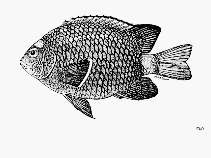
Raios dorsais (total) : 15; Raios anais : 13. Usually with 14 or 15 spines and 10 or 11 gill rakers (Ref. 7247).
Adults inhabit coral and rocky reefs (Ref. 9334). Somewhat territorial, they chase away small intruders (Ref. 5227). Omnivorous, they graze on algae and nibbles at small crustaceans and the tentacles of anemones (Ref. 28023). Oviparous, distinct pairing during breeding (Ref. 205). Eggs are demersal and adhere to the substrate (Ref. 205). Males guard and aerate the eggs (Ref. 205).
Ciclo de vida ou comportamento de acasalamento
Maturidade | Reprodução | Desova | Ovos | Fecundidade | Larvas
Oviparous, distinct pairing during breeding (Ref. 205). Eggs are demersal and adhere to the substrate (Ref. 205). Males guard and aerate the eggs (Ref. 205).
Grove, J.S. and R.J. Lavenberg, 1997. The fishes of the Galápagos Islands. Stanford University Press, Stanford, 863 p. (Ref. 28023)
Status na Lista Vermelha da UICN (Ref. 130435: Version 2025-1)
Ameaça para os humanos
Harmless
Uso pelos humanos
Ferramentas
Relatórios especiais
Baixar XML
Fontes da internet
Estimates based on models
Preferred temperature (Ref.
123201): 23.6 - 28.6, mean 26.8 °C (based on 49 cells).
Índice de diversidade filogenética (Ref.
82804): PD
50 = 0.5000 [Uniqueness, from 0.5 = low to 2.0 = high].
Bayesian length-weight: a=0.02089 (0.00953 - 0.04582), b=2.98 (2.80 - 3.16), in cm total length, based on LWR estimates for this Genus-body shape (Ref.
93245).
Nível Trófico (Ref.
69278): 3.0 ±0.44 se; based on food items.
Resiliência (Ref.
120179): Elevada, tempo mínimo de duplicação da população menor que 15 meses (Preliminary K or Fecundity.).
Fishing Vulnerability (Ref.
59153): Low vulnerability (23 of 100).
🛈
Nutrients (Ref.
124155): Calcium = 103 [53, 163] mg/100g; Iron = 0.737 [0.431, 1.217] mg/100g; Protein = 18.5 [17.4, 19.7] %; Omega3 = 0.0956 [, ] g/100g; Selenium = 18.1 [10.1, 35.0] μg/100g; VitaminA = 75.7 [22.3, 248.1] μg/100g; Zinc = 1.58 [1.06, 2.32] mg/100g (wet weight);