


Oreochromis esculentus (Graham, 1928)
Singida tilapia
Adicionar o seu Fotografias e vídeos
Fotografias | Imagem do Google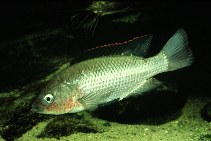 Oreochromis esculentus
Male Fotografia de Seegers, L.
Fotografias | Imagem do Google
Male Fotografia de Seegers, L.
Classificação / Nomes Nomes comuns | Sinónimos | Catalog of Fishes(Género, Espécies) | ITIS | CoL | WoRMS | Cloffa
> Cichliformes (Cichlids, convict blennies) > Cichlidae (Cichlids) > Pseudocrenilabrinae
Etymology: Oreochromis: Latin, aurum = gold + Greek, chromis = a fish, perhaps a perch (Ref. 45335); esculentus: Esculentus (latin) = edible (Ref. 27292). "The specific name esculenta is suggested, so as to express the fact that this is the important edible commercial species of Lake Victoria." (Ref. 27292, 55055).
Etymology: Oreochromis: Latin, aurum = gold + Greek, chromis = a fish, perhaps a perch (Ref. 45335); esculentus: Esculentus (latin) = edible (Ref. 27292). "The specific name esculenta is suggested, so as to express the fact that this is the important edible commercial species of Lake Victoria." (Ref. 27292, 55055).
Ambiente: milieu / zona climática / intervalo de profundidade / gama de distribuição Ecologia
; Água doce bentopelágico; intervalo de profundidade 0 - 50 m (Ref. 34291), usually ? - 20 m (Ref. 34290). Tropical; 23°C - 28°C (Ref. 3)
Distribuição Territórios | Áreas FAO | Ecossistemas | Ocorrências | Mapa dos pontos | Introduções | Faunafri
Africa: Lake Victoria, Lake Nabugabo, Lakes Kyoga and Kwania, the Victoria Nile above the Murchison Falls, Malawa River and Lake Gangu (Ref. 5166, 34290) in Tanzania, Uganda and Kenya (Ref. 3); but now extirpated from the main lake body and the only natural remaining populations are those of satellite lakes (Ref. 118638). The species has been introduced into dams of the Lake Victoria catchment, as well as the Pangani catchment, Zigi River, Malagarazi River, Lake Rukwa, Wami River and the central Tanzania lakes surrounding Dodoma and Tabora (Ref. 118630, 118638). Introductions in the Akagera lakes in Rwanda (Ref. 1739, 54979) seem to have been based on erroneous tilapia identifications (Ref. 46152).
Comprimento na primeira maturidade / Tamanho / Peso / Idade
Maturidade: Lm 24.9, range 17 - 27 cm
Max length : 50.0 cm SL macho/indeterminado; (Ref. 2); common length : 31.0 cm SL macho/indeterminado; (Ref. 34290); peso máx. Publicado: 2.5 kg (Ref. 2); Idade máx. registada: 10 anos (Ref. 2)
Max length : 50.0 cm SL macho/indeterminado; (Ref. 2); common length : 31.0 cm SL macho/indeterminado; (Ref. 34290); peso máx. Publicado: 2.5 kg (Ref. 2); Idade máx. registada: 10 anos (Ref. 2)
Descrição breve Chaves de identificação | Morfologia | Morfometria
Espinhos dorsais (total) : 16 - 18; Raios dorsais moles (total) : 10 - 11; Espinhos anais: 3; Raios anais moles: 10 - 12; Vértebras: 30 - 31. Diagnosis: A large bodied tilapia with a small rounded head, short snout, forward-facing mouth, deep body, relatively small eye for the body size, and generally lacking any dark stripes or blotches (Ref. 118638). Females and non-territorial males typically pale grey, white ventrally; males are typically darker, especially in the head/dorsal region; breeding males have a reddish-pink head and flank, dark fins with red/pink dorsal margins, and red/pink caudal region (Ref. 118638). In contrast to Oreochromis rukwaensis, mature males of O. esculentus do not show enlarged jaws (Ref. 27292). Oreochromis esculentus differs from O. niloticus as follows: no vertical stripes on the caudal fin; lower numbers of soft dorsal rays and therefore of total dorsal rays; lower modal number of lower gill-rakers; finer teeth in jaws and pharynx; a longer lower pharyngeal bone, 33.0-35.5% length of head; caudal peduncle as long as or, usually, longer than deep; O. niloticus, in common with many other species, is often preserved with three or four midlateral spots and another on the top of the caudal peduncle, a pattern not found in O. esculentus; and male genital papilla opening between a pair of often spongy lobes, vs. papilla conical or with a slight distal notch in O. niloticus (Ref. 2).
Body shape (shape guide): fusiform / normal.
Body shape (shape guide): fusiform / normal.
Occasionally forms schools (Ref. 2, 363, 36900), mainly diurnal (Ref. 2). Tolerant of low oxygen concentrations, less than 1 ppm, and high levels of carbon dioxide (Ref. 3, 52016). A plankton-feeder using the mucus-trap mechanism combined with the combing action of the pharyngeal teeth (Ref. 2); the species is non-selective, in the sense that all organisms of a size capable of being retained by these means are passed into the stomach, but it is selective in that the schools follow concentrations of diatoms in the lake (Ref. 2). Food consist almost entirely of phytoplankton (Ref. 3, 6316), mainly diatoms (Ref. 4903, 30832, 34291), but also higher plants, insects and their larvae, crustaceans and worms like Tubifex (Ref. 27292); insect larvae and planktonic crustaceans occur less frequently although they may contribute to the diet of young fishes (Ref. 4903, 34291). A maternal mouthbrooder (Ref. 363, 4903, 12468, 27292, 34291, 54840, 118638); males make simple nests in shallow water (Ref. 118638). Ecologically, an offshore-living plankton feeder, which complemented the more inshore-living Oreochromis variabilis in the original ecosystem of Lake Victoria; these niches are now filled by the introduced Oreochromis niloticus and O. leucostictus respectively (Ref. 118638). Was a major component of the fisheries catch in Lake Victoria; supports artisanal fisheries in satellite lakes of Lake Victoria and forms a large part of the catch in Lake Rukwa, Nyumba ya Mungu and the central Tanzania lakes (Ref. 118638). Excellent taste, firm meat and suitable for sundrying (Ref. 54860). IUCN conservation status is critically endangered (Ref. 118638).
Ciclo de vida e comportamento de acasalamento Maturidade | Reprodução | Desova | Ovos | Fecundidade | Larvas
Reproduction probably triggered by the rains (Ref. 2771), with the time of maximum spawning activity coinciding with the wettest months of the year (Ref. 363). Males form a crater-like spawning nest without a distinct wall (Ref. 27292). The pit is about 30cm in diameter and 10cm deep, and is probably made in the early morning (Ref. 27292). Ovaries show that a female may have a succession of three or more broods in a spawning period; brooding females often shelter in weed beds and swampy places (Ref. 2, 363). Males defend their breeding territory (Ref. 2) for weeks or on and off for several months, while females only make short visits to the spawning grounds and leave the territory immediately after spawning (Ref. 363). Males eat little while actively guarding the nest (Ref. 363). Papyrus swamp channels (Ref. 363, 34921, 55020) and beaches with weed grown swamps (Ref. 34921) function as nursery areas. Young become independent at a length of about 1.5cm (Ref. 2, 363)by which size the yolk sac is occluded and they have strated to feed (Ref. 363), and at about 12cm TL they move from the nursery areas to the open water (Ref. 2).
Referência principal
Carregar as suas referências | Referências | Coordenador : Kullander, Sven O. | Colaboradores
Trewavas, E., 1983. Tilapiine fishes of the genera Sarotherodon, Oreochromis and Danakilia. British Mus. Nat. Hist., London, UK. 583 p. (Ref. 2)
Categoria na Lista Vermelha da IUCN (Ref. 130435: Version 2025-2 (Global))
Quase ameaçada (NT) (A2bcde); Date assessed: 30 March 2021
CITES
Not Evaluated
Ameaça para o homem
Potential pest (Ref. 13364)
Utilização humana
Pescarias: espécies comerciais; Aquacultura: experimental
FAO - Publication: search | FishSource |
Mais informação
Ecologia Trófica
Produtos alimentares (presas)
Composição da dieta
Consumo alimentar
Rações alimentares
Predadores
Produtos alimentares (presas)
Composição da dieta
Consumo alimentar
Rações alimentares
Predadores
Dinâmica das populações
Parâmetros de crescimento
Idades / tamanhos máximos
Comprimento-peso rel.
Comprimento-comprimento rel.
Frequência de comprimento
Conversão de massa
Recrutamento
Abundância
Parâmetros de crescimento
Idades / tamanhos máximos
Comprimento-peso rel.
Comprimento-comprimento rel.
Frequência de comprimento
Conversão de massa
Recrutamento
Abundância
Ciclo de vida
Reprodução
Maturidade
Maturidade/Rel. das guelras
Fecundidade
Desova
Agregações de desova
Ovos
Desenvolvimento dos ovos
Larvas
Dinâmica larvar
Reprodução
Maturidade
Maturidade/Rel. das guelras
Fecundidade
Desova
Agregações de desova
Ovos
Desenvolvimento dos ovos
Larvas
Dinâmica larvar
Anatomia
Área branquial
Cérebro
Otólitos
Área branquial
Cérebro
Otólitos
Fisiologia
Composição corporal
Nutrientes
Consumo de oxigénio
Tipo de natação
Velocidade de natação
Pigmentos visuais
Som de peixe
Doenças e Parasitas
Toxicidade (LC50s)
Composição corporal
Nutrientes
Consumo de oxigénio
Tipo de natação
Velocidade de natação
Pigmentos visuais
Som de peixe
Doenças e Parasitas
Toxicidade (LC50s)
Genética
genoma
Genética
Heterozigotia
Hereditariedade
Diversidade genética
genoma
Genética
Heterozigotia
Hereditariedade
Diversidade genética
Relacionado com o ser humano
Sistemas de aquacultura
Perfis para aquacultura
Estirpes
Casos de Ciguatera
Selos, moedas, diversos.
Sistemas de aquacultura
Perfis para aquacultura
Estirpes
Casos de Ciguatera
Selos, moedas, diversos.
Ferramentas
Questionário orgânico | E-book | Guia de campo | Ferramenta auxiliar de frequências de comprimento | Ferramenta sobre a história de vida | Mapa dos pontos |
Captura-MSY |
Relatórios especiais
Descarregue XML
Fontes da internet
AFORO (otoliths) | Alien/Invasive Species database | Aquatic Commons | BHL | Cloffa | Websites from users | Consultar FishWatcher | CISTI | Catalog of Fishes: Género, Espécies | DiscoverLife | ECOTOX | FAO - Publication: search | Faunafri | Fishipedia | Fishtrace | GloBI | Google Books | Google Scholar | Google | IGFA World Record | OneZoom | Open Tree of Life | Otolith Atlas of Taiwan Fishes | Aquários públicos | PubMed | Reef Life Survey | Socotra Atlas | TreeBase | Árvore da vida | Wikipedia: ir para, procurar | World Records Freshwater Fishing | Registo zoológico
Estimativas baseadas em modelos
Índice de diversidade filogenética (Ref. 82804): PD50 = 0.5000 [Uniqueness, from 0.5 = low to 2.0 = high].
Bayesian length-weight: a=0.01413 (0.00822 - 0.02428), b=3.02 (2.88 - 3.16), in cm total length, based on LWR estimates for this species & Genus-body shape (Ref. 93245).
Nível Trófico (Ref. 69278): 2.5 ±0.17 se; based on food items.
Resiliência (Ref. 120179): Médio, tempo mínimo de duplicação da população 1,4 - 4,4 anos (tmax=10).