Environment: milieu / climate zone / rango de profundidad / distribution range
Ecología
marino demersal; rango de profundidad 70 - 490 m (Ref. 6390). Subtropical; 27°S - 41°S
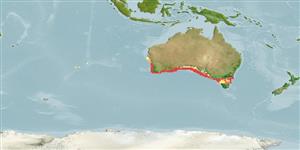
Indo-Pacific: endemic to the southern waters of Australia, from Marrawah in northwestern Tasmania to latitude 27°S off Western Australia. This species has been confused with Platycephalus speculator until recently.
Length at first maturity / Tamaño / Peso / Age
Madurez: Lm 40.0, range 45 - ? cm
Max length : 70.0 cm TL macho / no sexado; (Ref. 6390); 94.0 cm TL (female); peso máximo publicado: 0.00 g; edad máxima reportada: 20 años (Ref. 6390)
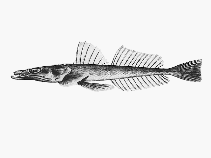
Occurs on the continental shelf and upper slope (Ref. 9563). Feeds primarily on fish, crustaceans and squid (Ref. 6390). Probably forms aggregations by sex (Ref. 27192). Sold as fresh, chilled, or frozen fillets in the domestic market.
Life cycle and mating behavior
Madurez | Reproducción | Puesta | Huevos | Fecundidad | Larva
Paxton, J.R., D.F. Hoese, G.R. Allen and J.E. Hanley, 1989. Pisces. Petromyzontidae to Carangidae. Zoological Catalogue of Australia, Vol. 7. Australian Government Publishing Service, Canberra, 665 p. (Ref. 7300)
IUCN Red List Status (Ref. 130435: Version 2025-1)
Threat to humans
Harmless
Human uses
Pesquerías: comercial
Herramientas
Special reports
Download XML
Fuentes de Internet
Estimates based on models
Preferred temperature (Referencia
123201): 12.7 - 15.8, mean 14.4 °C (based on 15 cells).
Phylogenetic diversity index (Referencia
82804): PD
50 = 0.5000 [Uniqueness, from 0.5 = low to 2.0 = high].
Bayesian length-weight: a=0.00457 (0.00230 - 0.00908), b=3.09 (2.91 - 3.27), in cm total length, based on LWR estimates for this (Sub)family-body shape (Ref.
93245).
Nivel trófico (Referencia
69278): 4.0 ±0.59 se; based on food items.
Resiliencia (Referencia
120179): Bajo, población duplicada en un tiempo mínimo de 4.5-14 años (tm=4-6; tmax=20).
Fishing Vulnerability (Ref.
59153): Moderate to high vulnerability (53 of 100).
🛈