>
Cichliformes (Cichlids, convict blennies) >
Cichlidae (Cichlids) > Pseudocrenilabrinae
Etymology: Sarotherodon: Greek, saros, -ou = sawdust + Greek, ther = animal * Greek, odous = teeth (Ref. 45335).
Eponymy: Karl Lohberger was (probably) Holly’s colleague at Naturhistorisches Staatsmuseum (Vienna). He published six papers on fishes (1929–1930) and then seems to have dropped from the ichthyological record. He named a barbel after Holly. (Ref. 128868), visit book page.
Miljö: miljö / Klimatzon / djupintervall / distributionsområde
Ekologi
; sötvatten bottenlevande. Tropical; 25°C - 27°C (Ref. 12468); 5°N - 4°N
Africa: Lake Barombi Mbo (Ref. 4999, 81260), a tributary of the Kake River (affluent of Lake Barombi Mbo) (Ref. 81260) and Kumba stream (tributary of the outlet of Barombi Mbo) (Ref. 4999), in west Cameroon.
Storlek / Vikt / Ålder
Könsmognad: Lm ? range ? - ? cm
Max length : 16.2 cm SL hane/ej könsbestämd; (Ref. 81260)
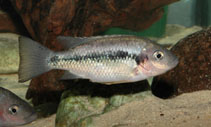
Taggstrålar i ryggfenan (totalt) : 15 - 17; Mjukstrålar i ryggfenan (totalt) : 10 - 12; Taggstrålar i analfenan: 3; Mjukstrålar i analfenan: 8 - 10; Ryggkotor: 29. Diagnosis: 14-18 rakers on lower limb of first arch; 30-31 scales in lateral line (Ref. 81260). Body silver-grey, with mid-lateral black band interrupted anteriorly on caudal peduncle (Ref. 2, 81260). Head length 33.0-38.4% of standard length; jaw teeth with slender shafts and broad crowns (Ref. 81260). Mature fishes of both sexes with variable black areas on lower jaw and lower parts of head; no tilapia-mark (Ref. 2).
Body shape (shape guide): short and / or deep.
Found throughout the lake, but seems to prefer zones with submerged wooden or stone structures (Ref. 52307). Usually forms schools at the surface; feeds mainly on epiphytic and epilithic filamentous algae, and the diatoms, rhizopods, rotifers and organic debris found among them; adults feed by opening their mouths very wide and applying them to the surface of the rock as though sucking the material in (Ref. 2). Lacks marked sexual dichromatism when sexually active (Ref. 81260). Both sexes are possible incubators (Ref. 52307). Forms temporary pair bonds (Ref. 81260), for the entire duration of incubation/broodcare (Ref. 52307).
Livscykel och parningsbeteende
Könsmognad | Reproduktion | Lek | Ägg | Fekunditet | Larver
Absence of sexual dichromatism suggests a biparental mouth-brooding function.
Trewavas, E. and G.G. Teugels, 1991. Sarotherodon. p. 425-437. In J. Daget, J.-P. Gosse, G.G. Teugels and D.F.E. Thys van den Audenaerde (eds.) Check-list of the freshwater fishes of Africa (CLOFFA). ISNB, Brussels; MRAC, Tervuren; and ORSTOM, Paris. Vol. 4. (Ref. 4999)
Status på IUCN:s rödlista (Ref. 130435: Version 2025-2)
Hot mot människor
Harmless
Mänskliga användningsområden
Verktyg
Särskilda rapporter
Ladda ner XML
Internet-källor
Uppskattningar baserade på modeller
Index för fylogenetisk mångfald (Ref.
82804): PD
50 = 0.5001 [Uniqueness, from 0.5 = low to 2.0 = high].
Bayesian length-weight: a=0.01862 (0.00830 - 0.04177), b=3.01 (2.82 - 3.20), in cm total length, based on LWR estimates for this (Sub)family-body shape (Ref.
93245).
Trofisk nivå (Ref.
69278): 2.2 ±0.15 se; based on food items.
Resiliens (Ref.
120179): Hög, lägsta populationsfördubblingstid mindre än 15 månader (Preliminary K or Fecundity.).
Sårbarhet i fisket (Ref.
59153): Low vulnerability (10 of 100).
🛈