-

- Об этой странице
- Языки
- Отзывы пользователей
- Цитировать
- Загрузка
- Близкие виды
-



Oreochromis karomo (Poll, 1948)
Karomo
Загрузить свой Фото и Видео
изображения | Изображение на Google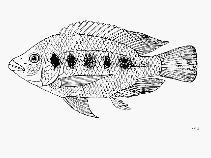 Oreochromis karomo
Male Изображение сделано FAO
изображения | Изображение на Google
Male Изображение сделано FAO
Классификация / Имена народные названия | синонимы | Catalog of Fishes(род, виды) | ITIS | CoL | WoRMS | Cloffa
> Cichliformes (Cichlids, convict blennies) > Cichlidae (Cichlids) > Pseudocrenilabrinae
Etymology: Oreochromis: Latin, aurum = gold + Greek, chromis = a fish, perhaps a perch (Ref. 45335); karomo: Karomo is the local name of the species (Ref. 2).
More on author: Poll.
Etymology: Oreochromis: Latin, aurum = gold + Greek, chromis = a fish, perhaps a perch (Ref. 45335); karomo: Karomo is the local name of the species (Ref. 2).
More on author: Poll.
Окружающая среда: среда / климатическая зона / пределы глубины / диапазон распространения экология
; пресноводный донно-пелагический. Tropical; 22°C - 28°C (Ref. 2060); 4°S - 6°S
распространение Территории | регионы FAO | Экосистемы | места находок | карта точек | интродукции | Faunafri
Размер / Вес / Возраст
Краткое описание определительные ключи | морфология | морфометрия
колючие лучи спинного плавника (общее число) : 15 - 16; членистые (мягкие) лучи спинного плавника (общее число) : 12 - 13; колючие лучи анального плавника: 3; членистые (мягкие) лучи анального плавника: 10 - 11; позвонки: 29. Diagnosis: A large bodied Oreochromis, characterised by elongated jaws, projecting forwards to form a long snout, with the tooth-bands meeting in the horizontal plane; broad bands of tricuspid teeth, with long, slender shafts and curved crowns, arranged in broad bands; maxilla with a flange resting on the premaxilla at the curve between its two arms; and dorsal region and flanks dark green/olive, ventral region lighter (Ref. 2, 118638). A tasseled species (Ref. 2). Fins of ripening males dark with orange lappets on the dorsal, female fins plain grey/olive (Ref. 118638). Females and non-breeding males have 3 large blotches on the flanks (Ref. 118638). Fully ripe males are purplish blue with dark spots on the flank scales, a blue-green head, bright blue lips and have blue-white stripes and spots on the dorsal, anal and tail fins; the dorsal and tailfins have broad orange margins, and there is a long, branched orange/red genital tassel (Ref. 118638).
Body shape (shape guide): short and / or deep.
Body shape (shape guide): short and / or deep.
Males were seen scooping up algal debris from the bottom, and occasionally they moved to the adjacent weed beds and rasp epiphytic algae (Ref. 2). A maternal mouthbrooder (Ref. 2, 118638); males defend territories in shallow water, building a small platform of fine sand in the centre of a small pit (Ref. 118638). Important in swamp fishery (Ref. 4967), and an important component of the fisheries catch in Lakes Sagera and Nyamagoma; potential as an aquaculture species (Ref. 118638). The IUCN status is critically endangered, based on small range, fishing pressure and habitat degradation (Ref. 118638). Excellent to eat; occurs in shallow water; common but localized (Ref. 53528).
Жизненный цикл и брачное поведение половая зрелость | размножение | нерест | икра | Плодовитость | личинки
A maternal mouthbrooder (Ref. 2, 118638); males defend territories in shallow water, building a small platform of fine sand in the centre of a small pit (Ref. 118638). Males construct and maintain a mating platform which is a circular area of fine sand (Ref. 2), usually only about 10-15cm in diameter which is much smaller than the length of the fish (Ref. 55077), surrounded by a low ridge, on the top of a mound about 10 cm high (Ref. 2), but the mound might be 1m in diameter at its base and 30cm high (Ref. 55074, 55077). The plaque of sand is kept very clean, making the nest visible from a considerable distance (Ref. 55077). Little boundary fighting between close neighbours, but males seen to drive away individuals of other species (e.g. Labeo and Clarias as well as other cichlids)(Ref. 2, 55077). Females are seen in the nests at various times throughout the day; the number of times a male spawns appears to be limited by the number of ripe females available; females cruise over the spawning grounds singly or in small shoals (Ref. 55077). Courtship behaviour short and not particularly complex (Ref. 364), including displaying by the male to attract a female, snout shaking (nose wagging) and tassel dragging (Ref. 364, 55077). Female lays a batch of eggs and immediately picks them up while the male drags his tassel over the nest (Ref. 2, 55077), but it remains unclear whether the eggs are fertilised in the water or in the mouth of the female (Ref. 55077). Two, 3 or more batches of eggs may be laid by the same female before she leaves the nest (Ref. 2, 55077), and the larger the female the more numerous the eggs (Ref. 55077). Normal spawning generally takes less than 5 minutes (Ref. 55077). Breeding individuals spend little time feeding (Ref. 2), and males do not leave their territory to feed (Ref. 5507). Young of 11 mm still with large yolk sacs were the largest seen from the mouth of a female (Ref. 55077). Young of 2-6cm remain in schools in the shallows (Ref. 2, 55077).
Основная ссылка
Загрузите свои рекомендации | ссылки | координатор : Kullander, Sven O. | соавторы
Trewavas, E., 1983. Tilapiine fishes of the genera Sarotherodon, Oreochromis and Danakilia. British Mus. Nat. Hist., London, UK. 583 p. (Ref. 2)
Статус Красного Списка МСОП (Ref. 130435: Version 2025-2)
Под угрозой исчезновения (EN) (B1ab(iii,v)); Date assessed: 13 March 2025
CITES
Not Evaluated
Угроза для людей
Harmless
Использование человеком
рыболовство: коммерческий; аквакультура (рыбоводство): предсказание будущего; аквариум: коммерческий
FAO - Publication: search | FishSource |
дополнительная информация
Трофическая экология
Пищевые предметы (добыча)
состав пищи
потребление пищи
Продовольственные пайки
хищники
Пищевые предметы (добыча)
состав пищи
потребление пищи
Продовольственные пайки
хищники
Динамика численности населения
Параметры роста
Макс. возраст / размер
Отношение длины к весу.
Отношение длины к длине.
Размерный состав
Преобразование массы
пополнение
численность
Параметры роста
Макс. возраст / размер
Отношение длины к весу.
Отношение длины к длине.
Размерный состав
Преобразование массы
пополнение
численность
Жизненный цикл
размножение
половая зрелость
Зрелость/Жиры относительно.
Плодовитость
нерест
Нерестовые скопления
икра
Развитие икры
личинки
динамика численности личинок
размножение
половая зрелость
Зрелость/Жиры относительно.
Плодовитость
нерест
Нерестовые скопления
икра
Развитие икры
личинки
динамика численности личинок
Анатомия
жаберная область
Мозг
Отолит
жаберная область
Мозг
Отолит
Физиология
Состав тела
Питательные вещества
Потребление кислорода
Тип плавания
Скорость плавания
Зрительные пигменты
Звук рыбы
Болезни и паразиты
Токсичность (LC50s)
Состав тела
Питательные вещества
Потребление кислорода
Тип плавания
Скорость плавания
Зрительные пигменты
Звук рыбы
Болезни и паразиты
Токсичность (LC50s)
генетика
Геном
генетика
Гетерозиготность
наследуемость
Генетическое разнообразие
Геном
генетика
Гетерозиготность
наследуемость
Генетическое разнообразие
Связанные с человеком
Системы аквакультуры
особенности рыбоводства
степень растяжения
Случаи заболевания сигуатерой
Марки, монеты и прочее.
Системы аквакультуры
особенности рыбоводства
степень растяжения
Случаи заболевания сигуатерой
Марки, монеты и прочее.
инструменты
Специальные отчеты
Проверить содержание в аквариумах | Проверить опубликованные видовые данные | Проверить опубликованные данные по аквакультуре
Скачать в формате XML
ресурсы в Интернет
AFORO (otoliths) | Aquatic Commons | BHL | Cloffa | Websites from users | Проверить FishWatcher | CISTI | Catalog of Fishes: род, виды | DiscoverLife | ECOTOX | FAO - Publication: search | Faunafri | Fishipedia | Fishtrace | GloBI | Google Books | Google Scholar | Google | IGFA World Record | OneZoom | Open Tree of Life | Otolith Atlas of Taiwan Fishes | PubMed | Reef Life Survey | Socotra Atlas | TreeBase | Tree of Life | Wikipedia: Вперёд, поиск | World Records Freshwater Fishing | Зоологическая летопись
Оценки, основанные на моделях
Индекс филогенетического разнообразия (ссылка 82804): PD50 = 0.5000 [Uniqueness, from 0.5 = low to 2.0 = high].
Bayesian length-weight: a=0.01862 (0.00830 - 0.04177), b=3.01 (2.82 - 3.20), in cm total length, based on LWR estimates for this (Sub)family-body shape (Ref. 93245).
Трофический уровень (ссылка 69278): 2.0 ±0.00 se; based on food items.
устойчивость к внешним воздействиям (ссылка 120179): средний (среднего размера), минимальное время удвоения популяции 1.4-4.4 года (Fec=250).