>
Clupeiformes (Herrings) >
Dorosomatidae (Gizzard shads and sardinellas)
Etymology: Sardinella: Latin and Greek, sarda = sardine; name related to the island of Sardinia; diminutive (Ref. 45335); rouxi: Named in honor of Charles Roux, director of the 'Centre Océanographique de Pointe-Noire' (Ref. 86940).
Eponymy: Professor Dr Charles Roux (d: 1920) was a French marine zoologist. [...] (Ref. 128868), visit book page.
More on author: Poll.
Environment: milieu / Klimaatzone / Diepte / distribution range
Ecologie
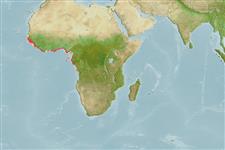
marien; brak water pelagic-neritic; diepte 0 - 50 m (Ref. 188). Tropical; 17°N - 10°S, 18°W - 14°E (Ref. 188)
Atlantic Ocean: Eastern Atlantic Ocean from Senegal southward to Congo, possibly to northern Angola (Ref. 188, 5286, 81269, 81631).
Grootte / Gewicht / Leeftijd
Maturiteit: Lm ? range ? - ? cm
Max length : 16.0 cm SL mannelijk / geslacht onbekend; (Ref. 188); common length : 13.0 cm SL mannelijk / geslacht onbekend; (Ref. 188)
Dorsale stekels (totaal) : 0; Dorsale zachte stralen (totaal) : 16 - 19; Anale stekels: 0; Anale zachte stralen: 16 - 21. Diagnosis: Body moderately deep, belly fairly sharply keeled (Ref. 188). Lower gillrakers 30-40 (Ref. 188). A black or golden spot behind gill opening; upper part of pectoral fin dusky; caudal fin pale yellow with dusky hind margin (Ref. 188). Sardinella rouxi resembles S. maderensis, which has more gillrakers and a grey caudal fin, its tips almost black (Ref. 188). It is distinguished from small S. aurita by having 1 unbranched and 7 branched pelvic fin rays vs. 1 unbranched and 8 branched in S. aurita, and no black spot on hind part of gill cover (Ref. 188).
Body shape (shape guide): fusiform / normal; Cross section: compressed.
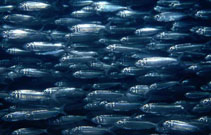
Sardinella rouxi is found in inshore waters and along beaches, forming schools (Ref. 188).
Levenscyclus en paargedrag
Maturiteit | Voortplanting | Paaien | Eieren | Fecunditeit | Larven
Whitehead, P.J.P., 1985. FAO Species Catalogue. Vol. 7. Clupeoid fishes of the world (suborder Clupeoidei). An annotated and illustrated catalogue of the herrings, sardines, pilchards, sprats, shads, anchovies and wolf-herrings. FAO Fish. Synop. 125(7/1):1-303. Rome: FAO. (Ref. 188)
Status op de Rode Lijst van het IUCN (Ref. 130435: Version 2025-1)
Gevaar voor de mens
Harmless
Gebruik door de mens
Visserij: van minder commercieel belang
Tools
Speciale rapporten
Download XML
Internetbronnen
Estimates based on models
Preferred temperature (Ref.
123201): 24.4 - 28, mean 26.8 °C (based on 66 cells).
Fylogenetische diversiteitsindex (Ref.
82804): PD
50 = 0.5000 [Uniqueness, from 0.5 = low to 2.0 = high].
Bayesian length-weight: a=0.00851 (0.00399 - 0.01817), b=3.05 (2.88 - 3.22), in cm total length, based on LWR estimates for this Genus-body shape (Ref.
93245).
Weerstandsvermogen (Ref.
120179): Hoog, minimale populatieverdubbelingstijd minder dan 15 maanden (Preliminary K or Fecundity.).
Fishing Vulnerability (Ref.
59153): Low vulnerability (10 of 100).
🛈