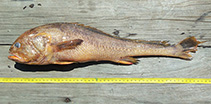
Classification / Noms
Noms communs | Synonymes | Catalog of Fishes(Genre, Espèce) | ITIS | CoL | WoRMS | Cloffa
Environnement : milieu / zone climatique / profondeur / gamme de distribution
Écologie
marin; saumâtre benthopélagique. Tropical
Western Central Pacific: Viet Nam, Thailand and Borneo.
Taille / Poids / Âge
Maturité: Lm ? range ? - ? cm
Max length : 50.0 cm SL mâle / non sexé; (Ref. 9772); common length : 30.0 cm SL mâle / non sexé; (Ref. 9772)
Épines dorsales (Total) : 6 - 7; Rayons mous dorsaux (Total) : 42 - 44; Épines anales: 2; Rayons mous anaux: 7 - 8; Vertèbres: 12 - 25. Elongate, cylindrical body. Eye small, 14-24 % of head length. Mental pores in 2 pairs, the first small, rounded, at front of chin, separated by symphysis. Gill rakers long, slender, equal to or slightly longer than gill filaments at angle of arch, 12-14 on lower limb. Dorsal fin with VI to VII spines and 42-44 soft rays, not incised between the two parts. Second anal spine long, stiff, 37-46 % of head length; the last dorsal, second anal, pectoral and pelvic spines progressively thicker with age or size. Scales cycloid (smooth) on head, ctenoid (rough to touch) on body. Swim bladder carrot-shaped, with 1 pair of tube-like appendages arising at the anterior end and immediately dividing into an anterior branch entering the head and ramifying under skull and a posterior tube lying beside the main bladder to its posterior end.
Inhabits shallow coastal waters and estuaries (Ref. 9772).
Cycle de vie et comportement reproducteur
Maturité | Reproduction | Frai | Œufs | Fécondité | Larves
Sasaki, K., 1995. A review of the Indo-West Pacific sciaenid genus Panna (Teleostei, Perciformes). Jap. J. Ichthyol. 42(1):27-37. (Ref. 10086)
Statut dans la liste rouge de l'IUCN (Ref. 130435: Version 2025-2)
Menace pour l'homme
Harmless
Utilisations par l'homme
Pêcheries: intérêt commercial mineur
Outils
Articles particuliers
Télécharger en XML
Sources Internet
Estimations basées sur des modèles
Température préférée (Réf.
123201): 28.2 - 29.1, mean 28.6 °C (based on 118 cells).
Indice de diversité phylogénétique (Réf.
82804): PD
50 = 0.6250 [Uniqueness, from 0.5 = low to 2.0 = high].
Bayesian length-weight: a=0.01000 (0.00244 - 0.04107), b=3.04 (2.81 - 3.27), in cm total length, based on all LWR estimates for this body shape (Ref.
93245).
Niveau trophique (Réf.
69278): 3.7 ±0.4 se; based on size and trophs of closest relatives
Résilience (Réf.
120179): Milieu, temps minimum de doublement de population : 1,4 à 4,4 années (Preliminary K or Fecundity.).
Vulnérabilité de la pêche (Ref.
59153): Moderate vulnerability (44 of 100).
🛈